Program in Systems Biology, Department of Biochemistry and Molecular Pharmacology, University of Massachusetts Medical School, Worcester, Massachusetts 01605, USA.
Department of Molecular and Cell Biology, Li Ka Shing Center for Biomedical and Health Sciences, CIRM Center of Excellence, University of California, Berkeley, California 94720, USA.
Genome Res. 2019 Feb;29(2):236-249. doi: 10.1101/gr.241547.118. Epub 2019 Jan 17.
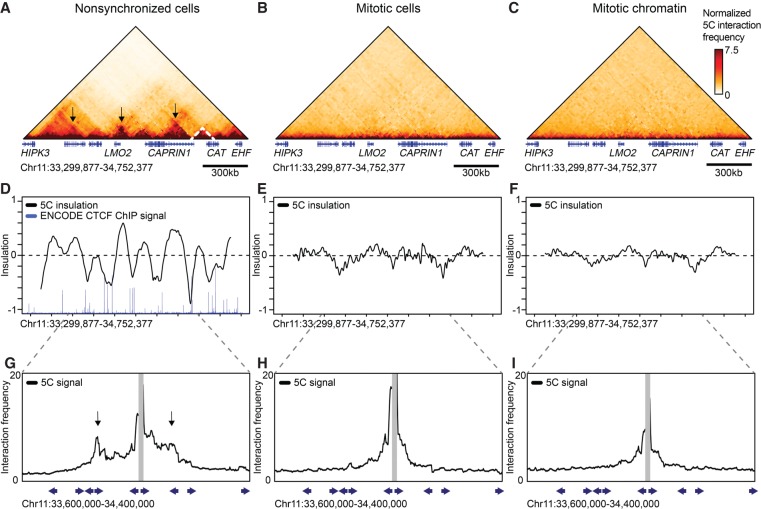
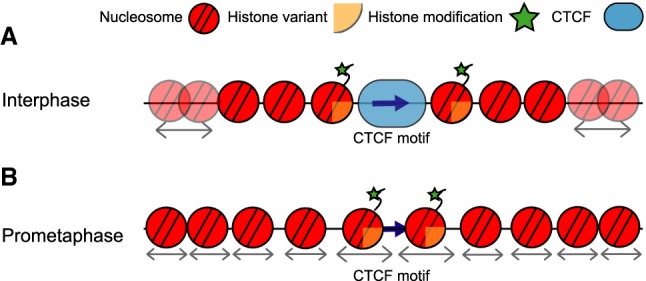
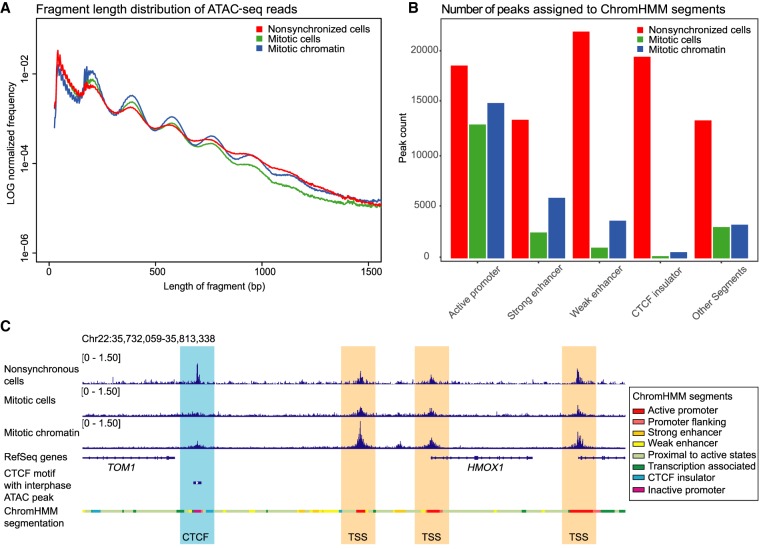
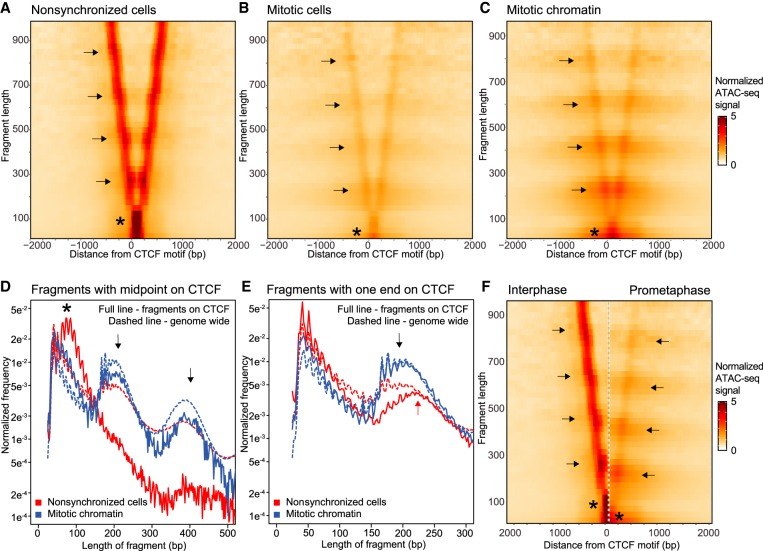
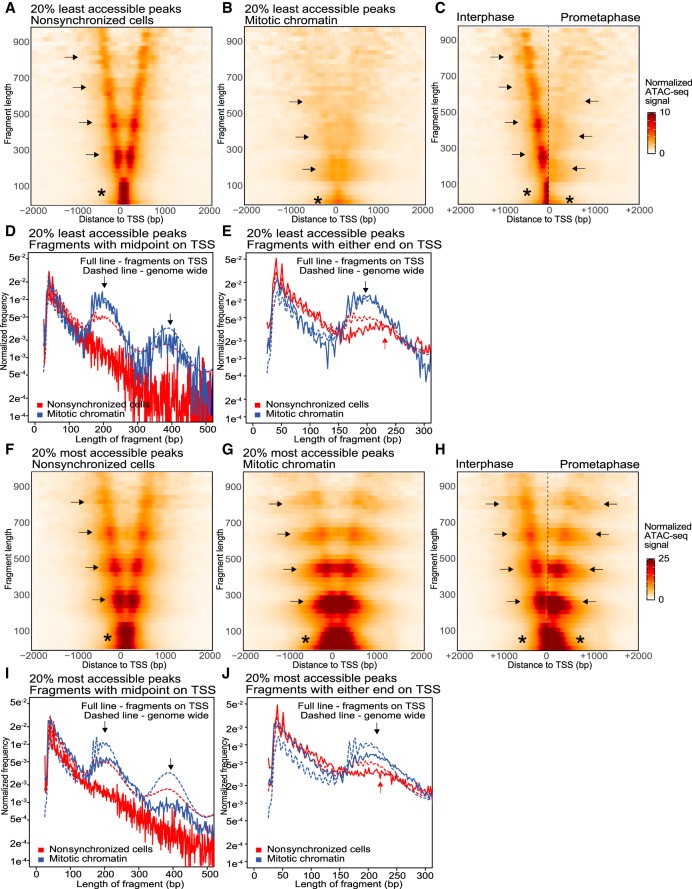
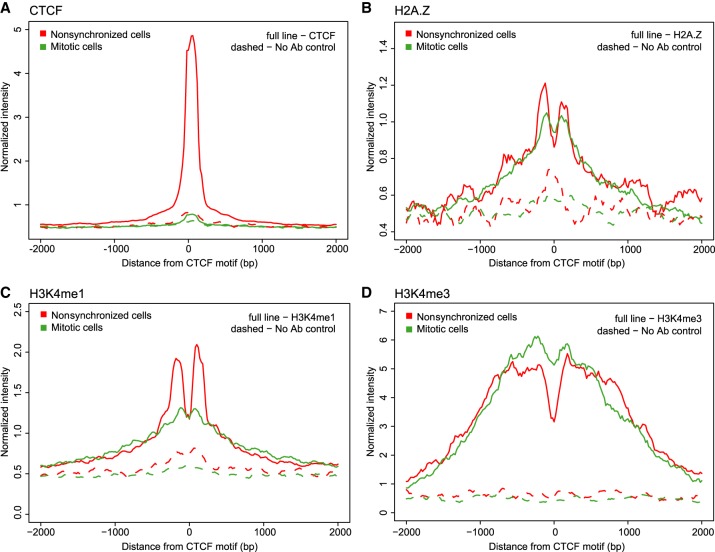
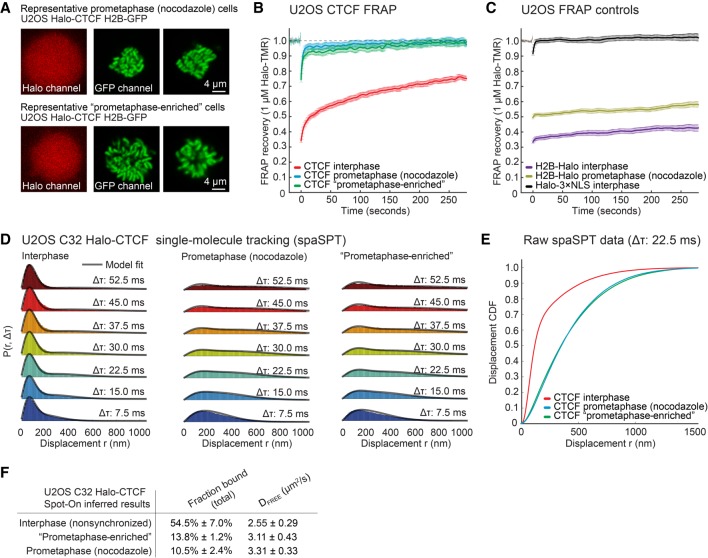
CCCTC-binding factor (CTCF) plays a key role in the formation of topologically associating domains (TADs) and loops in interphase. During mitosis TADs are absent, but how TAD formation is dynamically controlled during the cell cycle is not known. Several contradicting observations have been made regarding CTCF binding to mitotic chromatin using both genomics- and microscopy-based techniques. Here, we have used four different assays to address this debate. First, using 5C, we confirmed that TADs and CTCF loops are readily detected in interphase, but absent during prometaphase. Second, ATAC-seq analysis showed that CTCF sites display greatly reduced accessibility and lose the CTCF footprint in prometaphase, suggesting loss of CTCF binding and rearrangement of the nucleosomal array around the binding motif. In contrast, transcription start sites remain accessible in prometaphase, although adjacent nucleosomes can also become repositioned and occupy at least a subset of start sites during mitosis. Third, loss of site-specific CTCF binding was directly demonstrated using CUT&RUN. Histone modifications and histone variants are maintained in mitosis, suggesting a role in bookmarking of active CTCF sites. Finally, live-cell imaging, fluorescence recovery after photobleaching, and single molecule tracking showed that almost all CTCF chromatin binding is lost in prometaphase. Combined, our results demonstrate loss of CTCF binding to CTCF sites during prometaphase and rearrangement of the chromatin landscape around CTCF motifs. This, combined with loss of cohesin, would contribute to the observed loss of TADs and CTCF loops during mitosis and reveals that CTCF sites, key architectural -elements, display cell cycle stage-dependent dynamics in factor binding and nucleosome positioning.
CCCTC 结合因子(CTCF)在有丝分裂间期形成拓扑关联域(TAD)和环中发挥关键作用。有丝分裂期间 TAD 不存在,但细胞周期中 TAD 如何动态控制尚不清楚。使用基于基因组学和显微镜的技术,已经观察到几种关于 CTCF 与有丝分裂染色质结合的相互矛盾的现象。在这里,我们使用了四种不同的测定方法来解决这个争议。首先,我们使用 5C 证实 TAD 和 CTCF 环在有丝分裂间期很容易检测到,但在前期消失。其次,ATAC-seq 分析表明 CTCF 位点的可及性大大降低,并在前期失去 CTCF 足迹,表明 CTCF 结合丢失和围绕结合基序的核小体阵列重排。相比之下,转录起始位点在前期仍可接近,尽管相邻核小体也可以在有丝分裂期间重新定位并占据至少一部分起始位点。第三,使用 CUT&RUN 直接证明了特定位点 CTCF 结合的丢失。组蛋白修饰和组蛋白变体在有丝分裂中得以维持,这表明它们在标记活跃的 CTCF 位点方面发挥作用。最后,活细胞成像、光漂白后荧光恢复和单分子追踪显示,几乎所有 CTCF 染色质结合在前期丢失。综上所述,我们的结果表明,CTCF 结合到 CTCF 位点在前期丢失,并且 CTCF 基序周围的染色质景观发生重排。这与着丝粒蛋白的丢失一起,导致有丝分裂期间观察到 TAD 和 CTCF 环的丢失,并揭示了 CTCF 位点作为关键的结构元件,在因子结合和核小体定位方面表现出细胞周期阶段依赖性动力学。