Institute of Protein Research, Russian Academy of Sciences, Pushchino, 142290 Moscow, Russia.
Genes (Basel). 2019 Jan 29;10(2):96. doi: 10.3390/genes10020096.
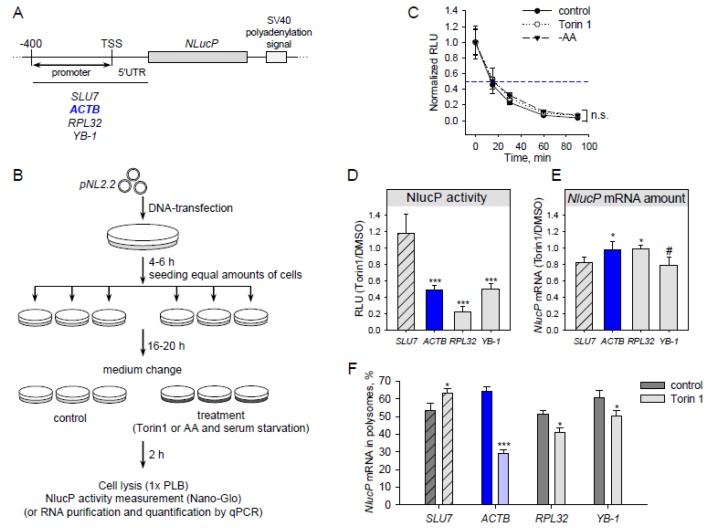
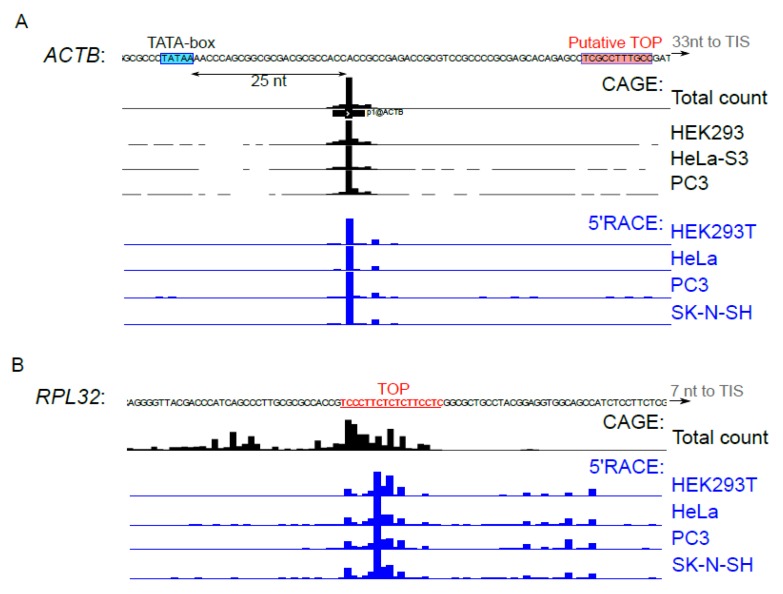
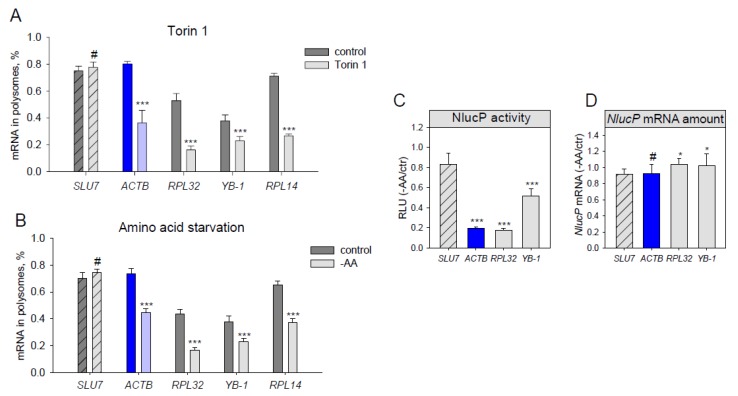
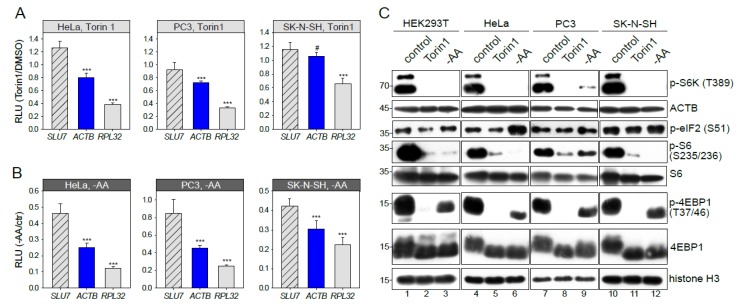
The mammalian target of rapamycin (mTOR) kinase is a well-known master regulator of growth-dependent gene expression in higher eukaryotes. Translation regulation is an important function of the mTORC1 pathway that controls the synthesis of many ribosomal proteins and translation factors. Housekeeping genes such as () are widely used as negative control genes in studies of growth-dependent translation. Here we demonstrate that translation of both endogenous and reporter mRNA is inhibited in the presence of mTOR kinase inhibitor (Torin1) and under amino acid starvation. Notably, 5'UTR and promoter of are sufficient for the mTOR-dependent translational response, and the degree of mTOR-sensitivity of mRNA translation is cell type-dependent.
哺乳动物雷帕霉素靶蛋白(mTOR)激酶是真核生物中高度依赖生长的基因表达的著名主调控因子。翻译调控是 mTORC1 途径的一个重要功能,它控制着许多核糖体蛋白和翻译因子的合成。管家基因如 () 广泛用作生长依赖翻译研究中的负调控基因。在这里,我们证明在 mTOR 激酶抑制剂(Torin1)和氨基酸饥饿存在的情况下,内源性和报告基因的翻译均受到抑制。值得注意的是, 的 5'UTR 和启动子足以产生 mTOR 依赖性翻译反应,并且 mTOR 敏感性对 的 mRNA 翻译程度是细胞类型依赖性的。