Department of Radiation Oncology, Duke University Medical Center, Durham, NC.
Division of Medical Oncology, Duke Cancer Institute, Durham, NC.
Blood Adv. 2019 Feb 12;3(3):333-338. doi: 10.1182/bloodadvances.2018023051.
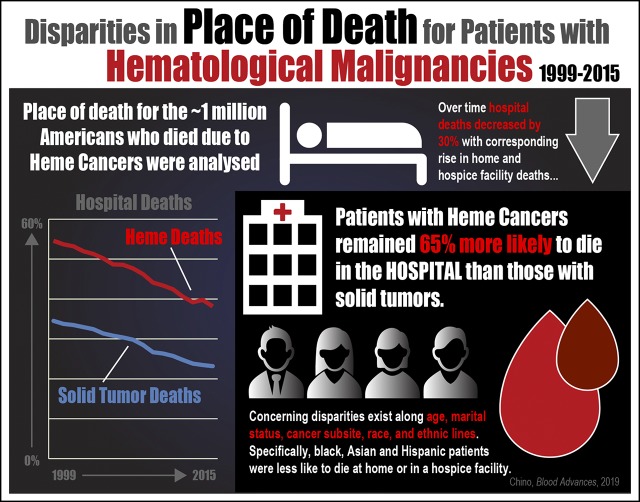
Patients with hematologic malignancies (HMs) often receive aggressive end-of-life care and less frequently use hospice. Comprehensive longitudinal reporting on place of death, a key quality indicator, is lacking. Deidentified death certificate data were obtained via the National Center for Health Statistics for all HM deaths from 1999 to 2015. Multivariate regression analysis (MVA) was used to test for disparities in place of death associated with sociodemographic variables. During the study period, there were 951 435 HM deaths. Hospital deaths decreased from 54.6% in 1999 to 38.2% in 2015, whereas home (25.9% to 32.7%) and hospice facility deaths (0% to 12.1%) increased (all < .001). On MVA of all cancers, HM patients had the lowest odds of home or hospice facility death (odds ratio [OR], 0.55; 95% confidence interval, 0.54-0.55). Older age (40-64 years: OR, 1.34; ≥65 years: OR, 1.89), being married (OR, 1.62), and having myeloma (OR, 1.34) were associated with home or hospice facility death, whereas being black or African American (OR, 0.68), Asian (OR, 0.58), or Hispanic (OR, 0.84) or having chronic leukemia (OR, 0.83) had decreased odds of dying at home or hospice (all < .001). In conclusion, despite hospital deaths decreasing over time, patients with HMs remained more likely to die in the hospital than at home.
患者患有血液恶性肿瘤(HM),经常接受积极的临终关怀,而较少使用临终关怀。缺乏对死亡地点的综合纵向报告,这是一个关键的质量指标。通过国家卫生统计中心从 1999 年至 2015 年获得了所有 HM 死亡的匿名死亡证明数据。使用多变量回归分析(MVA)来测试与社会人口统计学变量相关的死亡地点差异。在研究期间,有 951435 例 HM 死亡。医院死亡人数从 1999 年的 54.6%下降到 2015 年的 38.2%,而家庭(25.9%至 32.7%)和临终关怀机构(0%至 12.1%)死亡人数增加(均<.001)。在所有癌症的 MVA 中,HM 患者在家中或临终关怀机构死亡的可能性最低(优势比[OR],0.55;95%置信区间,0.54-0.55)。年龄较大(40-64 岁:OR,1.34;≥65 岁:OR,1.89)、已婚(OR,1.62)和患有骨髓瘤(OR,1.34)与在家中或临终关怀机构死亡相关,而黑人和非裔美国人(OR,0.68)、亚洲人(OR,0.58)或西班牙裔(OR,0.84)或患有慢性白血病(OR,0.83)在家中或临终关怀机构死亡的可能性降低(均<.001)。总之,尽管医院死亡人数随着时间的推移而减少,但 HM 患者仍更有可能在医院死亡,而不是在家中死亡。