Grup de Recerca GEMMAIR (AGAUR)-Medicina Aplicada, Departament de Medicina i Cirurgia, Universitat Rovira i Virgili (URV), Institut d'Investigació Sanitària Pere Virgili (IISPV), 43007 Tarragona, Spain.
Servei Medicina Interna, Hospital Universitari Joan XXIII Tarragona. Mallafré Guasch, No. 4, 43007 Tarragona, Spain.
Biomed Res Int. 2019 Jan 2;2019:8507583. doi: 10.1155/2019/8507583. eCollection 2019.
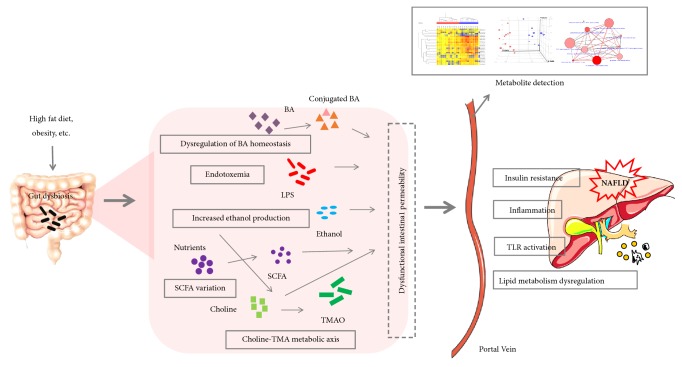
Nonalcoholic fatty liver disease (NAFLD) is a common, multifactorial, and poorly understood liver disease whose incidence is globally rising. During the past decade, several lines of evidence suggest that dysbiosis of intestinal microbiome represents an important factor contributing to NAFLD occurrence and its progression into NASH. The mechanisms that associate dysbiosis with NAFLD include changes in microbiota-derived mediators, deregulation of the gut endothelial barrier, translocation of mediators of dysbiosis, and hepatic inflammation. Changes in short chain fatty acids, bile acids, bacterial components, choline, and ethanol are the result of altered intestinal microbiota. We perform a narrative review of the previously published evidence and discuss the use of gut microbiota-derived mediators as potential markers in NAFLD.
非酒精性脂肪性肝病(NAFLD)是一种常见的、多因素的、尚未被充分认识的肝脏疾病,其发病率在全球范围内呈上升趋势。在过去的十年中,有几条证据表明,肠道微生物组的失调是导致 NAFLD 发生及其进展为 NASH 的一个重要因素。将失调与 NAFLD 联系起来的机制包括微生物衍生介质的变化、肠道内皮屏障的失调、失调介质的易位以及肝脏炎症。短链脂肪酸、胆汁酸、细菌成分、胆碱和乙醇的变化是肠道微生物改变的结果。我们对以前发表的证据进行了叙述性综述,并讨论了将肠道微生物衍生的介质用作 NAFLD 的潜在标志物的用途。