Division of Gastroenterology, Department of Gastroenterology, Hyogo College of Medicine, Mukogawa-cho 1-1, Nishinomiya, Hyogo, 663-8501, Japan.
J Gastroenterol. 2019 Apr;54(4):305-311. doi: 10.1007/s00535-019-01550-4. Epub 2019 Feb 14.
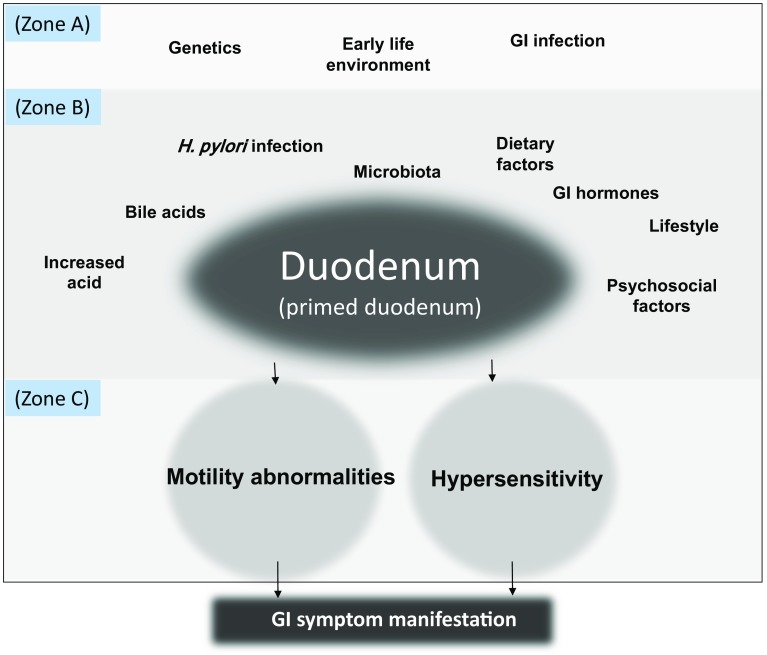
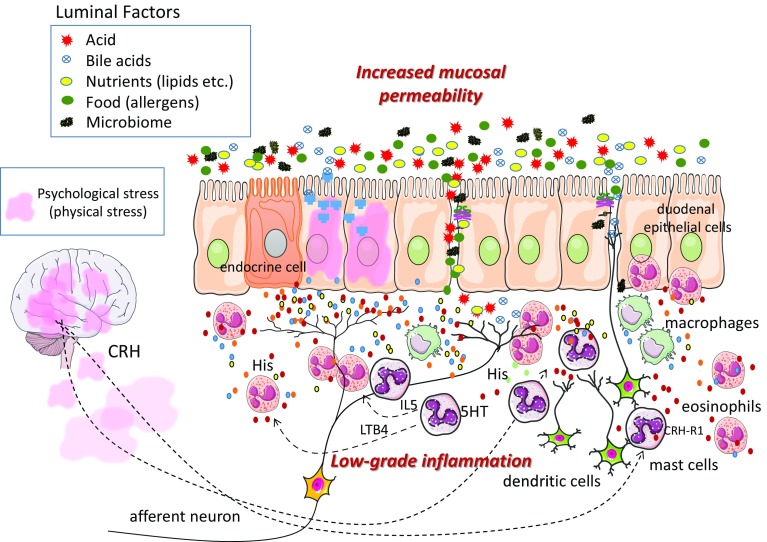
Over almost 30 years since functional dyspepsia (FD) was defined, researchers have endeavored to elucidate the pathophysiology of functional gastrointestinal disorders. Now a consensus is emerging that the gastric symptoms of FD are caused mainly by gastric motility abnormalities and gastric hypersensitivity. The involvement of other causative factors including acid, Helicobacter pylori, psychological factors, and diet has been debated, but how they are involved in the manifestation of dyspeptic symptoms remains unclear. We believe that most of those factors cause FD symptoms by inducing gastric motility abnormalities and gastric hypersensitivity via the duodenum. Here, we discuss 2 possible reasons why patients with FD experience chronic upper abdominal symptoms: (1) the possibility that the contents of the duodenum of patients with FD differ from those of healthy persons and the different contents stimulate the duodenum, and (2) the possibility that the duodenum of patients with FD is more sensitive to noxious stimuli because of low-grade inflammation and increased mucosal permeability.
自功能性消化不良 (FD) 定义以来的近 30 年中,研究人员一直在努力阐明功能性胃肠疾病的病理生理学。现在出现了一种共识,即 FD 的胃部症状主要是由胃动力异常和胃敏感性增加引起的。包括酸、幽门螺杆菌、心理因素和饮食在内的其他致病因素的参与一直存在争议,但它们如何参与消化不良症状的表现仍不清楚。我们认为,大多数这些因素通过十二指肠引起胃动力异常和胃敏感性增加来导致 FD 症状。在这里,我们讨论了 FD 患者出现慢性上腹部症状的 2 种可能原因:(1) FD 患者十二指肠的内容物可能与健康人不同,不同的内容物刺激十二指肠;(2) FD 患者的十二指肠因低度炎症和黏膜通透性增加而对有害刺激更敏感。