Pharmacometrics Research Group, Department of Pharmaceutical Biosciences, Uppsala University, Uppsala, Sweden.
Section of Clinical Microbiology and Infectious Medicine, Department of Medical Sciences, Uppsala University Hospital, Uppsala, Sweden.
PLoS One. 2019 Feb 21;14(2):e0211981. doi: 10.1371/journal.pone.0211981. eCollection 2019.
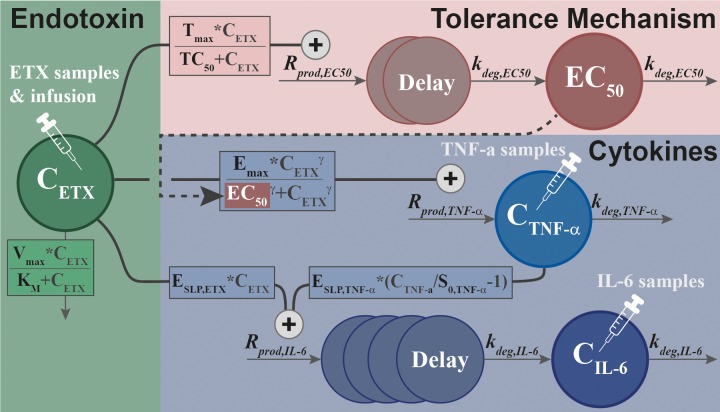
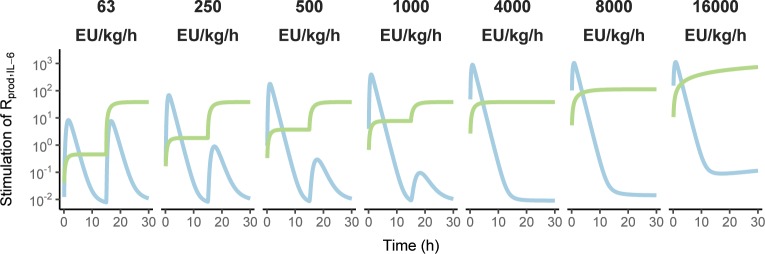
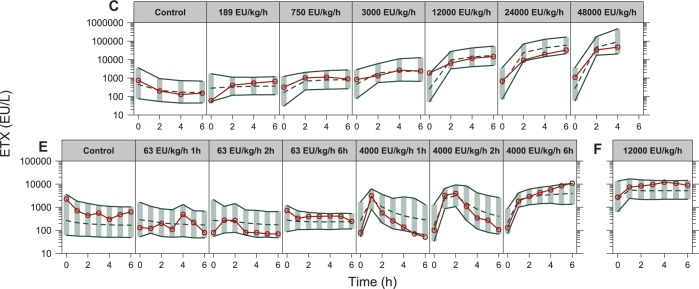
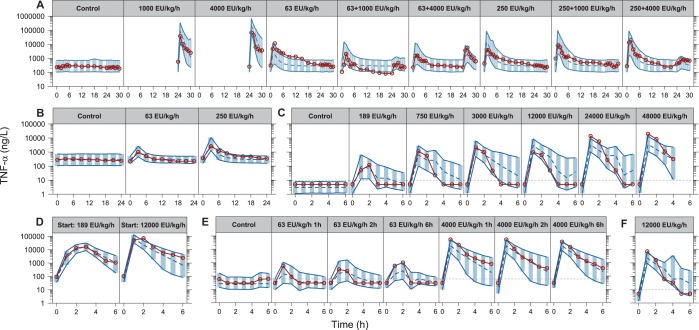
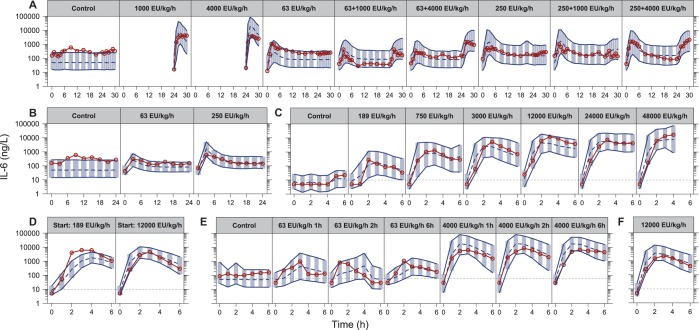
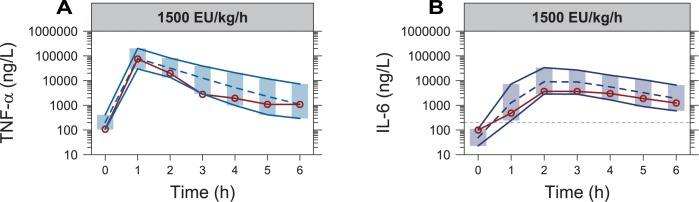
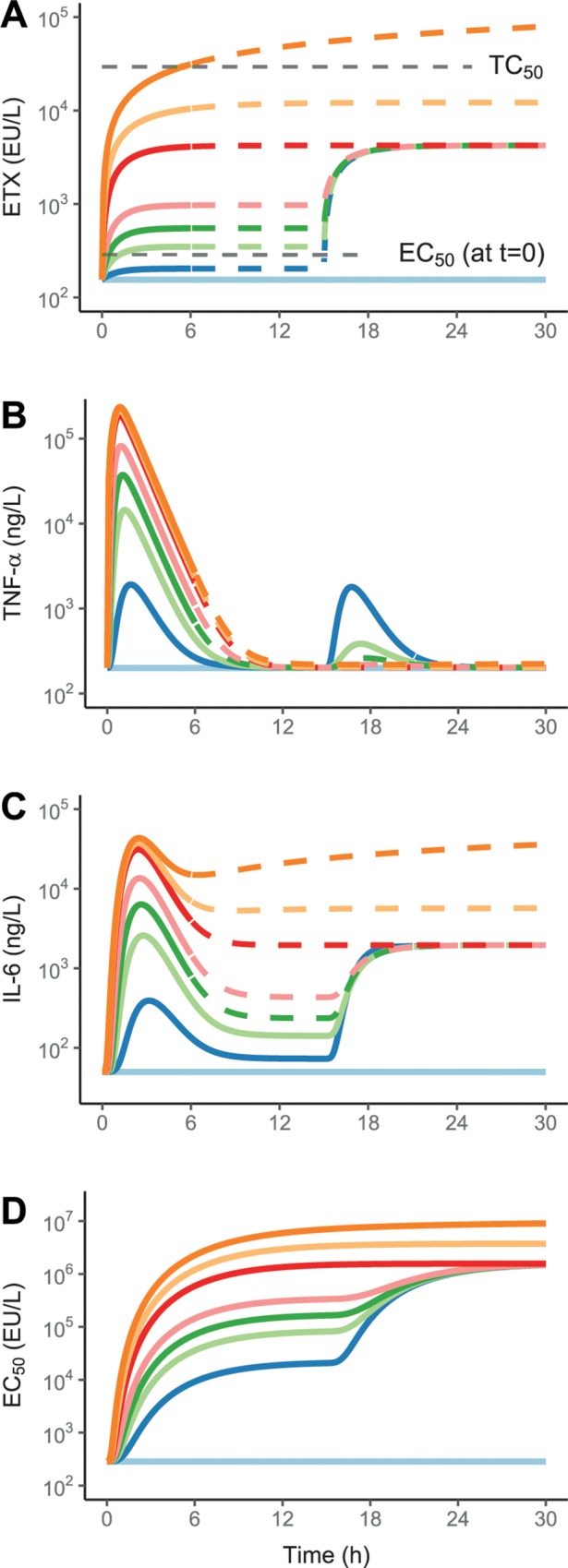
Endotoxin, a component of the outer membrane of Gram-negative bacteria, has been extensively studied as a stimulator of the innate immune response. However, the temporal aspects and exposure-response relationship of endotoxin and resulting cytokine induction and tolerance development is less well defined. The aim of this work was to establish an in silico model that simultaneously captures and connects the in vivo time-courses of endotoxin, tumor necrosis factor alpha (TNF-α), interleukin-6 (IL-6), and associated tolerance development. Data from six studies of porcine endotoxemia in anesthetized piglets (n = 116) were combined and used in the analysis, with purified endotoxin (Escherichia coli O111:B4) being infused intravenously for 1-30 h in rates of 0.063-16.0 μg/kg/h across studies. All data were modelled simultaneously by means of importance sampling in the non-linear mixed effects modelling software NONMEM. The infused endotoxin followed one-compartment disposition and non-linear elimination, and stimulated the production of TNF-α to describe the rapid increase in plasma concentration. Tolerance development, observed as declining TNF-α concentration with continued infusion of endotoxin, was also driven by endotoxin as a concentration-dependent increase in the potency parameter related to TNF-α production (EC50). Production of IL-6 was stimulated by both endotoxin and TNF-α, and four consecutive transit compartments described delayed increase in plasma IL-6. A model which simultaneously account for the time-courses of endotoxin and two immune response markers, the cytokines TNF-α and IL-6, as well as the development of endotoxin tolerance, was successfully established. This model-based approach is unique in its description of the time-courses and their interrelation and may be applied within research on immune response to bacterial endotoxin, or in pre-clinical pharmaceutical research when dealing with study design or translational aspects.
内毒素是革兰氏阴性菌外膜的一个组成部分,已被广泛研究作为先天免疫反应的刺激物。然而,内毒素及其导致的细胞因子诱导和耐受发展的时间方面和暴露-反应关系尚未得到很好的定义。本工作的目的是建立一个能够同时捕捉和连接内毒素、肿瘤坏死因子-α(TNF-α)、白细胞介素-6(IL-6)的体内时间过程以及相关耐受发展的计算模型。对六项麻醉猪仔猪内毒素血症的研究数据(n = 116)进行了组合,并在分析中使用静脉内输注纯化内毒素(大肠杆菌 O111:B4),在研究中,输注率为 0.063-16.0 μg/kg/h,持续 1-30 h。所有数据均通过非线性混合效应模型 NONMEM 中的重要性采样同时进行建模。输注的内毒素遵循单室分布和非线性消除,刺激 TNF-α的产生以描述血浆浓度的快速增加。随着内毒素的持续输注,观察到的耐受发展(即 TNF-α浓度的下降)也由内毒素驱动,这是由于与 TNF-α产生相关的效力参数(EC50)呈浓度依赖性增加。IL-6 的产生受内毒素和 TNF-α的刺激,四个连续的转运隔室描述了血浆 IL-6的延迟增加。成功建立了一个能够同时考虑内毒素和两种免疫反应标志物(细胞因子 TNF-α和 IL-6)的时间过程及其相互关系,以及内毒素耐受发展的模型。这种基于模型的方法在其对内毒素和两种免疫反应标志物(细胞因子 TNF-α和 IL-6)的时间过程及其相互关系的描述方面是独特的,可应用于对细菌内毒素免疫反应的研究,或在涉及研究设计或转化方面的临床前药物研究中。