Department of Kinesiology, University of Waterloo, Waterloo, Canada.
PLoS One. 2019 Feb 22;14(2):e0212122. doi: 10.1371/journal.pone.0212122. eCollection 2019.
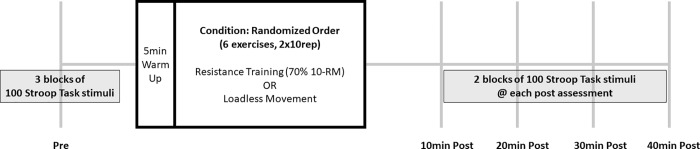
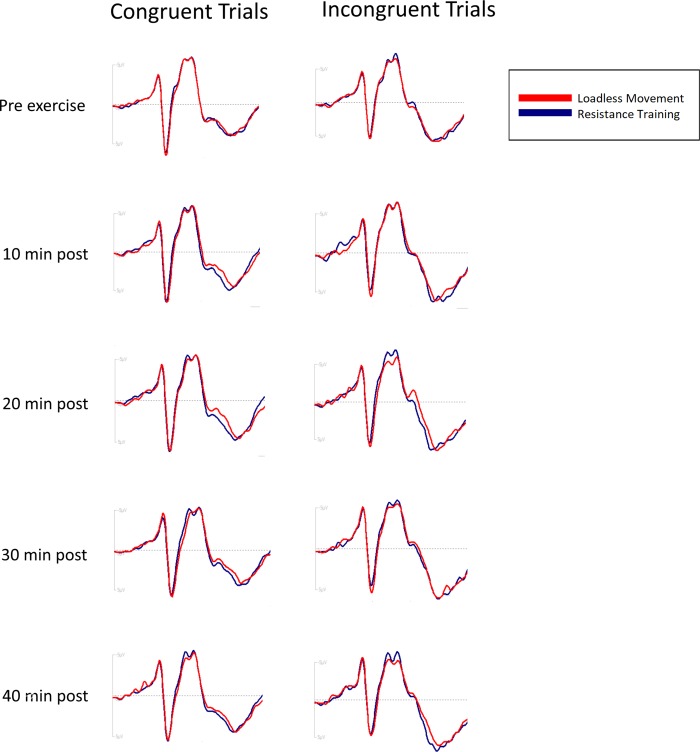
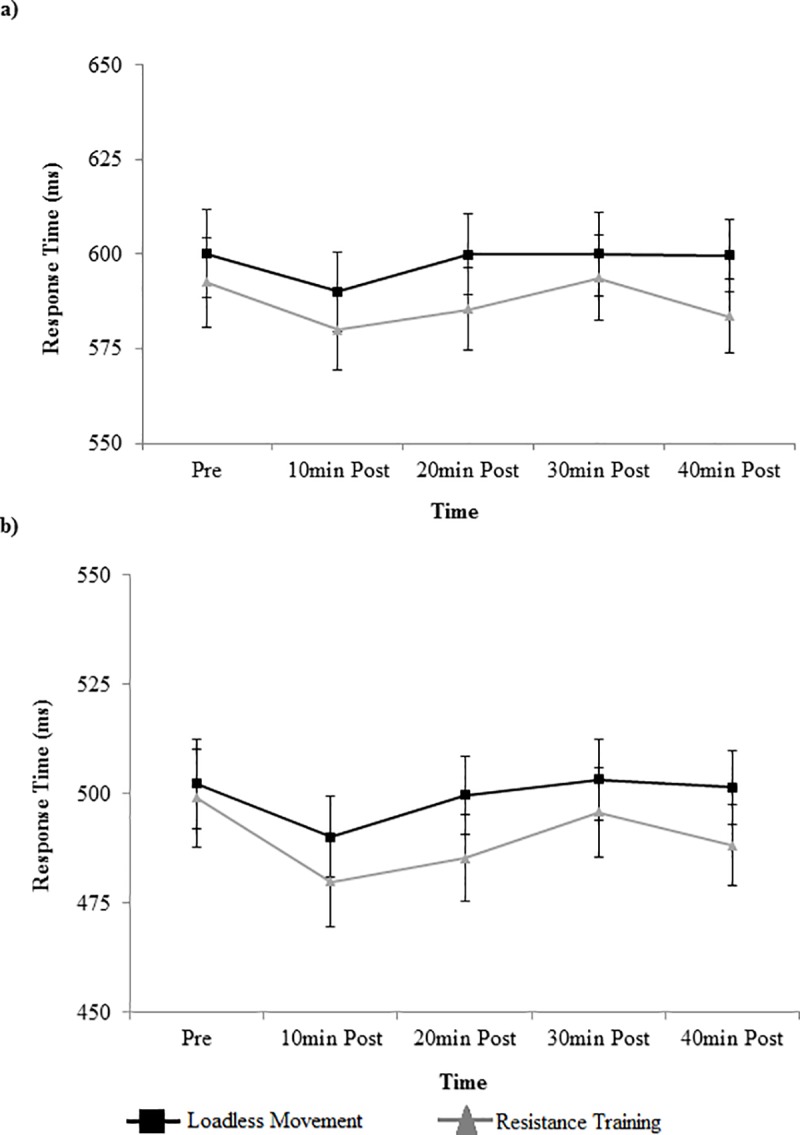
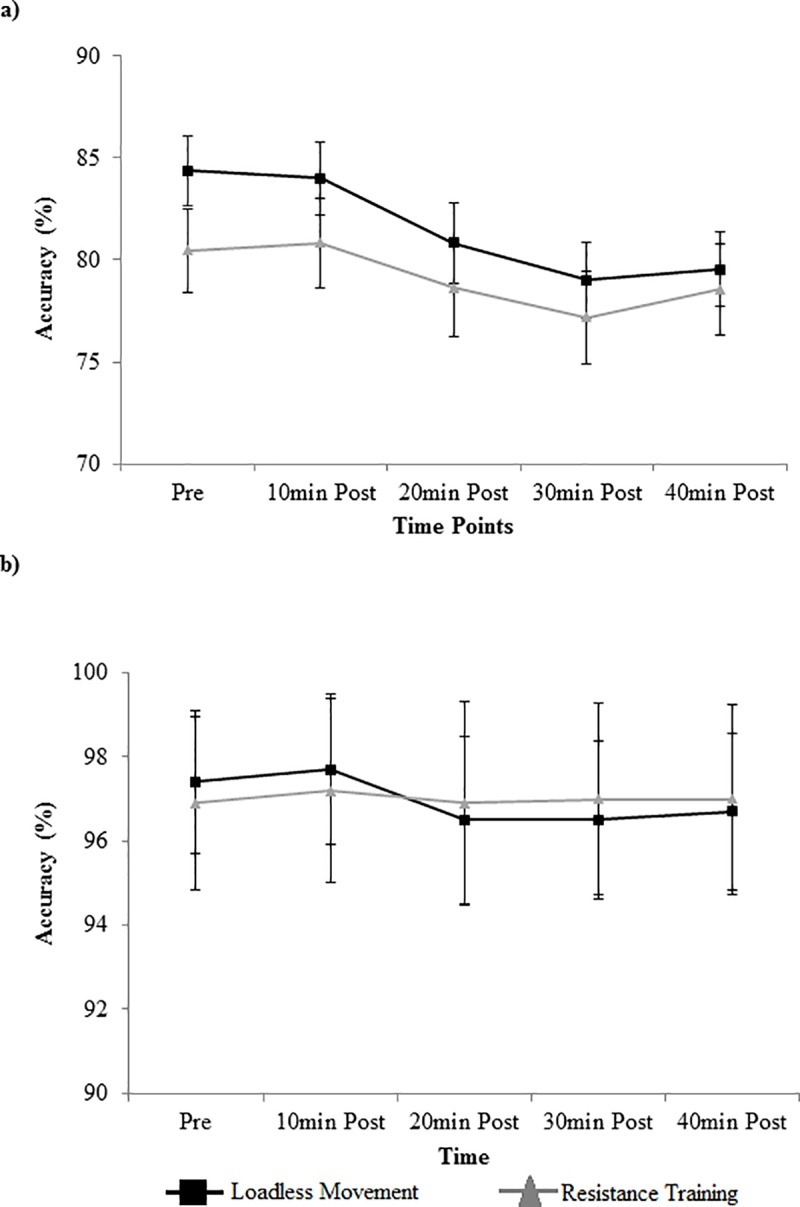
Growing evidence suggests that physical exercise may improve cognitive function in the short- and long-term. Aerobic exercise has been studied most extensively. Preliminary work suggests that resistance training also improves cognitive function, particularly executive function. Conversely, most studies found little dose-effect by intensity. Consequently, cognitive benefits may be elicited, at least in part, by the movement rather than the physical exertion of resistance training. The objective here was to examine and compare acute changes in executive function after resistance training and a loadless movement control among young, healthy adults. Twenty-two young healthy adults (mean age 23.4 years [2.4]; 50% female) completed three conditions, a baseline condition and two experimental conditions (moderate intensity resistance training, loadless movement control). Participants completed a computerized modified Stroop task with concurrent electroencephalography (EEG) before and 10, 20, 30, and 40min after each intervention. Outcomes (incongruent and congruent response time, accuracy, EEG P3 amplitude and latency) were analyzed using mixed linear regression models (factors: condition, time, condition*time). There was a main effect of time for Stroop response time (F4,84 = 3.94, p = 0.006 and F4,84 = 10.27, p<0.0001 respectively) and incongruent and congruent P3 amplitude (F4,76 = 4.40, p = 0.003 and F4,76 = 5.09, p = 0.001 respectively). Post-hoc analyses indicated that both incongruent and congruent P3 amplitude were elevated at time points up to and including 40min after the interventions (compared to pre-intervention, p<0.05). Both incongruent and congruent response times were faster at 10min post-intervention than pre-intervention (p<0.04). There was no main effect of condition or interaction between condition and time for either outcome (p≥0.53). Similar improvements in executive function were observed after loadless movement and resistance training, suggesting that movement is at least partially responsible for the benefits to executive function. Future research should continue to probe the influence of movement versus physical exertion in resistance training by including a movement and non-movement control.
越来越多的证据表明,体育锻炼可以在短期和长期内改善认知功能。有氧运动的研究最为广泛。初步研究表明,抗阻训练也可以改善认知功能,尤其是执行功能。相反,大多数研究发现,强度对认知功能的影响很小。因此,认知益处至少部分是由运动而不是抗阻训练的体力活动引起的。本研究旨在比较年轻人和健康成年人在进行抗阻训练和无负荷运动控制后的执行功能的急性变化。22 名健康年轻人(平均年龄 23.4 岁[2.4];50%为女性)完成了三种条件,一种基线条件和两种实验条件(中等强度抗阻训练,无负荷运动控制)。参与者在干预前和干预后 10、20、30 和 40 分钟时使用计算机化改良 Stroop 任务和同时进行脑电图(EEG)。使用混合线性回归模型(因素:条件、时间、条件*时间)分析结果(不一致和一致的反应时间、准确性、EEG P3 幅度和潜伏期)。Stroop 反应时间(F4,84 = 3.94,p = 0.006 和 F4,84 = 10.27,p<0.0001)和不一致和一致的 P3 幅度(F4,76 = 4.40,p = 0.003 和 F4,76 = 5.09,p = 0.001)存在时间的主要影响。事后分析表明,干预后直至包括 40 分钟,不一致和一致的 P3 幅度均升高(与干预前相比,p<0.05)。与干预前相比,干预后 10 分钟时不一致和一致的反应时间均更快(p<0.04)。两种结果(p≥0.53)均无条件的主要影响或条件与时间之间的相互作用。在无负荷运动和抗阻训练后,执行功能均观察到类似的改善,这表明运动至少部分负责改善执行功能。未来的研究应继续通过包括运动和非运动控制来探索运动与抗阻训练中的体力活动对运动的影响。