College of Agronomy, Sichuan Agricultural University, Chengdu, Sichuan, China.
Key Laboratory of Crop Eco-physiology and Farming System in Southwest, Ministry of Agriculture, Chengdu, Sichuan, P.R. China.
PLoS One. 2019 Feb 26;14(2):e0212885. doi: 10.1371/journal.pone.0212885. eCollection 2019.
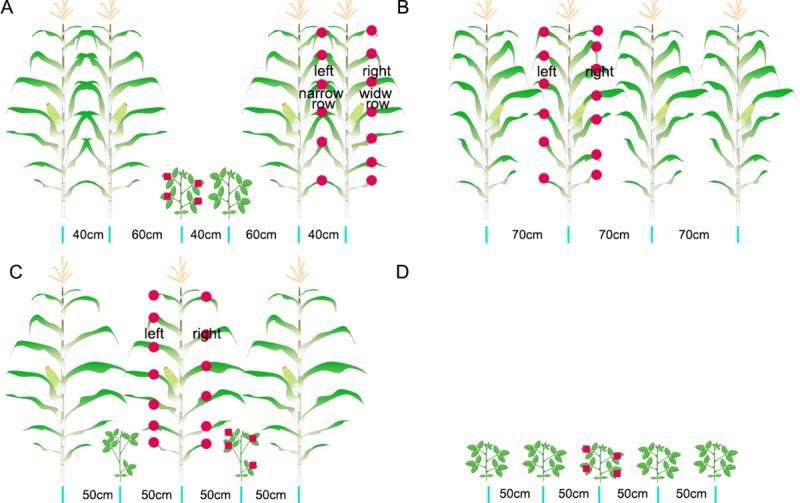
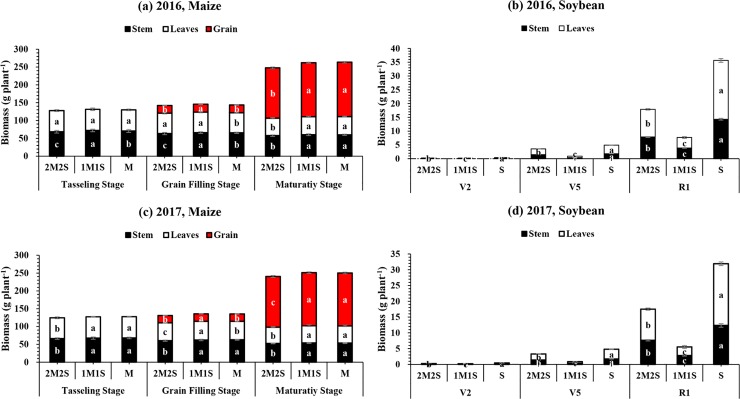
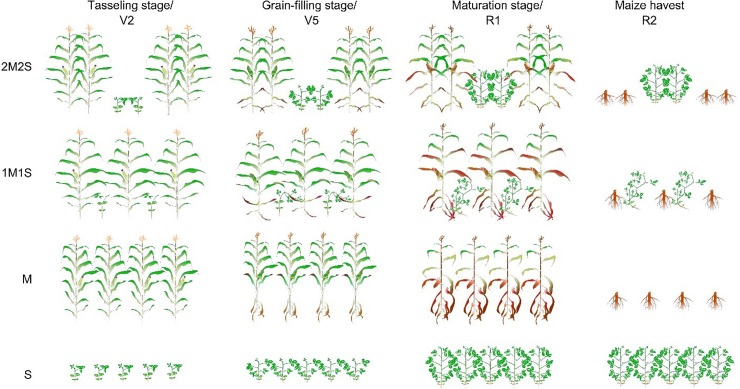
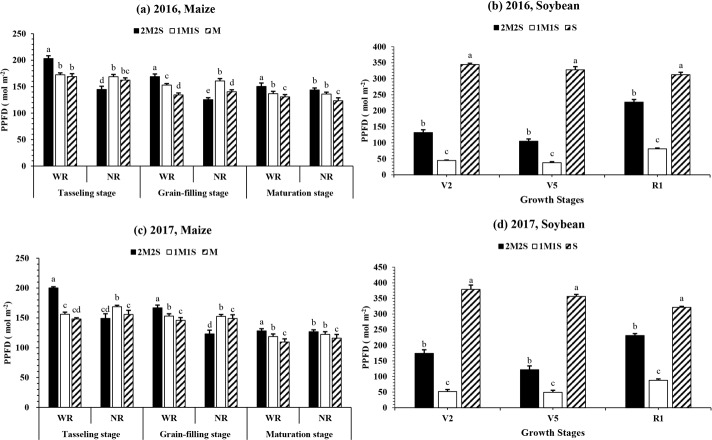
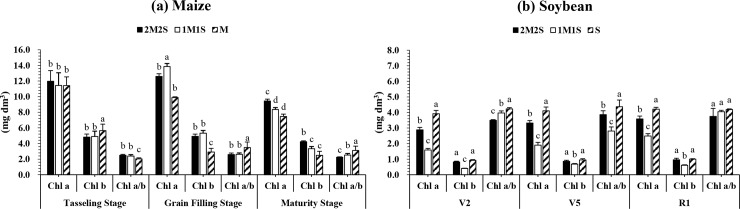
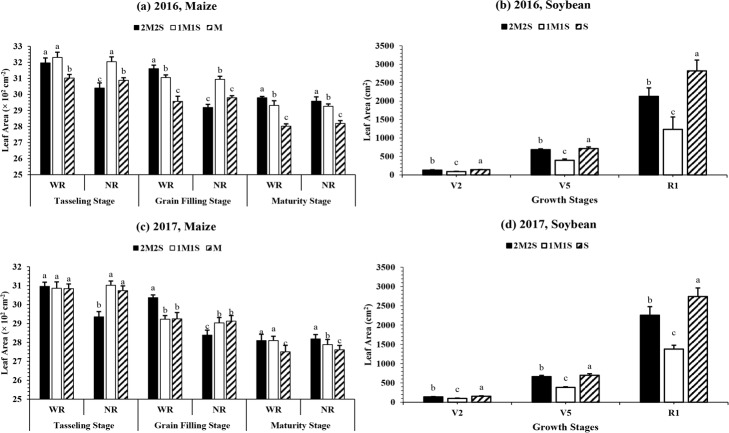
Different planting patterns affect the light interception of intercrops under intercropping conditions. Here we revealed that narrow-wide-row relay-intercropping improves the light interception across maize leaves in wide rows (60cm) and narrow rows (40cm), accelerated the biomass production of intercrop-species and compensated the slight maize yield loss by considerably increasing the soybean yield. In a two-year experiment, maize was planted with soybean in different planting patterns (1M1S, 50:50cm and 2M2S, 40:60cm) of relay-intercropping, both planting patterns were compared with sole cropping of maize (M) and soybean (S). As compared to M and 1M1S, 2M2S increased the total light interception of maize leaves in wide rows (WR) by 27% and 23%, 20% and 10%, 16% and 9% which in turn significantly enhanced the photosynthetic rate of WR maize leaves by 7% and 5%, 12% and 9%, and 19% and 4%, at tasseling, grain-filling and maturity stage of maize, respectively. Similarly, the light transmittance at soybean canopy increased by 218%, 160% and 172% at V2, V5 and R1 stage in 2M2S compared with 1M1S. The improved light environment at soybean canopy in 2M2S considerably enhanced the mean biomass accumulation, and allocation to stem and leaves of soybean by 168%, and 131% and 207%, respectively, while it decreased the mean biomass accumulation, and distribution to stem, leaves and seed of maize by 4%, and 4%, 6% and 5%, respectively than 1M1S. Compared to 1M1S, 2M2S also increased the CR values of soybean (by 157%) but decreased the CR values of maize (by 61%). Overall, under 2M2S, relay-cropped maize and soybean produced 94% and 69% of the sole cropping yield, and the 2M2S achieved LER of 1.7 with net income of 1387.7 US $ ha-1 in 2016 and 1434.4 US $ ha-1 in 2017. Our findings implied that selection of optimum planting pattern (2M2S) may increase the light interception and influence the light distribution between maize and soybean rows under relay-intercropping conditions which will significantly increase the intercrops productivity. Therefore, more attention should be paid to the light environment when considering the sustainability of maize-soybean relay-intercropping via appropriate planting pattern selection.
不同的种植模式会影响间作条件下间作作物的光截获。在这里,我们揭示了宽窄行间作可以提高宽行(60cm)和窄行(40cm)玉米叶片的光截获,加速间作物种的生物量生产,并通过显著提高大豆产量来弥补玉米产量的轻微损失。在一项为期两年的实验中,玉米与大豆在不同的种植模式(1M1S,50:50cm 和 2M2S,40:60cm)下进行间作,与玉米(M)和大豆(S)的单作模式进行了比较。与 M 和 1M1S 相比,2M2S 增加了宽行(WR)玉米叶片的总光截获量 27%和 23%,20%和 10%,16%和 9%,从而分别显著提高了 WR 玉米叶片的光合速率 7%和 5%,12%和 9%,和 19%和 4%,在玉米抽穗期、灌浆期和成熟期。同样,与 1M1S 相比,在 V2、V5 和 R1 期,2M2S 中大豆冠层的光透射率增加了 218%、160%和 172%。2M2S 中大豆冠层光环境的改善显著提高了大豆的平均生物量积累和茎、叶的分配,分别提高了 168%、131%和 207%,而玉米的平均生物量积累和茎、叶、种子的分配则分别降低了 4%、4%、6%和 5%。与 1M1S 相比,2M2S 还增加了大豆的 CR 值(增加了 157%),但降低了玉米的 CR 值(降低了 61%)。总体而言,在 2M2S 下,间作玉米和大豆的产量分别达到单作产量的 94%和 69%,2M2S 在 2016 年的 LER 为 1.7,净收入为 1387.7 美元/公顷,在 2017 年的净收入为 1434.4 美元/公顷。我们的研究结果表明,在间作条件下,通过选择最优的种植模式(2M2S)可以增加光的截获,并影响玉米和大豆行间的光分布,这将显著提高间作作物的生产力。因此,在考虑通过适当的种植模式选择来实现玉米-大豆间作的可持续性时,应该更加关注光环境。