Selvaganesan Kartiga, Whitehead Emily, DeAlwis Paba M, Schindler Matthew K, Inati Souheil, Saad Ziad S, Ohayon Joan E, Cortese Irene C M, Smith Bryan, Nath Avindra, Reich Daniel S, Inati Sara, Nair Govind
National Institute of Neurological Disorders and Stroke (NINDS), Bethesda, MD, 20893, USA.
Inati Analytics, Potomac, MD 20854, USA.
Heliyon. 2019 Feb 18;5(2):e01226. doi: 10.1016/j.heliyon.2019.e01226. eCollection 2019 Feb.
Brain- and lesion-volumes derived from magnetic resonance images (MRI) serve as important imaging markers of disease progression in neurodegenerative diseases and aging. While manual segmentation of these volumes is both tedious and impractical in large cohorts of subjects, automated segmentation methods often fail in accurate segmentation of brains with severe atrophy or high lesion loads. The purpose of this study was to develop an atlas-free brain Classification using DErivative-based Features (C-DEF), which utilizes all scans that may be acquired during the course of a routine MRI study at any center.
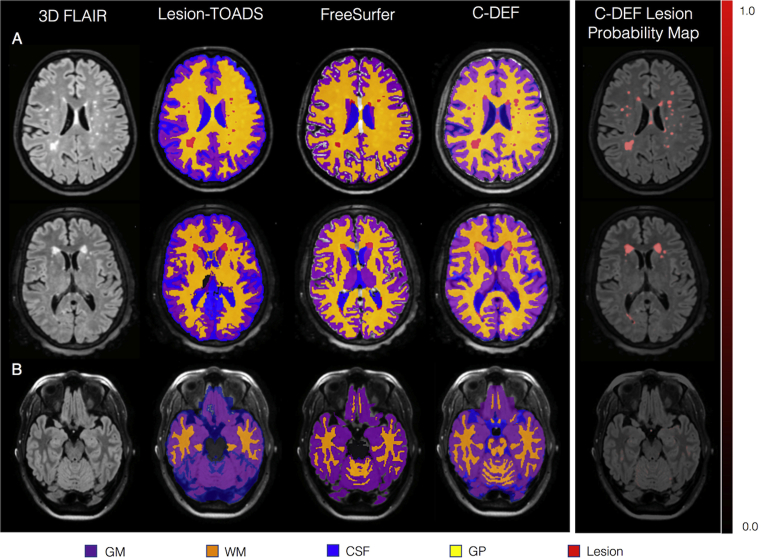
Proton-density, T-weighted, T-weighted, brain-free water, 3D FLAIR, 3D T-weighted, and 3D T*-weighted images, collected routinely on patients with neuroinflammatory diseases at the NIH, were used to optimize the C-DEF algorithm on healthy volunteers and HIV + subjects (cohort 1). First, manually marked lesions and eroded FreeSurfer brain segmentation masks (compiled into gray and white matter, globus pallidus, CSF labels) were used in training. Next, the optimized C-DEF was applied on a separate cohort of HIV + subjects (cohort two), and the results were compared with that of FreeSurfer and Lesion-TOADS. Finally, C-DEF segmentation was evaluated on subjects clinically diagnosed with various other neurological diseases (cohort three).
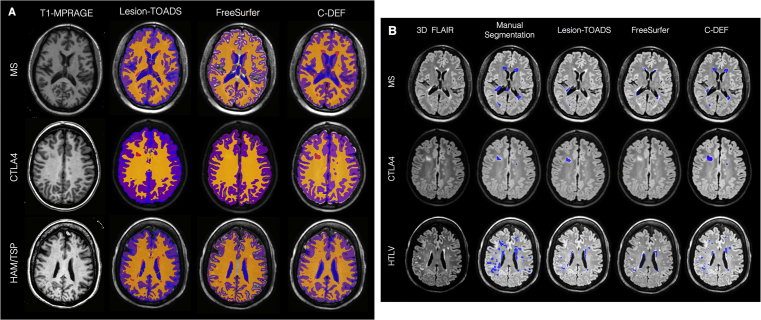
C-DEF algorithm was optimized using leave-one-out cross validation on five healthy subjects (age 36 ± 11 years), and five subjects infected with HIV (age 57 ± 2.6 years) in cohort one. The optimized C-DEF algorithm outperformed FreeSurfer and Lesion-TOADS segmentation in 49 other subjects infected with HIV (cohort two, age 54 ± 6 years) in qualitative and quantitative comparisons. Although trained only on HIV brains, sensitivity to detect lesions using C-DEF increased by 45% in HTLV-I-associated myelopathy/tropical spastic paraparesis (n = 5; age 58 ± 7 years), 33% in multiple sclerosis (n = 5; 42 ± 9 years old), and 4% in subjects with polymorphism of the cytotoxic T-lymphocyte-associated protein 4 gene (n = 5; age 24 ± 12 years) compared to Lesion-TOADS.
C-DEF outperformed other segmentation algorithms in the various neurological diseases explored herein, especially in lesion segmentation. While the results reported are from routine images acquired at the NIH, the algorithm can be easily trained and optimized for any set of contrasts and protocols for wider application. We are currently exploring various technical aspects of optimal implementation of CDEF in a clinical setting and evaluating a larger cohort of patients with other neurological diseases. Improving the accuracy of brain segmentation methodology will help better understand the relationship of imaging abnormalities to clinical and neuropsychological markers in disease.
源自磁共振成像(MRI)的脑体积和病变体积是神经退行性疾病及衰老过程中疾病进展的重要影像标志物。虽然手动分割这些体积在大量受试者队列中既繁琐又不切实际,但自动分割方法在严重萎缩或病变负荷高的脑的准确分割中常常失败。本研究的目的是开发一种基于导数特征的无图谱脑分类法(C-DEF),该方法利用在任何中心的常规MRI研究过程中可能获取的所有扫描数据。
美国国立卫生研究院(NIH)对患有神经炎性疾病的患者常规采集的质子密度、T加权、T加权、脑自由水、3D FLAIR、3D T加权和3D T*加权图像,用于在健康志愿者和HIV阳性受试者(队列1)上优化C-DEF算法。首先,在训练中使用手动标记的病变和侵蚀的FreeSurfer脑分割掩码(编译为灰质、白质、苍白球、脑脊液标签)。接下来,将优化后的C-DEF应用于另一组HIV阳性受试者(队列二),并将结果与FreeSurfer和Lesion-TOADS的结果进行比较。最后,在临床诊断为各种其他神经系统疾病的受试者(队列三)上评估C-DEF分割。
在队列一中,使用留一法交叉验证对五名健康受试者(年龄36±11岁)和五名感染HIV的受试者(年龄57±2.6岁)优化了C-DEF算法。在定性和定量比较中,优化后的C-DEF算法在另外49名感染HIV的受试者(队列二,年龄54±6岁)中优于FreeSurfer和Lesion-TOADS分割。尽管仅在HIV脑上进行训练,但与Lesion-TOADS相比,使用C-DEF检测病变的敏感性在HTLV-I相关脊髓病/热带痉挛性截瘫(n = 5;年龄58±7岁)中提高了45%,在多发性硬化症(n = 5;42±9岁)中提高了33%,在细胞毒性T淋巴细胞相关蛋白4基因多态性受试者(n = 5;年龄24±12岁)中提高了4%。
在本文探索的各种神经系统疾病中,C-DEF优于其他分割算法,尤其是在病变分割方面。虽然报告的结果来自于NIH采集的常规图像,但该算法可以很容易地针对任何一组对比和方案进行训练和优化,以实现更广泛的应用。我们目前正在探索CDEF在临床环境中最佳实施的各种技术方面,并评估更大队列的患有其他神经系统疾病的患者。提高脑分割方法的准确性将有助于更好地理解疾病中影像异常与临床和神经心理标志物之间的关系。