
来自南非阴茎拭子的六种新型γ乳头瘤病毒类型的发现、特征描述及基因组变异
Discovery, characterisation and genomic variation of six novel Gammapapillomavirus types from penile swabs in South Africa.
作者信息
Murahwa Alltalents T, Meiring Tracy L, Mbulawa Zizipho Z A, Williamson Anna-Lise
机构信息
Division of Medical Virology, Department of Pathology, Faculty of Health Sciences, University of Cape Town, Cape Town, 7925, South Africa; Institute of Infectious Disease and Molecular Medicine, University of Cape Town, Cape Town, South Africa.
Division of Medical Virology, Department of Pathology, Faculty of Health Sciences, University of Cape Town, Cape Town, 7925, South Africa; Institute of Infectious Disease and Molecular Medicine, University of Cape Town, Cape Town, South Africa; Center for HIV and STIs, National Institute for Communicable Disease, National Health Laboratory Service, Johannesburg, South Africa; SAMRC Gynaecological Cancer Research Centre, Faculty of Health Sciences, University of Cape Town, Cape Town, South Africa.
出版信息
Papillomavirus Res. 2019 Jun;7:102-111. doi: 10.1016/j.pvr.2019.02.005. Epub 2019 Mar 4.
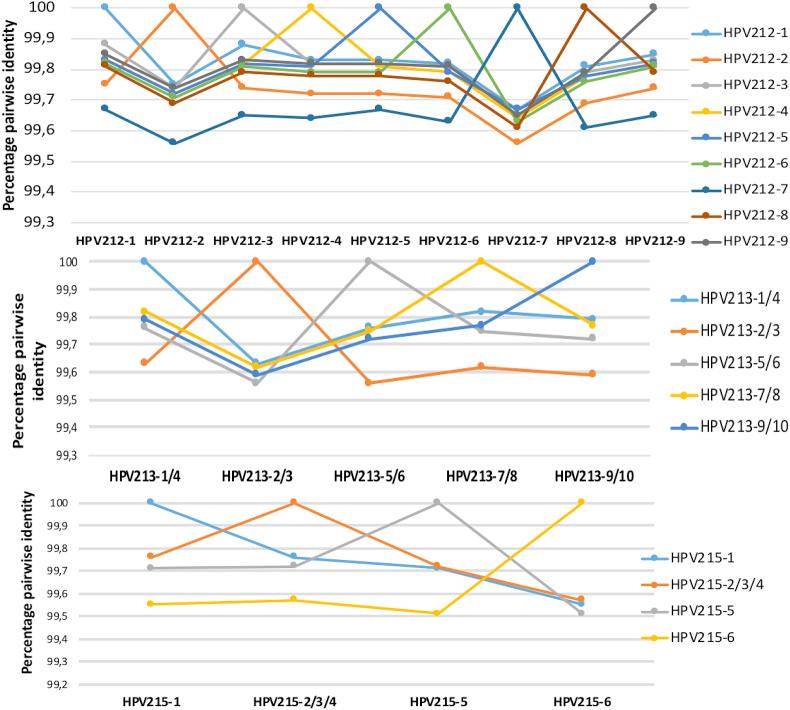
Six novel human papillomaviruses from penile swabs were characterised. Multiple full genome clones for each novel type were generated, and complete genome sizes were: HPV211 (7253bp), HPV212 (7208bp), HPV213 (7096bp), HPV214 (7357), HPV215 (7186bp) and HPV216 (7233bp). Phylogenetically the novel papillomaviruses all clustered with Gammapapillomaviruses: HPV211 is most closely related to HPV168 (72% identity in the L1 nucleotide sequence) of the Gamma-8 species, HPV212 is most closely related to HPV144 (82.9%) of the Gamma-17 species, HPV213 is most closely related to HPV153 (71.8%) of the Gamma-13 species, HPV214 is most closely related to HPV103 (75.3%) of the Gamma-6 species, HPV215 and HPV216 are most closely related to HPV129 (76.8% and 79.2% respectively) of the Gamma-9 species. The novel HPV types demonstrated the classical genomic organisation of Gammapapillomavirusess, with seven open reading frames (ORFs) encoding five early (E1, E2, E4, E6 and E7) and two late (L1 and L2) proteins. Typical of Gammapapillomavirusess the novel types all lacked the E5 ORF and HPV214 also lacked the E6 ORF. HPV212 had nine unique variants, HPV213 had five and HPV215 had four variants. Conserved domains observed among the novel types are the Zinc finger Binding Domain and PDZ domains. A retinoblastoma binding domain (pRB) binding domain in E7 protein was additionally identified in HPV214. This study expands the knowledge of the rapidly growing Gammapapillomavirus genus.
对来自阴茎拭子的六种新型人乳头瘤病毒进行了特征分析。针对每种新型病毒产生了多个全基因组克隆,完整基因组大小分别为:HPV211(7253bp)、HPV212(7208bp)、HPV213(7096bp)、HPV214(7357bp)、HPV215(7186bp)和HPV216(7233bp)。在系统发育上,这些新型乳头瘤病毒均与γ乳头瘤病毒聚类:HPV211与γ-8物种的HPV168(L1核苷酸序列同一性为72%)关系最为密切,HPV212与γ-17物种的HPV144(82.9%)关系最为密切,HPV213与γ-13物种的HPV153(71.8%)关系最为密切,HPV214与γ-6物种的HPV103(75.3%)关系最为密切,HPV215和HPV216与γ-9物种的HPV129(分别为76.8%和79.2%)关系最为密切。这些新型HPV类型展示了γ乳头瘤病毒的经典基因组结构,具有七个开放阅读框(ORF),编码五种早期(E1、E2、E4、E6和E7)和两种晚期(L1和L2)蛋白。γ乳头瘤病毒的典型特征是,这些新型病毒均缺乏E5 ORF,HPV214还缺乏E6 ORF。HPV212有九个独特变体,HPV213有五个,HPV215有四个变体。在这些新型病毒中观察到的保守结构域是锌指结合结构域和PDZ结构域。在HPV214中还额外鉴定出E7蛋白中的视网膜母细胞瘤结合结构域(pRB)结合结构域。本研究扩展了对快速增长的γ乳头瘤病毒属的认识。


 Zotero 插件