Ma Geng, Liu Weixing, Li Shasha, Zhang Panpan, Wang Chenyang, Lu Hongfang, Wang Lifang, Xie Yingxin, Ma Dongyun, Kang Guozhang
College of Agronomy, Henan Agricultural University, Zhengzhou, China.
State Key Laboratory of Wheat and Maize Crop Science, Henan Agricultural University, Zhengzhou, China.
Front Plant Sci. 2019 Feb 22;10:181. doi: 10.3389/fpls.2019.00181. eCollection 2019.
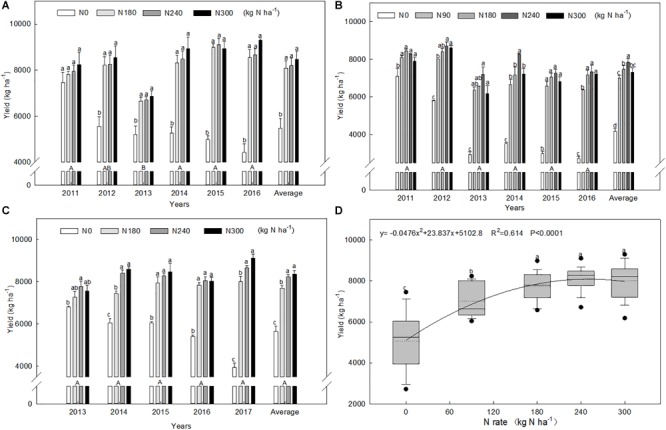
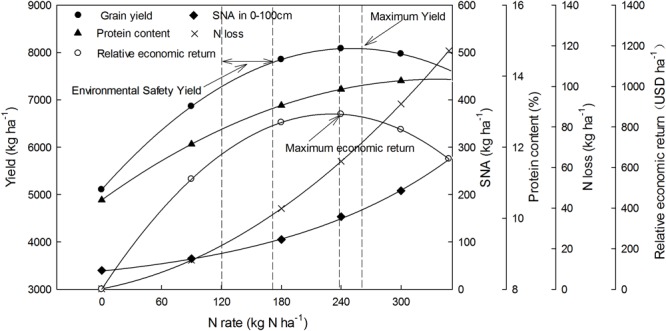
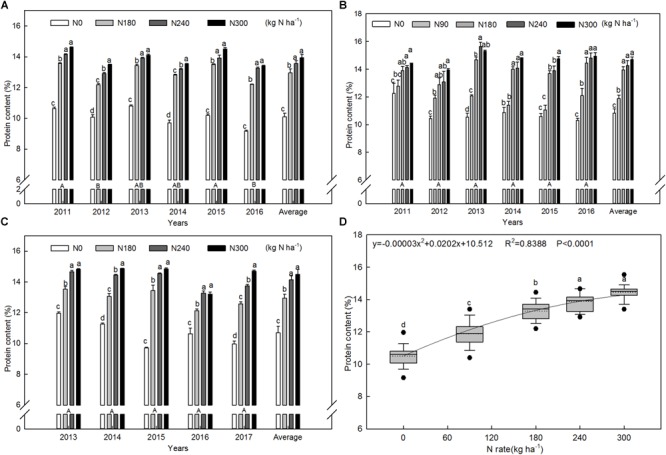
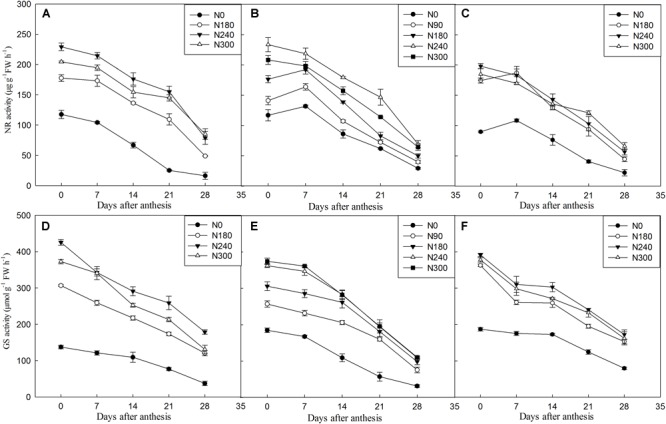
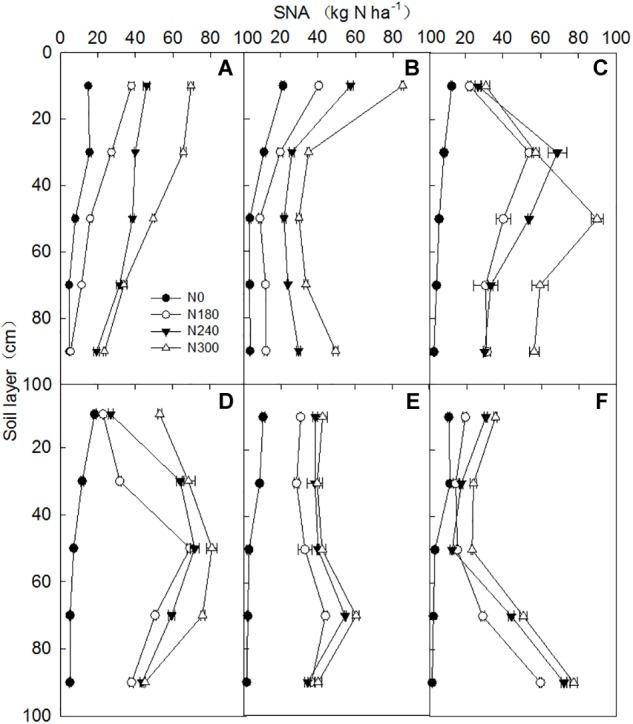
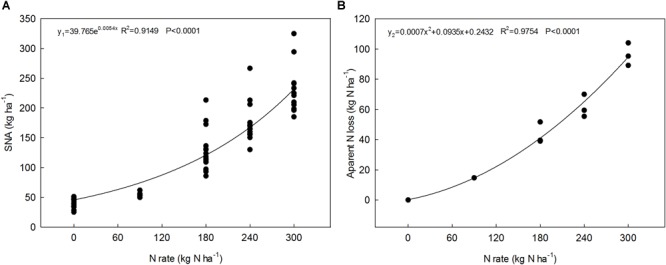
Excessive or improper nitrogen (N) application rates negatively affect crop production and thereby environmental quality, particularly for winter wheat production in the North China Plain. Therefore, it is very important to optimize N fertilizer input to balance grain yield, environmental risk, and benefits under irrigated conditions. Three long-term stationary field experiments including five N levels, from 0 to 300 kg ha [0 (N0), 90 (N90), 180 (N180), 240 (N240), and 300 (N300) kg ha] were carried out to investigate the effects of N regime on wheat yield, photosynthesis, and N balance at different sites. The grain yield and protein content increased quadratically with N rate, and the maximum values were 8087 kg ha and 13.9% at N application rates of 250 and 337 kg N ha, respectively. N application increased the photosynthetic fluorescence parameters (Pn, Gs, and Tr) and N metabolism enzyme activities (NR and GS) which then increased grain yield. The leaching of soil nitrate into the deeper soil layers ( > 100 cm) increased with higher N fertilization and experimental years. The partial factor productivity (PFPN) was decreased by N because the apparent N loss increased with N application rate. In order to balance grain yield, N use efficiency (NUE), and N loss, the recommended N rate should be 120-171 kg N ha, and the corresponding yields and apparent N loss were 7278-7787 ka ha and 22-37 kg ha, respectively.
过量或不当的施氮量会对作物产量产生负面影响,进而影响环境质量,尤其是对华北平原的冬小麦生产而言。因此,在灌溉条件下优化氮肥投入以平衡粮食产量、环境风险和效益非常重要。开展了三项长期定位田间试验,设置了从0到300 kg ha的五个施氮水平[0(N0)、90(N90)、180(N180)、240(N240)和300(N300)kg ha],以研究不同施氮模式对不同地点小麦产量、光合作用和氮平衡的影响。籽粒产量和蛋白质含量随施氮量呈二次曲线增加,施氮量分别为250和337 kg N ha时,最大值分别为8087 kg ha和13.9%。施氮增加了光合荧光参数(Pn、Gs和Tr)以及氮代谢酶活性(NR和GS),进而提高了籽粒产量。随着施氮量增加和试验年份增加,土壤硝态氮向深层土壤(>100 cm)的淋溶增加。由于表观氮损失随施氮量增加而增加,氮肥的偏生产力(PFPN)降低。为了平衡粮食产量、氮素利用效率(NUE)和氮损失,推荐施氮量应为120 - 171 kg N ha,相应的产量和表观氮损失分别为7278 - 7787 ka ha和22 - 37 kg ha。