Damiati Samar
Department of Biochemistry, Faculty of Science, King Abdulaziz University (KAU), Jeddah, Saudi Arabia.
J Med Biochem. 2019 Mar 3;38(2):145-152. doi: 10.2478/jomb-2018-0025. eCollection 2019 Apr.
Although vitamin D in not a traditional marker for cardiovascular and renal diseases, several studies have proposed a correlation between vitamin D deficiency and these diseases due to the effect of vitamin D on endothelial function. Asymmetric and symmetric dimethyl arginine (ADMA and SDMA, respectively) are endogenous markers of endothelial dysfunction, and are considered as future markers for the assessment of cardiovascular and renal diseases. The present study investigated the association of kidney function tests (urea and creatinine) and dimethylarginine toxins (ADMA and SDMA) in women with vitamin D insufficiency or deficiency. Indeed, sex hormones (estrogen and testosterone) were analyzed in the participants.
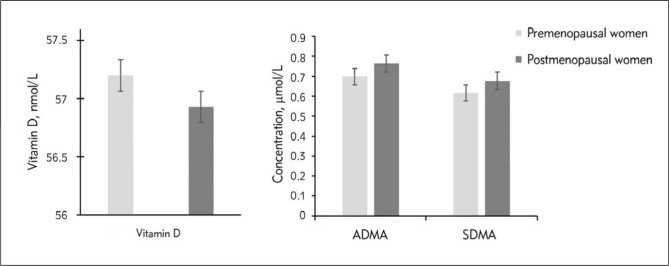
Women were divided into two groups: premenopausal women (younger than 50 years) and postmenopausal women (older than 50 years). Urea, creatinine, estrogen, testosterone, ADMA, and SDMA levels were analyzed when vitamin D level was deficient or insufficient in the participants.
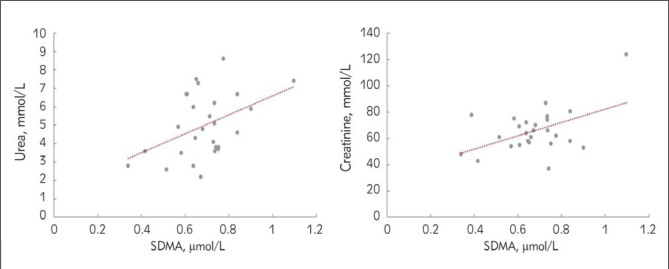
The premenopausal women group showed no significant correlations between dimethylarginine toxins and renal failure tests or sex hormones. In the elderly (postmenstrual) women group, only SDMA was significantly correlated with urea and creatinine, while both ADMA and SDMA were not correlated with sex hormones.
Although ADMA and SDMA are promising candidates of endothelial dysfunction and are increased in menopause and aging, no direct link between ADMA and further progression of renal failure was observed in women with low vitamin D levels. In contrast, a possible direct correlation between SDMA and renal dysfunction was noticed, but only in an age-dependent manner.
尽管维生素D并非心血管疾病和肾脏疾病的传统标志物,但由于维生素D对内皮功能的影响,多项研究提出维生素D缺乏与这些疾病之间存在关联。不对称和对称二甲基精氨酸(分别为ADMA和SDMA)是内皮功能障碍的内源性标志物,被视为评估心血管疾病和肾脏疾病的未来标志物。本研究调查了维生素D不足或缺乏的女性中肾功能检查(尿素和肌酐)与二甲基精氨酸毒素(ADMA和SDMA)之间的关联。实际上,对参与者的性激素(雌激素和睾酮)进行了分析。
将女性分为两组:绝经前女性(年龄小于50岁)和绝经后女性(年龄大于50岁)。当参与者的维生素D水平不足或缺乏时,分析其尿素、肌酐、雌激素、睾酮、ADMA和SDMA水平。
绝经前女性组中二甲基精氨酸毒素与肾衰竭检查或性激素之间无显著相关性。在老年(绝经后)女性组中,只有SDMA与尿素和肌酐显著相关,而ADMA和SDMA均与性激素无关。
尽管ADMA和SDMA是内皮功能障碍的有前景的标志物,且在绝经和衰老过程中会升高,但在维生素D水平低的女性中未观察到ADMA与肾衰竭进一步进展之间的直接联系。相反,注意到SDMA与肾功能障碍之间可能存在直接相关性,但仅以年龄依赖的方式存在。