Department of Genetics, Harvard Medical School, Boston, MA, USA.
Broad Institute of MIT and Harvard, Cambridge, MA, USA.
Science. 2019 Mar 15;363(6432):1230-1234. doi: 10.1126/science.aav4040.
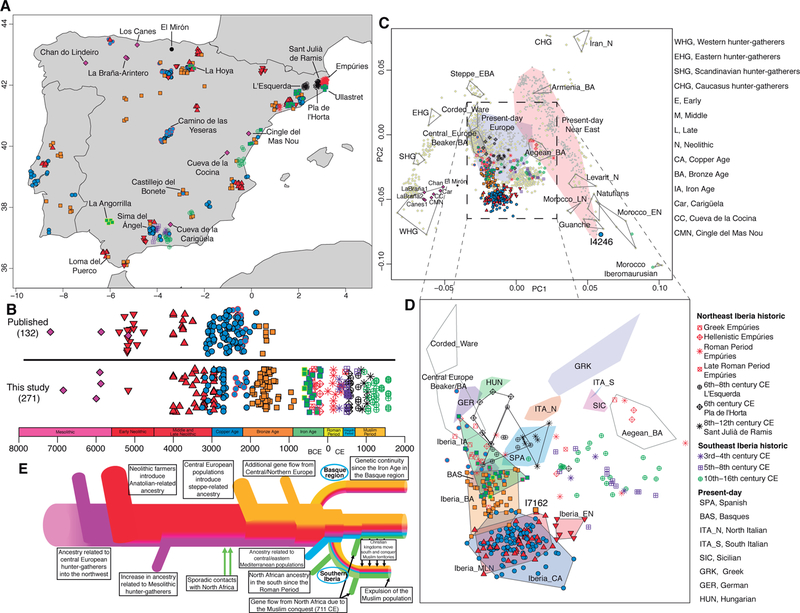
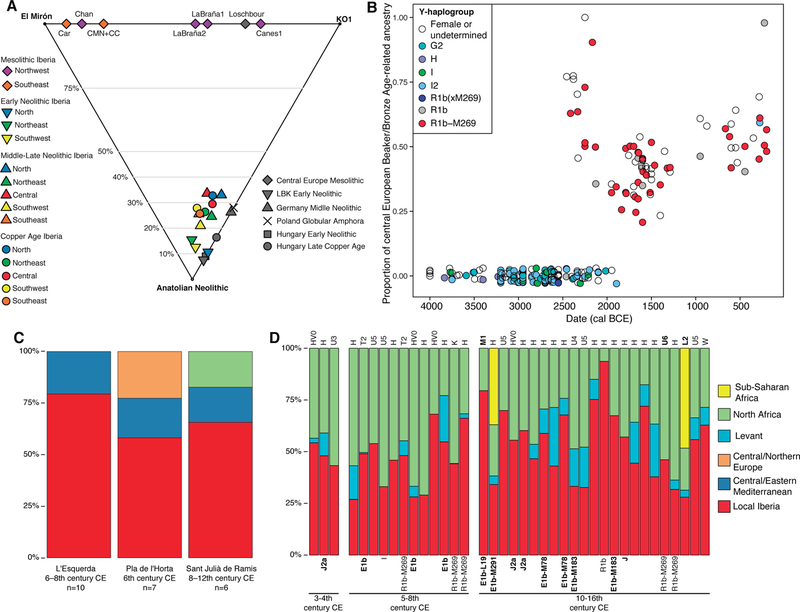
We assembled genome-wide data from 271 ancient Iberians, of whom 176 are from the largely unsampled period after 2000 BCE, thereby providing a high-resolution time transect of the Iberian Peninsula. We document high genetic substructure between northwestern and southeastern hunter-gatherers before the spread of farming. We reveal sporadic contacts between Iberia and North Africa by ~2500 BCE and, by ~2000 BCE, the replacement of 40% of Iberia's ancestry and nearly 100% of its Y-chromosomes by people with Steppe ancestry. We show that, in the Iron Age, Steppe ancestry had spread not only into Indo-European-speaking regions but also into non-Indo-European-speaking ones, and we reveal that present-day Basques are best described as a typical Iron Age population without the admixture events that later affected the rest of Iberia. Additionally, we document how, beginning at least in the Roman period, the ancestry of the peninsula was transformed by gene flow from North Africa and the eastern Mediterranean.
我们汇集了来自 271 位伊比利亚古人类的全基因组数据,其中 176 位来自公元前 2000 年后的大部分未采样时期,从而提供了伊比利亚半岛的高分辨率时间剖面。我们记录了在农业传播之前,西北和东南的狩猎采集者之间存在高度的遗传亚结构。我们揭示了公元前 2500 年左右伊比利亚和北非之间的零星接触,到公元前 2000 年,约 40%的伊比利亚祖先和几乎 100%的 Y 染色体被具有草原祖先的人所取代。我们表明,在铁器时代,草原祖先不仅传播到了说印欧语的地区,也传播到了不说印欧语的地区,我们还揭示了现代巴斯克人最好被描述为一个典型的铁器时代人口,没有后来影响伊比利亚其他地区的混合事件。此外,我们记录了从罗马时期开始,半岛的祖先血统是如何通过来自北非和东地中海的基因流而发生变化的。