Dudley Quentin M, Nash Connor J, Jewett Michael C
Department of Chemical and Biological Engineering, Northwestern University, Evanston, IL, USA.
Chemistry of Life Processes Institute, Northwestern University, Evanston, IL, USA.
Synth Biol (Oxf). 2019;4(1):ysz003. doi: 10.1093/synbio/ysz003. Epub 2019 Jan 14.
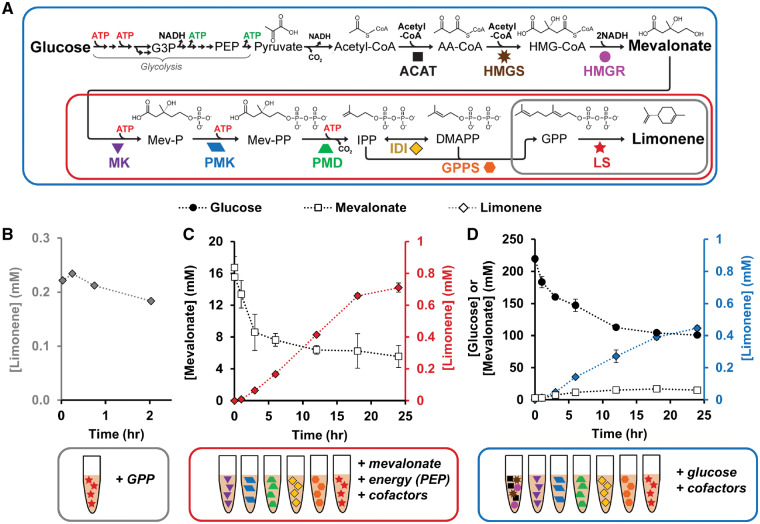
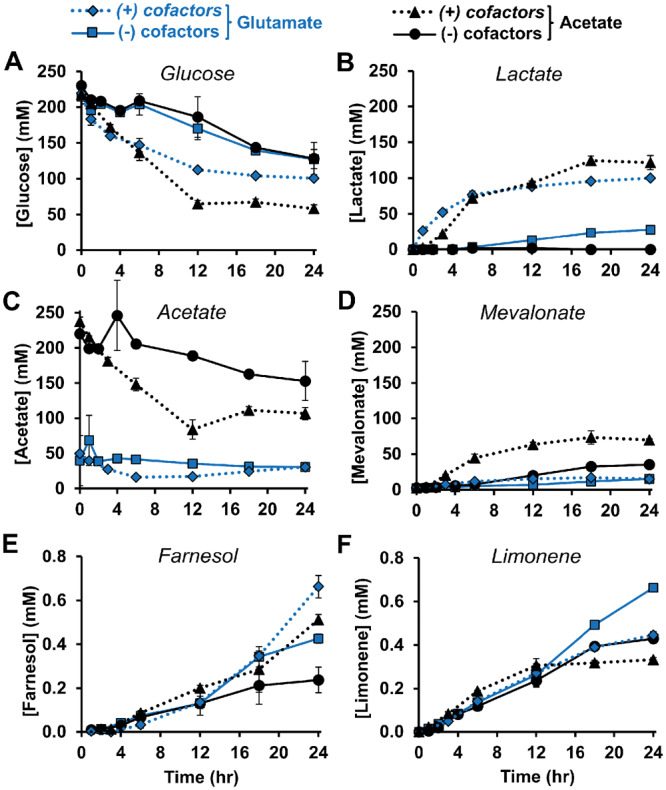
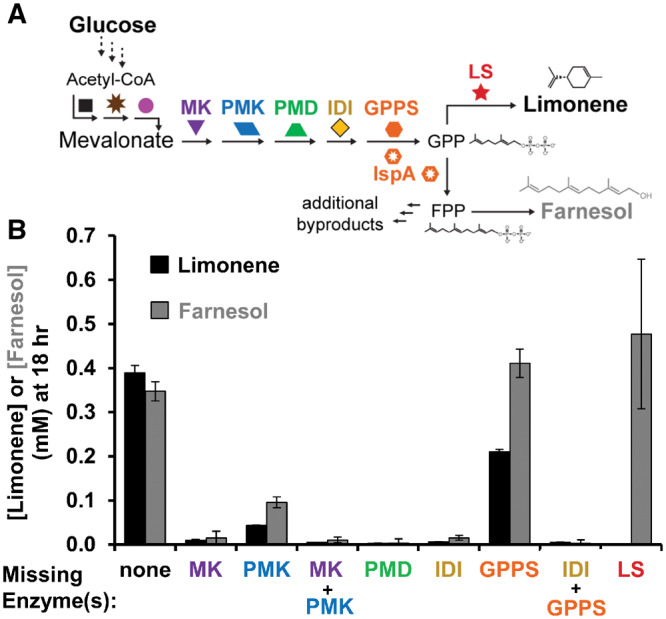
Isoprenoids are an attractive class of metabolites for enzymatic synthesis from renewable substrates. However, metabolic engineering of microorganisms for monoterpenoid production is limited by the need for time-consuming, and often non-intuitive, combinatorial tuning of biosynthetic pathway variations to meet design criteria. Towards alleviating this limitation, the goal of this work was to build a modular, cell-free platform for construction and testing of monoterpenoid pathways, using the fragrance and flavoring molecule limonene as a model. In this platform, multiple lysates, each enriched with a single overexpressed pathway enzyme, are mixed to construct the full biosynthetic pathway. First, we show the ability to synthesize limonene from six enriched lysates with mevalonate substrate, an adenosine triphosphate (ATP) source, and cofactors. Next, we extend the pathway to use glucose as a substrate, which relies on native metabolism in the extract to convert glucose to acetyl-CoA along with three additional enzymes to convert acetyl-CoA to mevalonate. We find that the native farnesyl diphosphate synthase (IspA) is active in the lysate and diverts flux from the pathway intermediate geranyl pyrophospahte to farnesyl pyrophsophate and the byproduct farnesol. By adjusting the relative levels of cofactors NAD, ATP and CoA, the system can synthesize 0.66 mM (90.2 mg l) limonene over 24 h, a productivity of 3.8 mg l h. Our results highlight the flexibility of crude lysates to sustain complex metabolism and, by activating a glucose-to-limonene pathway with 9 heterologous enzymes encompassing 20 biosynthetic steps, expands an approach of using enzyme-enriched lysates for constructing, characterizing and prototyping enzymatic pathways.
类异戊二烯是一类极具吸引力的代谢产物,可通过可再生底物进行酶促合成。然而,微生物用于单萜类化合物生产的代谢工程受到限制,因为需要对生物合成途径变体进行耗时且通常非直观的组合调整,以满足设计标准。为了缓解这一限制,本研究的目标是构建一个模块化的无细胞平台,用于构建和测试单萜类化合物途径,以香料和调味分子柠檬烯作为模型。在这个平台中,将多种裂解物混合,每种裂解物都富含一种过表达的途径酶,以构建完整的生物合成途径。首先,我们展示了利用六种富含甲羟戊酸底物、三磷酸腺苷(ATP)源和辅因子的裂解物合成柠檬烯的能力。接下来,我们将该途径扩展为使用葡萄糖作为底物,这依赖于提取物中的天然代谢将葡萄糖转化为乙酰辅酶A,同时还需要三种额外的酶将乙酰辅酶A转化为甲羟戊酸。我们发现天然的法呢基二磷酸合酶(IspA)在裂解物中具有活性,并将通量从途径中间体香叶基焦磷酸转移到法呢基焦磷酸和副产物法呢醇。通过调整辅因子NAD、ATP和辅酶A的相对水平,该系统在24小时内可合成0.66 mM(90.2 mg l)的柠檬烯,生产率为3.8 mg l h。我们的结果突出了粗裂解物维持复杂代谢的灵活性,并通过激活包含20个生物合成步骤的9种异源酶的葡萄糖到柠檬烯途径,扩展了一种使用富含酶的裂解物构建、表征和原型化酶促途径的方法。