• 文献检索
  • 文档翻译
  • 深度研究
  • 学术资讯
  • Suppr Zotero 插件Zotero 插件
  • 邀请有礼
  • 套餐&价格
  • 历史记录
应用&插件
Suppr Zotero 插件Zotero 插件浏览器插件Mac 客户端Windows 客户端微信小程序
定价
高级版会员购买积分包购买API积分包
服务
文献检索文档翻译深度研究API 文档MCP 服务
关于我们
关于 Suppr公司介绍联系我们用户协议隐私条款
关注我们

Suppr 超能文献

核心技术专利:CN118964589B侵权必究
粤ICP备2023148730 号-1Suppr @ 2026

文献检索

告别复杂PubMed语法,用中文像聊天一样搜索,搜遍4000万医学文献。AI智能推荐,让科研检索更轻松。

立即免费搜索

文件翻译

保留排版,准确专业,支持PDF/Word/PPT等文件格式,支持 12+语言互译。

免费翻译文档

深度研究

AI帮你快速写综述,25分钟生成高质量综述,智能提取关键信息,辅助科研写作。

立即免费体验

人类可以解读对抗性图像。

Humans can decipher adversarial images.

机构信息

Department of Psychological & Brain Sciences, Johns Hopkins University, 3400 N Charles St., Baltimore, MD, 21218, USA.

出版信息

Nat Commun. 2019 Mar 22;10(1):1334. doi: 10.1038/s41467-019-08931-6.

DOI:10.1038/s41467-019-08931-6
PMID:30902973
原文链接:https://pmc.ncbi.nlm.nih.gov/articles/PMC6430776/
Abstract

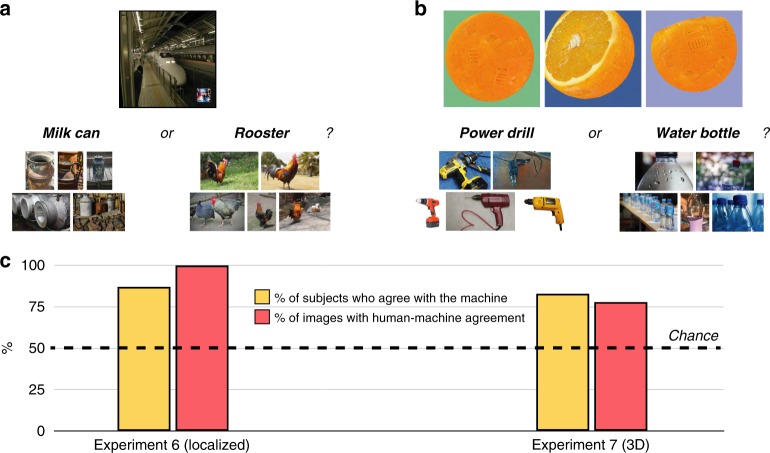
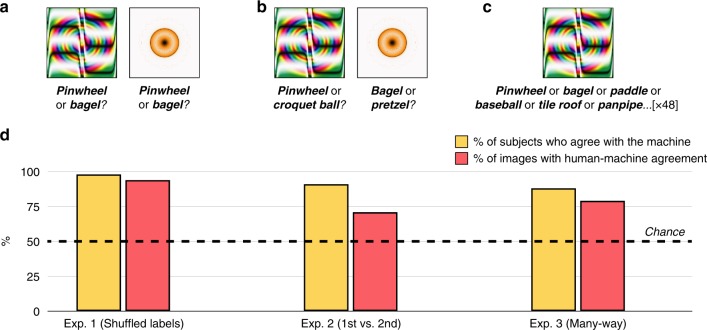
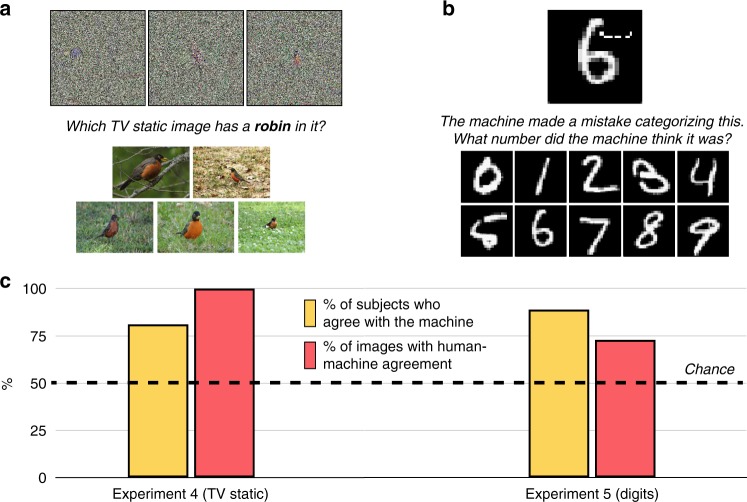
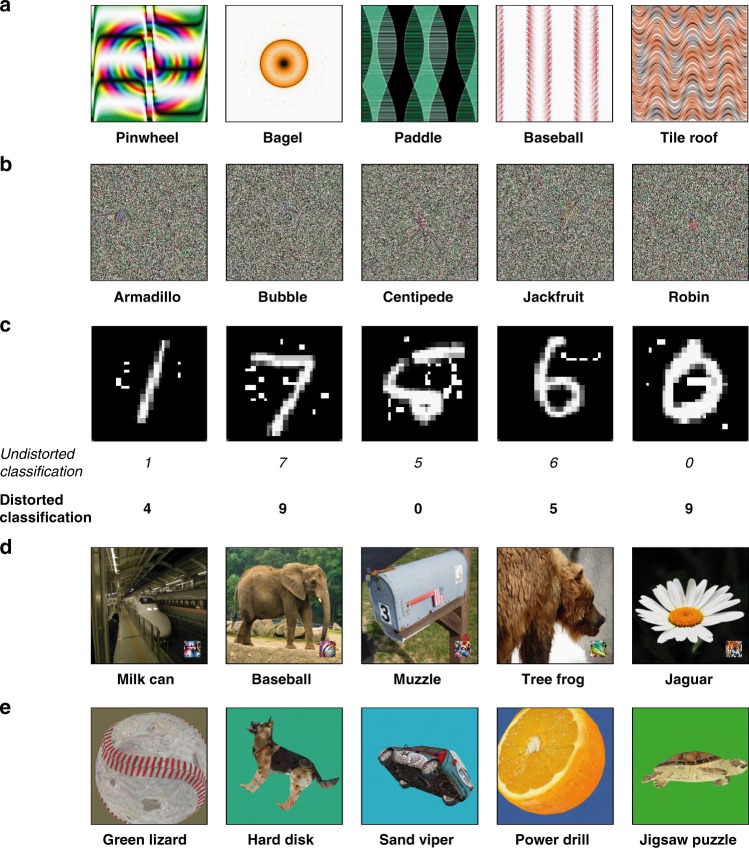
Does the human mind resemble the machine-learning systems that mirror its performance? Convolutional neural networks (CNNs) have achieved human-level benchmarks in classifying novel images. These advances support technologies such as autonomous vehicles and machine diagnosis; but beyond this, they serve as candidate models for human vision itself. However, unlike humans, CNNs are "fooled" by adversarial examples-nonsense patterns that machines recognize as familiar objects, or seemingly irrelevant image perturbations that nevertheless alter the machine's classification. Such bizarre behaviors challenge the promise of these new advances; but do human and machine judgments fundamentally diverge? Here, we show that human and machine classification of adversarial images are robustly related: In 8 experiments on 5 prominent and diverse adversarial imagesets, human subjects correctly anticipated the machine's preferred label over relevant foils-even for images described as "totally unrecognizable to human eyes". Human intuition may be a surprisingly reliable guide to machine (mis)classification-with consequences for minds and machines alike.

摘要

人类的思维是否类似于反映其性能的机器学习系统?卷积神经网络 (CNN) 在对新型图像进行分类方面已达到人类水平的基准。这些进展支持了自动驾驶汽车和机器诊断等技术的发展;但除此之外,它们本身也可以作为人类视觉的候选模型。然而,与人类不同的是,CNN 会被对抗性示例所“愚弄”——这些示例是机器识别为熟悉物体的无意义模式,或者是看似不相关的图像干扰,但却改变了机器的分类。这些奇怪的行为挑战了这些新进展的承诺;但是人类和机器的判断是否从根本上不同呢?在这里,我们表明,人类和机器对对抗性图像的分类是紧密相关的:在对 5 个著名的、多样化的对抗性图像集进行的 8 项实验中,人类受试者能够正确地预测出机器对相关干扰的首选标签,即使是对于被描述为“人类的眼睛完全无法识别”的图像也是如此。人类的直觉可能是机器(错误)分类的一个惊人可靠的指南——这对人类和机器都有影响。
https://cdn.ncbi.nlm.nih.gov/pmc/blobs/9f39/6430776/e26e7c0201e6/41467_2019_8931_Fig4_HTML.jpg
https://cdn.ncbi.nlm.nih.gov/pmc/blobs/9f39/6430776/c3835ca8cd51/41467_2019_8931_Fig1_HTML.jpg
https://cdn.ncbi.nlm.nih.gov/pmc/blobs/9f39/6430776/749b2d72a485/41467_2019_8931_Fig2_HTML.jpg
https://cdn.ncbi.nlm.nih.gov/pmc/blobs/9f39/6430776/1d040fe41097/41467_2019_8931_Fig3_HTML.jpg
https://cdn.ncbi.nlm.nih.gov/pmc/blobs/9f39/6430776/e26e7c0201e6/41467_2019_8931_Fig4_HTML.jpg
https://cdn.ncbi.nlm.nih.gov/pmc/blobs/9f39/6430776/c3835ca8cd51/41467_2019_8931_Fig1_HTML.jpg
https://cdn.ncbi.nlm.nih.gov/pmc/blobs/9f39/6430776/749b2d72a485/41467_2019_8931_Fig2_HTML.jpg
https://cdn.ncbi.nlm.nih.gov/pmc/blobs/9f39/6430776/1d040fe41097/41467_2019_8931_Fig3_HTML.jpg
https://cdn.ncbi.nlm.nih.gov/pmc/blobs/9f39/6430776/e26e7c0201e6/41467_2019_8931_Fig4_HTML.jpg

相似文献

1
Humans can decipher adversarial images.人类可以解读对抗性图像。
Nat Commun. 2019 Mar 22;10(1):1334. doi: 10.1038/s41467-019-08931-6.
2
Robust image classification against adversarial attacks using elastic similarity measures between edge count sequences.使用边缘计数序列之间的弹性相似性度量来进行对抗攻击的鲁棒图像分类。
Neural Netw. 2020 Aug;128:61-72. doi: 10.1016/j.neunet.2020.04.030. Epub 2020 Apr 30.
3
An Ensemble of Fine-Tuned Convolutional Neural Networks for Medical Image Classification.用于医学图像分类的微调卷积神经网络集成
IEEE J Biomed Health Inform. 2017 Jan;21(1):31-40. doi: 10.1109/JBHI.2016.2635663. Epub 2016 Dec 5.
4
Medical Image Synthesis via Deep Learning.基于深度学习的医学图像合成。
Adv Exp Med Biol. 2020;1213:23-44. doi: 10.1007/978-3-030-33128-3_2.
5
Skin lesion classification with ensembles of deep convolutional neural networks.基于深度卷积神经网络集成的皮肤损伤分类。
J Biomed Inform. 2018 Oct;86:25-32. doi: 10.1016/j.jbi.2018.08.006. Epub 2018 Aug 10.
6
DeephESC 2.0: Deep Generative Multi Adversarial Networks for improving the classification of hESC.DeephESC 2.0:用于改善 hESC 分类的深度生成式多对抗网络。
PLoS One. 2019 Mar 6;14(3):e0212849. doi: 10.1371/journal.pone.0212849. eCollection 2019.
7
What do adversarial images tell us about human vision?对抗图像能告诉我们人类视觉什么?
Elife. 2020 Sep 2;9:e55978. doi: 10.7554/eLife.55978.
8
Automated detection of erythema migrans and other confounding skin lesions via deep learning.基于深度学习的红斑游走疹及其他混淆性皮肤损伤的自动检测。
Comput Biol Med. 2019 Feb;105:151-156. doi: 10.1016/j.compbiomed.2018.12.007. Epub 2018 Dec 18.
9
Generative Adversarial Networks for Noise Reduction in Low-Dose CT.生成对抗网络在低剂量 CT 中的噪声降低。
IEEE Trans Med Imaging. 2017 Dec;36(12):2536-2545. doi: 10.1109/TMI.2017.2708987. Epub 2017 May 26.
10
A dataset for evaluating one-shot categorization of novel object classes.一个用于评估新型对象类别的一次性分类的数据集。
Data Brief. 2020 Feb 21;29:105302. doi: 10.1016/j.dib.2020.105302. eCollection 2020 Apr.

引用本文的文献

1
Model interpretability enhances domain generalization in the case of textual complexity modeling.在文本复杂性建模的情况下,模型可解释性增强了领域泛化能力。
Patterns (N Y). 2025 Feb 6;6(2):101177. doi: 10.1016/j.patter.2025.101177. eCollection 2025 Feb 14.
2
Extreme image transformations affect humans and machines differently.极端的图像变换对人和机器的影响不同。
Biol Cybern. 2023 Oct;117(4-5):331-343. doi: 10.1007/s00422-023-00968-7. Epub 2023 Jun 13.
3
The neuroconnectionist research programme.神经连接主义研究计划。

本文引用的文献

1
Predicting eye movement patterns from fMRI responses to natural scenes.从 fMRI 对自然场景的反应中预测眼球运动模式。
Nat Commun. 2018 Dec 4;9(1):5159. doi: 10.1038/s41467-018-07471-9.
2
Deep learning-Using machine learning to study biological vision.深度学习——利用机器学习研究生物视觉。
J Vis. 2018 Dec 3;18(13):2. doi: 10.1167/18.13.2.
3
Shared spatiotemporal category representations in biological and artificial deep neural networks.生物和人工深度神经网络中的共享时空类别表示。
Nat Rev Neurosci. 2023 Jul;24(7):431-450. doi: 10.1038/s41583-023-00705-w. Epub 2023 May 30.
4
A tale of two lexica: Investigating computational pressures on word representation with neural networks.两部词典的故事:用神经网络研究单词表征的计算压力
Front Artif Intell. 2023 Mar 27;6:1062230. doi: 10.3389/frai.2023.1062230. eCollection 2023.
5
When will AI misclassify? Intuiting failures on natural images.人工智能何时会出错?对自然图像故障的直观推断。
J Vis. 2023 Apr 3;23(4):4. doi: 10.1167/jov.23.4.4.
6
Studying Healthy Psychosislike Experiences to Improve Illness Prediction.研究健康的精神病样体验以改善疾病预测。
JAMA Psychiatry. 2023 May 1;80(5):515-517. doi: 10.1001/jamapsychiatry.2023.0059.
7
Brain-inspired Predictive Coding Improves the Performance of Machine Challenging Tasks.受大脑启发的预测编码提高了机器挑战性任务的性能。
Front Comput Neurosci. 2022 Nov 16;16:1062678. doi: 10.3389/fncom.2022.1062678. eCollection 2022.
8
An EANM position paper on the application of artificial intelligence in nuclear medicine.核医学中人工智能应用的 EANM 立场文件。
Eur J Nucl Med Mol Imaging. 2022 Dec;50(1):61-66. doi: 10.1007/s00259-022-05947-x. Epub 2022 Aug 25.
9
ImageNet-trained deep neural networks exhibit illusion-like response to the Scintillating grid.基于 ImageNet 训练的深度神经网络对闪烁网格表现出类似幻觉的反应。
J Vis. 2021 Oct 5;21(11):15. doi: 10.1167/jov.21.11.15.
10
Training for object recognition with increasing spatial frequency: A comparison of deep learning with human vision.用增加空间频率的方法进行目标识别训练:深度学习与人眼视觉的比较。
J Vis. 2021 Sep 1;21(10):14. doi: 10.1167/jov.21.10.14.
PLoS Comput Biol. 2018 Jul 24;14(7):e1006327. doi: 10.1371/journal.pcbi.1006327. eCollection 2018 Jul.
4
Large-Scale, High-Resolution Comparison of the Core Visual Object Recognition Behavior of Humans, Monkeys, and State-of-the-Art Deep Artificial Neural Networks.大规模、高分辨率的人类、猴子和最先进的深度人工神经网络核心视觉对象识别行为比较。
J Neurosci. 2018 Aug 15;38(33):7255-7269. doi: 10.1523/JNEUROSCI.0388-18.2018. Epub 2018 Jul 13.
5
Deep Convolutional Neural Networks Outperform Feature-Based But Not Categorical Models in Explaining Object Similarity Judgments.在解释物体相似性判断方面,深度卷积神经网络的表现优于基于特征的模型,但不优于分类模型。
Front Psychol. 2017 Oct 9;8:1726. doi: 10.3389/fpsyg.2017.01726. eCollection 2017.
6
Mid-level perceptual features contain early cues to animacy.中级感知特征包含有关生命性的早期线索。
J Vis. 2017 Jun 1;17(6):20. doi: 10.1167/17.6.20.
7
Deep Neural Networks: A New Framework for Modeling Biological Vision and Brain Information Processing.深度神经网络:一种用于模拟生物视觉和大脑信息处理的新框架。
Annu Rev Vis Sci. 2015 Nov 24;1:417-446. doi: 10.1146/annurev-vision-082114-035447.
8
Exploring Human Cognition Using Large Image Databases.利用大型图像数据库探索人类认知。
Top Cogn Sci. 2016 Jul;8(3):569-88. doi: 10.1111/tops.12209.
9
Understanding Innovation Engines: Automated Creativity and Improved Stochastic Optimization via Deep Learning.理解创新引擎:通过深度学习实现自动化创造力与改进的随机优化
Evol Comput. 2016 Fall;24(3):545-72. doi: 10.1162/EVCO_a_00189. Epub 2016 Jul 1.
10
Comparison of deep neural networks to spatio-temporal cortical dynamics of human visual object recognition reveals hierarchical correspondence.将深度神经网络与人类视觉物体识别的时空皮层动力学进行比较,揭示了层级对应关系。
Sci Rep. 2016 Jun 10;6:27755. doi: 10.1038/srep27755.