Cañigueral Roser, Hamilton Antonia F de C
Institute of Cognitive Neuroscience, Division of Psychology and Language Sciences, University College London, London, United Kingdom.
Front Psychol. 2019 Mar 15;10:560. doi: 10.3389/fpsyg.2019.00560. eCollection 2019.
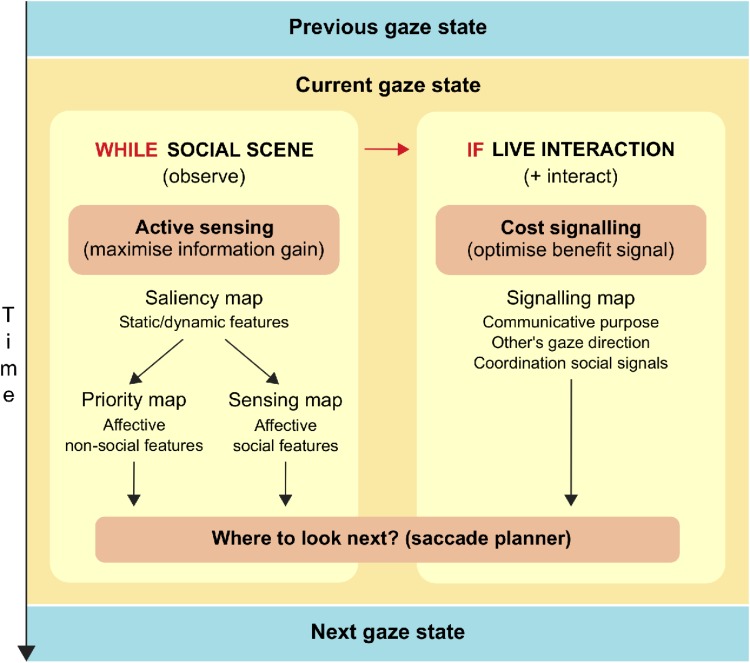
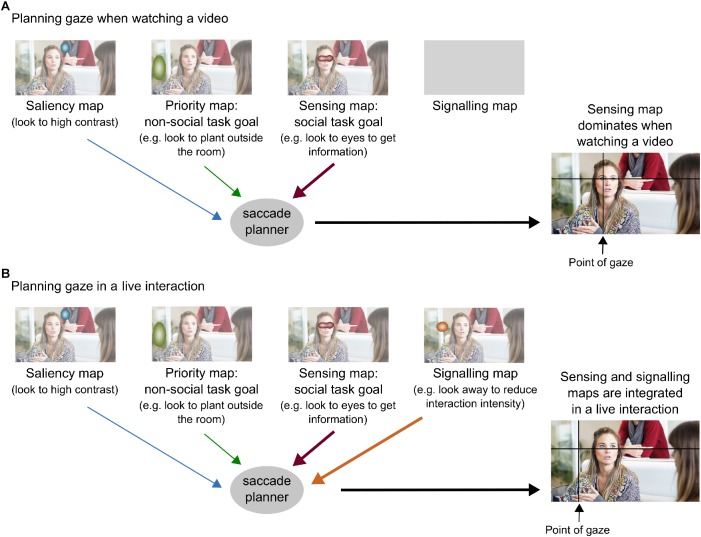
Social interactions involve complex exchanges of a variety of social signals, such as gaze, facial expressions, speech and gestures. Focusing on the dual function of eye gaze, this review explores how the presence of an audience, communicative purpose and temporal dynamics of gaze allow interacting partners to achieve successful communication. First, we focus on how being watched modulates social cognition and behavior. We then show that the study of interpersonal gaze processing, particularly gaze temporal dynamics, can provide valuable understanding of social behavior in real interactions. We propose that the Interpersonal Gaze Processing model, which combines both sensing and signaling functions of eye gaze, provides a framework to make sense of gaze patterns in live interactions. Finally, we discuss how autistic individuals process the belief in being watched and interpersonal dynamics of gaze, and suggest that systematic manipulation of factors modulating gaze signaling can reveal which aspects of social eye gaze are challenging in autism.
社交互动涉及多种社交信号的复杂交流,如目光、面部表情、言语和手势。本综述聚焦于目光注视的双重功能,探讨观众的存在、交流目的以及注视的时间动态如何使互动伙伴实现成功的沟通。首先,我们关注被注视如何调节社会认知和行为。然后我们表明,人际注视处理的研究,特别是注视的时间动态,可以为真实互动中的社会行为提供有价值的理解。我们提出,人际注视处理模型结合了目光注视的感知和信号功能,为理解实时互动中的注视模式提供了一个框架。最后,我们讨论自闭症个体如何处理被注视的信念和注视的人际动态,并表明系统地操纵调节注视信号的因素可以揭示社会目光注视在自闭症中具有挑战性的哪些方面。