Ragavendran Chinnasamy, Manigandan Venkatesan, Kamaraj Chinnaperumal, Balasubramani Govindasamy, Prakash Joy Sebastian, Perumal Pachiappan, Natarajan Devarajan
Natural Drug Research Laboratory, Department of Biotechnology, School of Biosciences, Periyar University, Salem, India.
Biomedical Zebrafish Laboratory, Department of Medical Biotechnology, Faculty of Allied Health Sciences, Chettinad Academy of Research and Education, Chennai, India.
Front Microbiol. 2019 Mar 18;10:427. doi: 10.3389/fmicb.2019.00427. eCollection 2019.
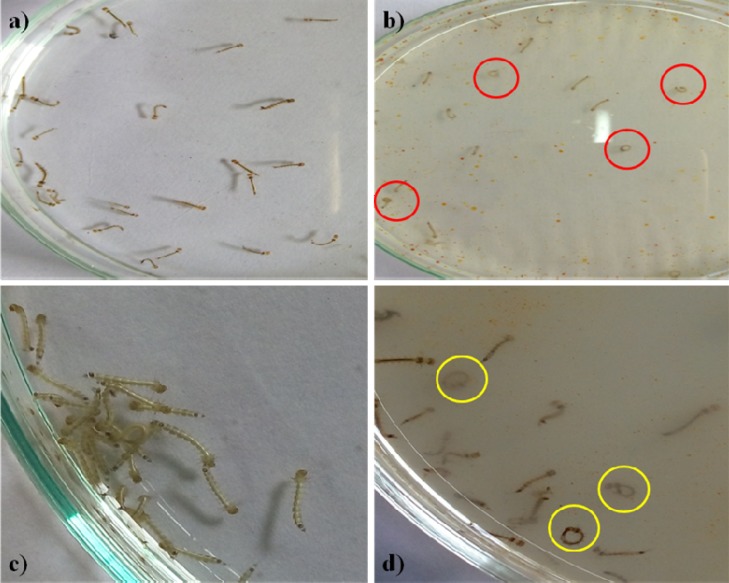
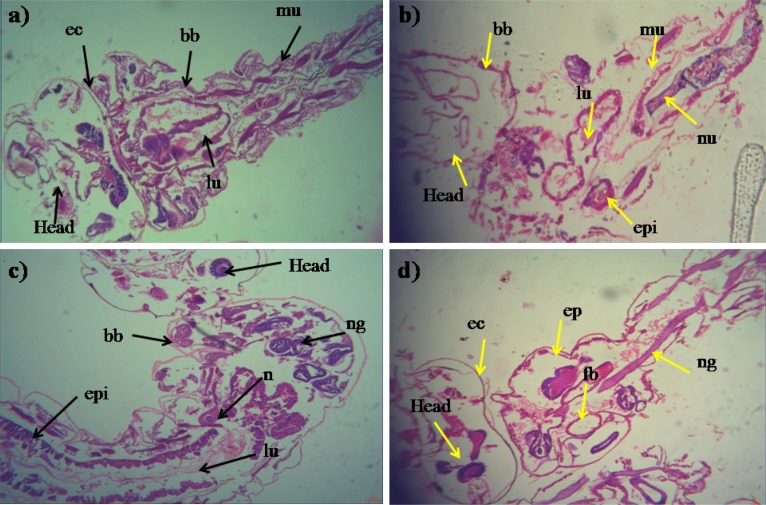
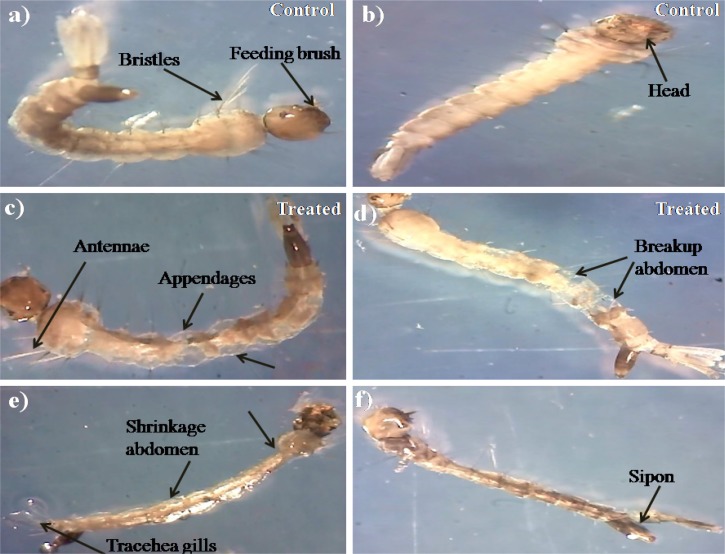
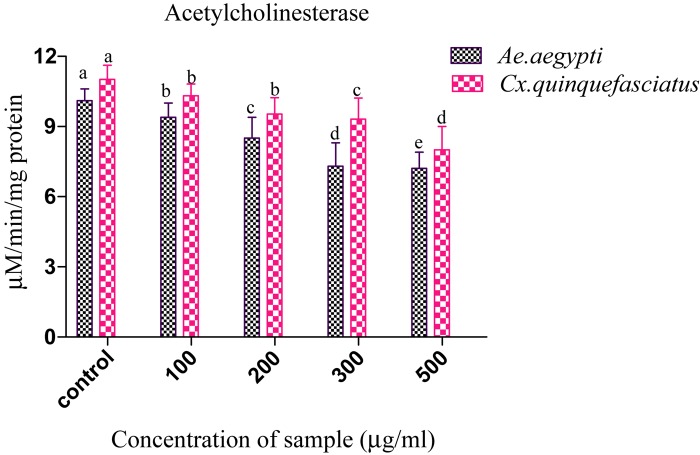
Fungal metabolites are considered to be most efficient tools to overcome the issues related to insecticide resistance and environmental pollution. The present study focus on the evaluation of the mosquito larvicidal efficacy of metabolites of seven indigenous fungal isolates ( sp. , , , sp. sp. and sp.) on the larvae of and under the laboratory condition. The preliminary screening of the isolate, sp. showed better larvicidal effect when compared to other fungi. The fungus was grown on Potato Dextrose Broth (PDB) in the laboratory (at 25°C) and maintained in the relative humidity (at 76 ± 4% for 15 days). Larvicidal potency of mycelial ethyl acetate extract (MEAE) of sp. was performed against 1st to 4th instars larvae of and using four different concentrations (100, 200, 300, and 500 μg/ml) that showed better larval mortality values (μg/ml) of LC = 6.554, 5.487, 6.874, 6.892, and the LC = 11.486, 10.366, 12.879, 13.865 for and LC = 7.000, 13.943, 18.129, 25.212 and the LC = 12.541, 23.761, 30.923, 41.696 for . Exposure of metabolite to larvae resulted in behavior changes i.e., excitation, up and down with aggressive movement, anal papillae biting behavior. Further, the larvae treated with sp. metabolite exhibited significant reduction in the levels of acetylcholinesterase. The 4th instar mosquito larvae treated with the 500 μg/ml mycelia extract showed severe histological damages. During the antibacterial analysis of sp.- mycelium the maximum growth inhibition zone was recorded in (31.2 mm) and (31.1 mm) followed by others. In addition, to check the toxicity of sp. MEAE against embryos of Zebrafish, a model system, using different concentrations of metabolites (1.0, 0.5, 0.125 mg/ml, 30, 3.0, and 0.5 μg/ml) and life-stage parameters were observed at 124 hpf. Furthermore, the Fourier Transformed Infrared and GCMS spectrum analysis of mycelium reflected several chemical compounds. The outcome of the study clearly shows that sp. metabolites could serve as an ideal eco-friendly, single-step and inexpensive source for the control of and larvae.
真菌代谢产物被认为是克服与杀虫剂抗性和环境污染相关问题的最有效工具。本研究聚焦于评估七种本土真菌分离株(种、种、种、种、种和种)的代谢产物在实验室条件下对致倦库蚊和白纹伊蚊幼虫的杀蚊幼虫效力。与其他真菌相比,分离株种的初步筛选显示出更好的杀幼虫效果。该真菌在实验室(25°C)的马铃薯葡萄糖肉汤(PDB)中培养,并在相对湿度(76±4%,持续15天)下保存。种的菌丝体乙酸乙酯提取物(MEAE)对致倦库蚊和白纹伊蚊1至4龄幼虫的杀幼虫效力,使用四种不同浓度(100、200、300和500μg/ml)进行测试,结果显示出较好的幼虫死亡率值(μg/ml),致倦库蚊的LC50分别为6.554、5.487、6.874、6.892,白纹伊蚊的LC50分别为11.486、10.366、12.879、13.865;致倦库蚊的LC90分别为7.000、13.943、18.129、25.212,白纹伊蚊的LC90分别为12.541、23.761、30.923、41.696。代谢产物暴露于幼虫会导致行为变化,即兴奋、上下剧烈移动、咬肛乳突行为。此外,用种代谢产物处理的幼虫乙酰胆碱酯酶水平显著降低。用500μg/ml菌丝体提取物处理的4龄蚊幼虫表现出严重的组织学损伤。在种菌丝体的抗菌分析中,在大肠杆菌(31.2mm)和金黄色葡萄球菌(31.1mm)中记录到最大生长抑制区,其次是其他菌。此外,为检测种MEAE对斑马鱼胚胎(一种模型系统)的毒性,使用不同浓度的代谢产物(1.0、0.5、0.125mg/ml、30、3.0和0.5μg/ml),并在124hpf观察生命阶段参数。此外,菌丝体的傅里叶变换红外光谱和气相色谱 - 质谱联用光谱分析反映出几种化学化合物。研究结果清楚地表明,种代谢产物可作为控制致倦库蚊和白纹伊蚊幼虫的理想生态友好、单步且廉价的来源。