University of Humanistic Studies, Kromme Nieuwegracht 29, 3512HD, Utrecht, The Netherlands.
BMC Med Ethics. 2019 Apr 5;20(1):23. doi: 10.1186/s12910-019-0361-2.
Family members do not have an official position in the practice of euthanasia and physician assisted suicide (EAS) in the Netherlands according to statutory regulations and related guidelines. However, recent empirical findings on the influence of family members on EAS decision-making raise practical and ethical questions. Therefore, the aim of this review is to explore how family members are involved in the Dutch practice of EAS according to empirical research, and to map out themes that could serve as a starting point for further empirical and ethical inquiry.
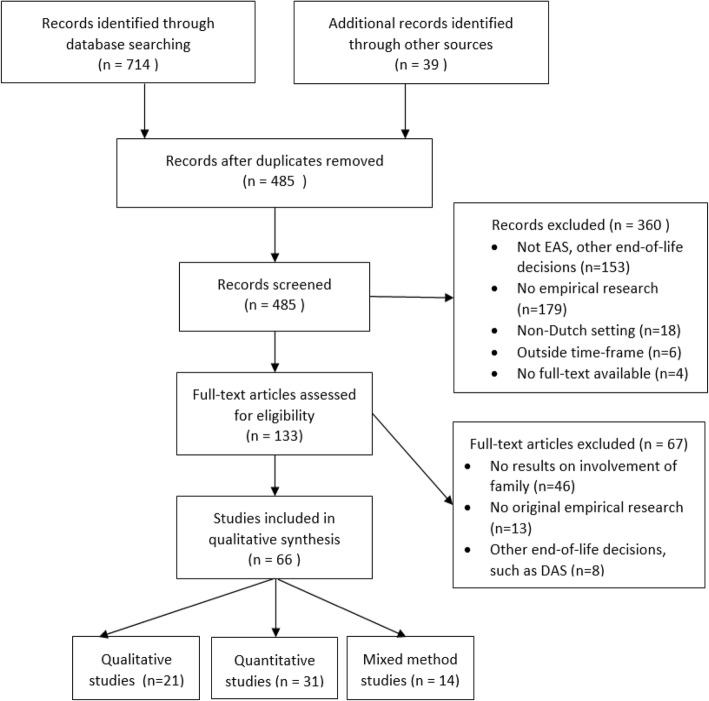
A systematic mixed studies review was performed. The databases Pubmed, Embase, PsycInfo, and Emcare were searched to identify empirical studies describing any aspect of the involvement of family members before, during and after EAS in the Netherlands from 1980 till 2018. Thematic analysis was chosen as method to synthesize the quantitative and qualitative studies.
Sixty-six studies were identified. Only 14 studies had family members themselves as study participants. Four themes emerged from the thematic analysis. 1) Family-related reasons (not) to request EAS. 2) Roles and responsibilities of family members during EAS decision-making and performance. 3) Families' experiences and grief after EAS. 4) Family and 'the good euthanasia death' according to Dutch physicians.
Family members seem to be active participants in EAS decision-making, which goes hand in hand with ambivalent feelings and experiences. Considerations about family members and the social context appear to be very important for patients and physicians when they request or grant a request for EAS. Although further empirical research is needed to assess the depth and generalizability of the results, this review provides a new perspective on EAS decision-making and challenges the Dutch ethical-legal framework of EAS. Euthanasia decision-making is typically framed in the patient-physician dyad, while a patient-physician-family triad seems more appropriate to describe what happens in clinical practice. This perspective raises questions about the interpretation of autonomy, the origins of suffering underlying requests for EAS, and the responsibilities of physicians during EAS decision-making.
根据法定法规和相关准则,在荷兰,家庭成员在安乐死和协助自杀(EAS)实践中没有正式职位。然而,最近有关家庭成员对 EAS 决策影响的实证研究结果引发了实际和伦理问题。因此,本综述的目的是根据实证研究探讨家庭成员如何参与荷兰的 EAS 实践,并制定出可以作为进一步实证和伦理探究起点的主题。
进行了系统的混合研究综述。检索了 Pubmed、Embase、PsycInfo 和 Emcare 数据库,以确定 1980 年至 2018 年间描述荷兰 EAS 之前、期间和之后家庭成员参与的任何方面的实证研究。选择主题分析作为综合定量和定性研究的方法。
确定了 66 项研究。只有 14 项研究让家庭成员自己作为研究参与者。从主题分析中出现了四个主题。1)请求 EAS 的家庭相关原因(不)。2)家庭成员在 EAS 决策制定和执行中的角色和责任。3)家庭在 EAS 后的经历和悲痛。4)家庭和荷兰医生眼中的“好安乐死死亡”。
家庭成员似乎是 EAS 决策制定的积极参与者,这与矛盾的感受和经历息息相关。在请求或批准 EAS 请求时,患者和医生似乎非常考虑家庭成员和社会背景。尽管需要进一步的实证研究来评估结果的深度和普遍性,但本综述为 EAS 决策提供了新的视角,并对荷兰 EAS 的伦理法律框架提出了挑战。安乐死决策通常在医患二人组中进行框架,而患者-医生-家庭三人组似乎更适合描述临床实践中发生的情况。这种观点引发了关于自主性的解释、EAS 请求背后痛苦的起源以及医生在 EAS 决策中的责任等问题的质疑。