School of Biological Sciences, University of Nebraska-Lincoln, Nebraska 68502
School of Biological Sciences, University of Nebraska-Lincoln, Nebraska 68502.
Genetics. 2019 Jun;212(2):537-552. doi: 10.1534/genetics.119.302052. Epub 2019 Apr 11.
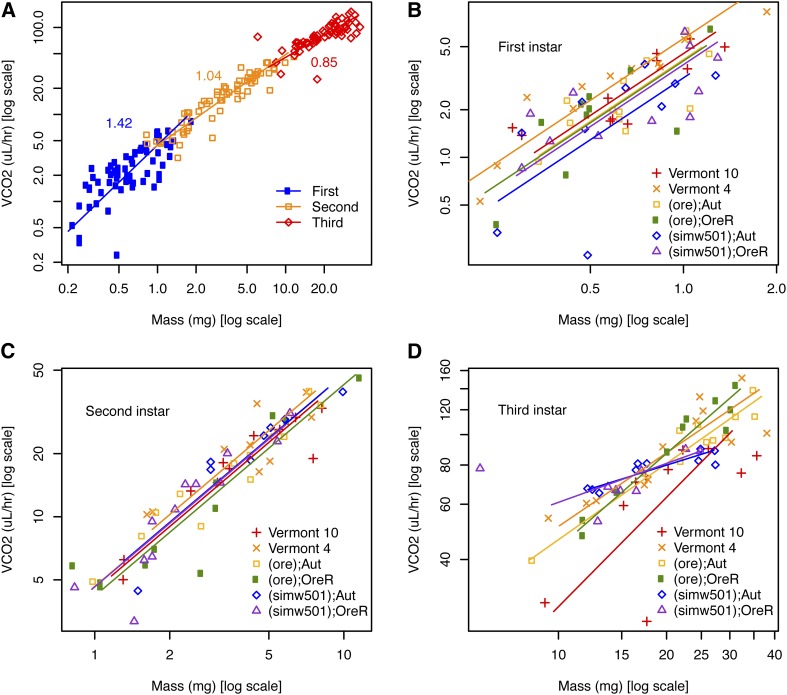
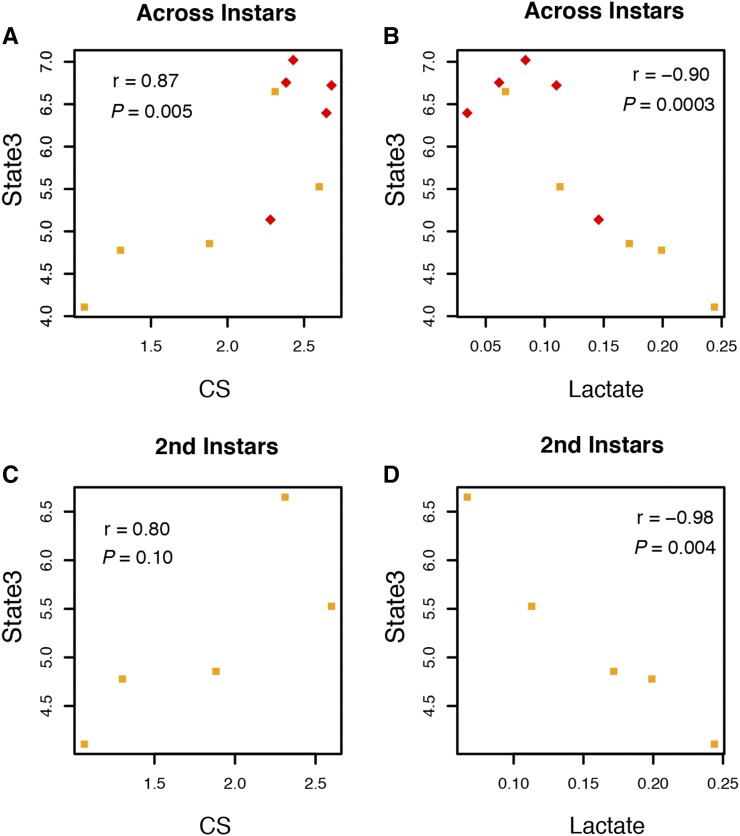
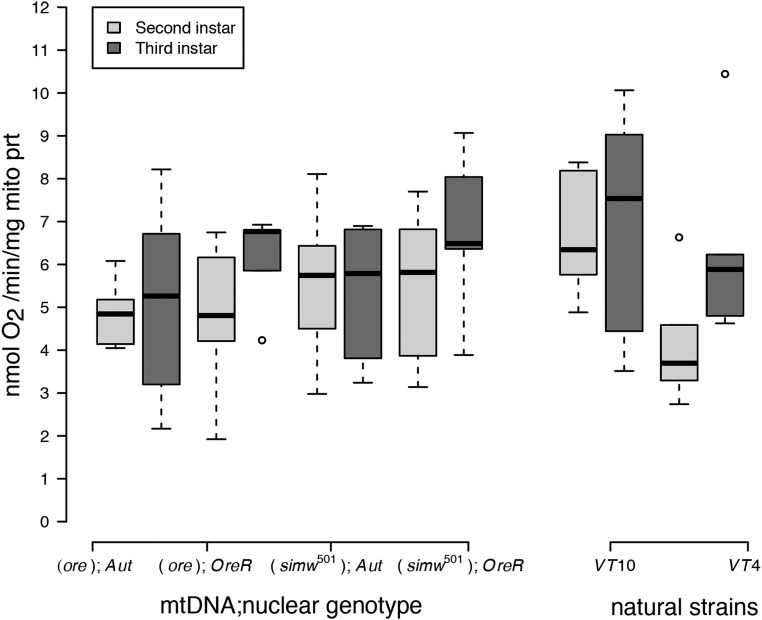
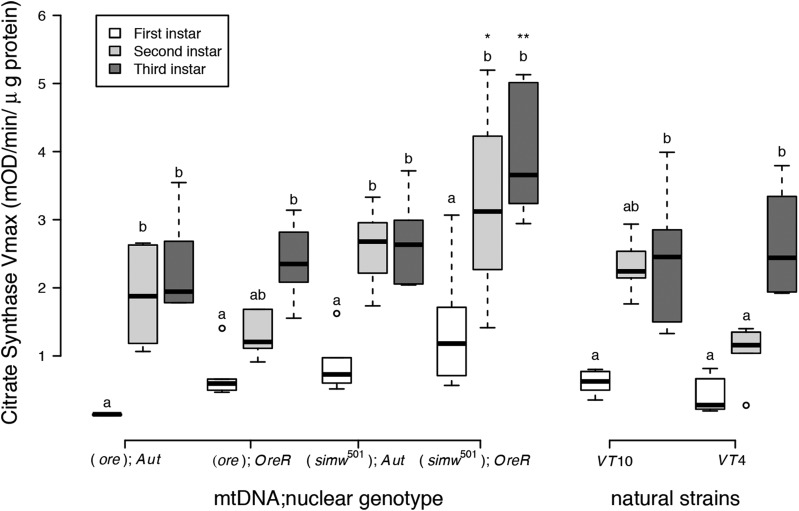
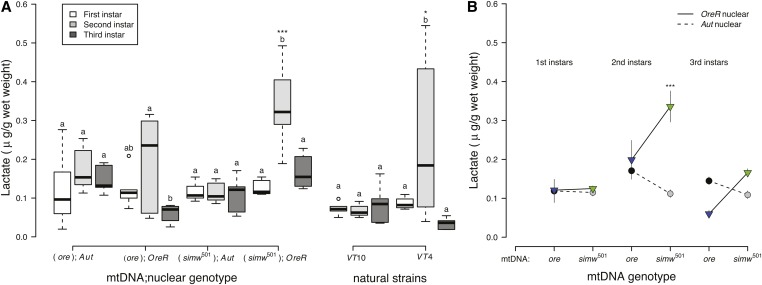
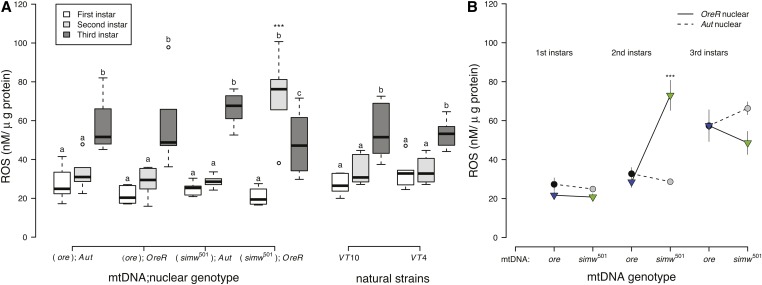
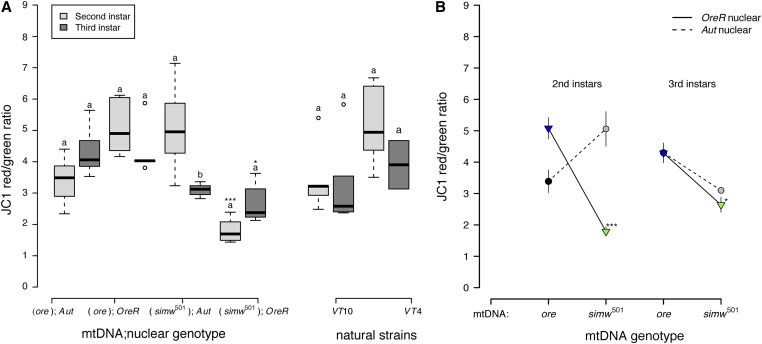
Organismal physiology emerges from metabolic pathways and subcellular structures like the mitochondria that can vary across development and among individuals. Here, we tested whether genetic variation at one level of physiology can be buffered at higher levels of biological organization during development by the inherent capacity for homeostasis in physiological systems. We found that the fundamental scaling relationship between mass and metabolic rate, as well as the oxidative capacity per mitochondria, changed significantly across development in the fruit fly However, mitochondrial respiration rate was maintained at similar levels across development. Furthermore, larvae clustered into two types-those that switched to aerobic, mitochondrial ATP production before the second instar, and those that relied on anaerobic, glycolytic production of ATP through the second instar. Despite genetic variation for the timing of this metabolic shift, metabolic rate in second-instar larvae was more robust to genetic variation than was the metabolic rate of other instars. We found that larvae with a mitochondrial-nuclear incompatibility that disrupts mitochondrial function had increased aerobic capacity and relied more on anaerobic ATP production throughout development relative to larvae from wild-type strains. By taking advantage of both ways of making ATP, larvae with this mitochondrial-nuclear incompatibility maintained mitochondrial respiratory capacity, but also had higher levels of whole-body reactive oxygen species and decreased mitochondrial membrane potential, potentially as a physiological defense mechanism. Thus, genetic defects in core physiology can be buffered at the organismal level via physiological plasticity, and natural populations may harbor genetic variation for distinct metabolic strategies in development that generate similar organismal outcomes.
生物体的生理学从代谢途径和亚细胞结构(如线粒体)中显现出来,这些结构在发育过程中会发生变化,在个体之间也会有所不同。在这里,我们测试了在发育过程中,生理系统的内在自稳态能力是否可以在一个生理水平的遗传变异在更高水平的生物组织中得到缓冲。我们发现,在果蝇的发育过程中,质量和代谢率之间的基本比例关系以及每个线粒体的氧化能力发生了显著变化。然而,线粒体呼吸速率在整个发育过程中保持在相似的水平。此外,幼虫聚类为两种类型——那些在第二龄前切换到有氧、线粒体 ATP 产生的类型,以及那些通过第二龄依赖无氧、糖酵解产生 ATP 的类型。尽管在这种代谢转变的时间上存在遗传变异,但第二龄幼虫的代谢率比其他龄期的代谢率更能耐受遗传变异。我们发现,一种线粒体-核不兼容的遗传缺陷会破坏线粒体功能,与来自野生型菌株的幼虫相比,这种幼虫具有更高的有氧能力,并在整个发育过程中更依赖无氧 ATP 产生。通过利用两种产生 ATP 的方式,具有这种线粒体-核不兼容的幼虫保持了线粒体呼吸能力,但也具有更高水平的全身活性氧和降低的线粒体膜电位,这可能是一种生理防御机制。因此,核心生理学中的遗传缺陷可以通过生理可塑性在机体水平上得到缓冲,并且自然种群可能在发育过程中具有不同代谢策略的遗传变异,从而产生相似的机体结果。