Division of Allergy and Infectious Diseases, University of Washington, Seattle, WA, United States; Vaccine and Infectious Disease Division, Fred Hutchinson Cancer Research Center, Seattle, WA, United States.
Division of Allergy and Infectious Diseases, University of Washington, Seattle, WA, United States; Vaccine and Infectious Disease Division, Fred Hutchinson Cancer Research Center, Seattle, WA, United States; Clinical Research Division, Fred Hutchinson Cancer Research Center, Seattle, WA, United States.
J Clin Virol. 2019 Jun;115:43-46. doi: 10.1016/j.jcv.2019.04.001. Epub 2019 Apr 4.
Early and accurate detection of respiratory viruses (RV) is important for patient management. We have previously shown that self-collected nasal swabs (NS) are feasible and as sensitive as clinician-collected nasal washes for detection of RV, but the additive benefit of self-collected throat swabs is unknown.
To evaluate the added yield of self-collected nasal to throat swabs for detection of RV by PCR in patients with upper respiratory tract infection (URTI) symptoms.
Patients with URTI symptoms self-collected paired polyurethane foam NS and nylon flocked throat swabs and completed a symptom survey. Swabs were tested for 12 RV by real-time reverse transcription (RT)-PCR. Descriptive, McNemar's, and Wilcoxon signed rank statistical tests were used.
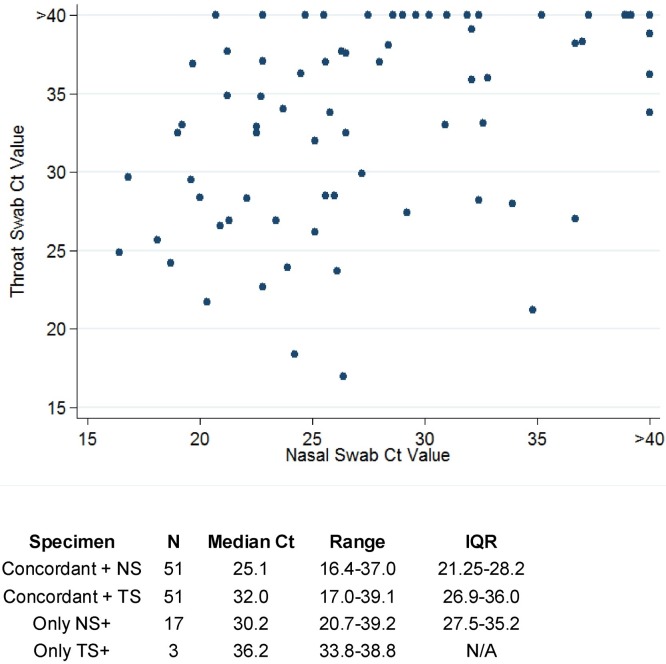
115 paired nasal and throat swabs were collected from 63 individuals, with 71/115 (62%) positive for a RV by at least one specimen, including 51 positive by both, 17 positive by NS only, and 3 positive by throat swab only. The sensitivity of NS was 96% (95%CI: 88-99) versus 76% (95% CI: 65-85) in throat swabs, p<0.001. The median PCR cycle threshold (Ct) in 51 concordant samples was lower (indicating higher viral concentration) in NS (25.1) versus throat swabs (32.0). The three samples positive only by throat swab had high Ct values (33.8, 36.2, and 38.8, all rhinovirus).
Self-collection of NS was significantly more sensitive than self collection of throat swabs for detection of RV by RT-PCR. The addition of throat sampling does not appear to increase the diagnostic load in the self-testing setting.
早期准确地检测呼吸道病毒(RV)对患者管理非常重要。我们之前已经表明,自我采集的鼻腔拭子(NS)与临床医生采集的鼻腔洗液一样,对于 RV 的检测具有可行性和敏感性,但自我采集的咽喉拭子的附加收益尚不清楚。
评估自我采集的鼻腔到咽喉拭子对呼吸道感染(URTI)症状患者 RV 检测的 PCR 检测的附加价值。
URTI 症状患者自我采集成对的聚氨酯泡沫 NS 和尼龙植绒咽喉拭子,并完成症状调查。拭子通过实时逆转录(RT)-PCR 检测 12 种 RV。使用描述性、McNemar's 和 Wilcoxon 符号秩检验进行统计分析。
从 63 名个体中采集了 115 对 NS 和咽喉拭子,其中 71/115(62%)至少有一种标本检测到 RV 阳性,包括 51 种 NS 和咽喉拭子均阳性,17 种 NS 阳性,3 种仅咽喉拭子阳性。NS 的敏感性为 96%(95%CI:88-99),而咽喉拭子为 76%(95%CI:65-85),p<0.001。51 个一致样本的中位 PCR 循环阈值(Ct)在 NS(25.1)中低于咽喉拭子(32.0),表明病毒浓度更高。仅通过咽喉拭子检测阳性的三个样本的 Ct 值较高(33.8、36.2 和 38.8,均为鼻病毒)。
自我采集 NS 比自我采集咽喉拭子用于 RT-PCR 检测 RV 的敏感性更高。在自我检测环境中,增加咽喉采样似乎不会增加诊断负担。