Trang Trinh Thi, Hung Nguyen Huu, Ninh Nguyen Huu, Knibb Wayne, Nguyen Nguyen Hong
Faculty of Science, Health, Education and engineering, GeneCology Research Centre, University of the Sunshine Coast, Maroochydore, QLD, Australia.
Vietnam National University of Agriculture, Gia Lâm, Vietnam.
Front Genet. 2019 Mar 28;10:264. doi: 10.3389/fgene.2019.00264. eCollection 2019.
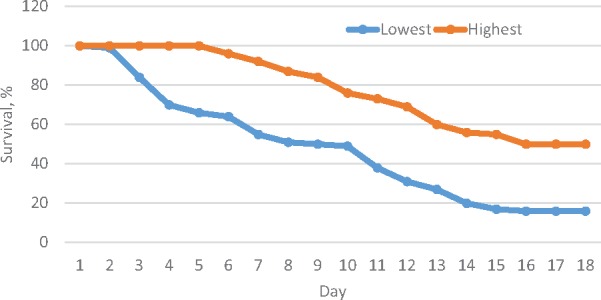
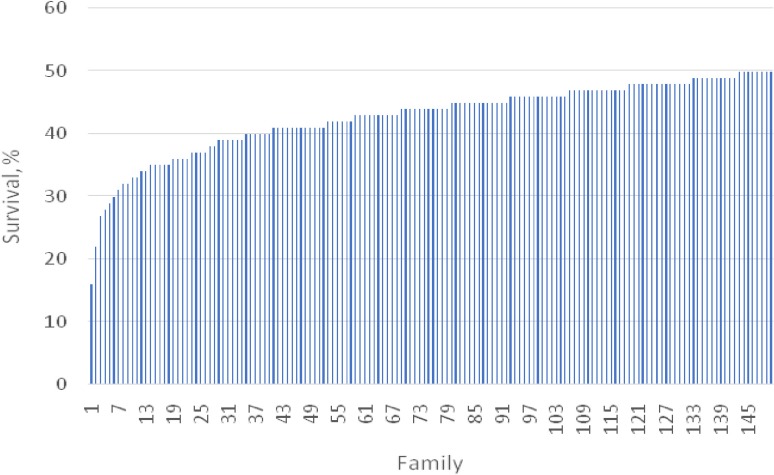
White Spot Syndrome Virus (WSSV) is the most damaging pathogen in terms of production and economic losses for the shrimp sector world-wide. Estimation of heritability for WSSV resistance was made in this study to obtain necessary parameter inputs for broadening the breeding objectives of an ongoing selective breeding programme for Whiteleg shrimp () that has focussed exclusively on improving growth performance since 2014. The present study involved a disease challenge test experiment using a total of 15,000 shrimps from 150 full- and half-sib families (100 individuals per family). Survival rates were recorded at six different experimental periods: 1-3 days (S1), 1-5 days (S2), 1-7 days (S3), 1-9 days (S4), 1-12 days (S5), and 1-15 days (S6) and were used as measures of WSSV resistance. There was significant variation in WSSV resistance among families studied. Quantitative-real time PCR (qPCR) analysis showed that the amount of viral titer (viral load) was significantly lower in high than low resistance families. Analyses of heritability were carried out using linear mixed model (LMM) and threshold logistic generalized model (TLGM). Both linear and threshold models used showed that the heritability (h) for WSSV resistance was moderate in the early infection phases (S1-S4), whilst a low h value was observed for survival after 12 and 15 days of the challenge test (S5 and S6). The transformed heritabilities for WSSV resistance ranged from 1 to 31% which were somewhat lower than those estimated on the liability scale. Genetic correlations between survival rates measured over six different days post-infection were high and positive (0.82-0.99). The phenotypic correlations ranged from 0.31 ± 0.01 to 0.97 ± 0.01. The genetic correlations between body weights and WSSV resistance were negative. Our results on the heritability and genetic correlations show that improvement of WSSV resistance can be achieved through selective breeding in this population of Whiteleg shrimp.
就全球对虾养殖业的产量和经济损失而言,白斑综合征病毒(WSSV)是危害最大的病原体。本研究对凡纳滨对虾抗WSSV的遗传力进行了估计,以便获得必要的参数输入,从而扩大自2014年以来一直专注于提高生长性能的凡纳滨对虾(Litopenaeus vannamei)现行选择性育种计划的育种目标。本研究进行了一项疾病攻毒试验,使用了来自150个全同胞和半同胞家系的总共15000只虾(每个家系100只个体)。在六个不同的试验阶段记录存活率:1 - 3天(S1)、1 - 5天(S2)、1 - 7天(S3)、1 - 9天(S4)、1 - 12天(S5)和1 - 15天(S6),并将其用作抗WSSV的指标。在所研究的家系中,抗WSSV能力存在显著差异。定量实时PCR(qPCR)分析表明,高抗性家系的病毒滴度(病毒载量)显著低于低抗性家系。使用线性混合模型(LMM)和阈值逻辑广义模型(TLGM)进行遗传力分析。所使用的线性模型和阈值模型均表明,在早期感染阶段(S1 - S4),抗WSSV的遗传力(h)为中等,而在攻毒试验12天和15天后的存活率方面观察到较低的h值(S5和S6)。抗WSSV的转化遗传力范围为1%至31%,略低于在易感性尺度上估计的值。感染后六个不同日期测得的存活率之间的遗传相关性高且为正(0.82 - 0.99)。表型相关性范围为0.31±0.01至0.97±0.01。体重与抗WSSV能力之间的遗传相关性为负。我们关于遗传力和遗传相关性的结果表明,通过对该凡纳滨对虾群体进行选择性育种,可以实现抗WSSV能力的提高。