University of Tübingen, Institute of Medical Psychology and Behavioral Neurobiology, Silcherstr. 5, 72076 Tübingen, Germany.
Princeton Neuroscience Institute, Princeton University, Washington Road, Princeton, NJ 08544, USA.
Sci Adv. 2019 Apr 24;5(4):eaav1695. doi: 10.1126/sciadv.aav1695. eCollection 2019 Apr.
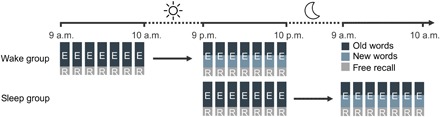
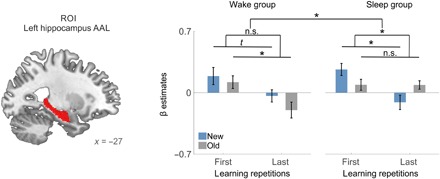
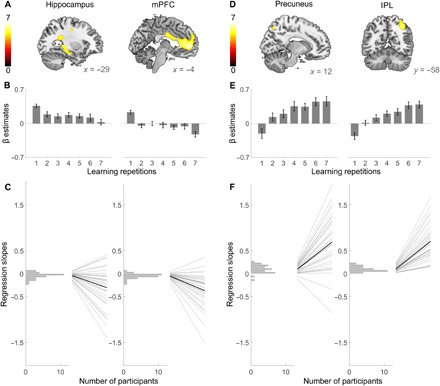
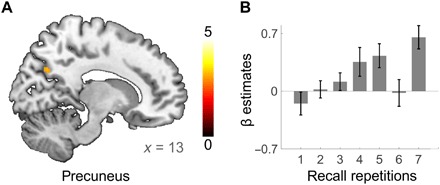
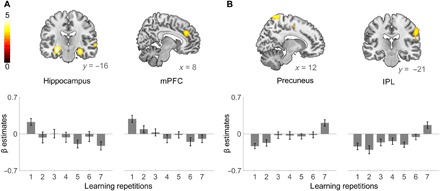
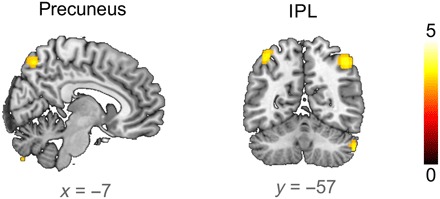
After encoding, memories undergo a transitional process termed systems memory consolidation. It allows fast acquisition of new information by the hippocampus, as well as stable storage in neocortical long-term networks, where memory is protected from interference. Whereas this process is generally thought to occur slowly over time and sleep, we recently found a rapid memory systems transition from hippocampus to posterior parietal cortex (PPC) that occurs over repeated rehearsal within one study session. Here, we use fMRI to demonstrate that this transition is stabilized over sleep, whereas wakefulness leads to a reset to naïve responses, such as observed during early encoding. The role of sleep therefore seems to go beyond providing additional rehearsal through memory trace reactivation, as previously thought. We conclude that repeated study induces systems consolidation, while sleep ensures that these transformations become stable and long lasting. Thus, sleep and repeated rehearsal jointly contribute to long-term memory consolidation.
编码后,记忆会经历一个被称为系统记忆巩固的过渡过程。它允许海马体快速获取新信息,并将其稳定存储在新皮质的长期网络中,从而使记忆免受干扰。虽然这个过程通常被认为是随着时间和睡眠而缓慢发生的,但我们最近发现,在一次学习过程中,记忆系统会从海马体快速转移到后顶叶皮层(PPC)。在这里,我们使用 fMRI 来证明,这种转变在睡眠中是稳定的,而在清醒状态下则会导致向幼稚反应的重置,就像在早期编码期间观察到的那样。因此,睡眠的作用似乎不仅仅是通过记忆痕迹的重新激活来提供额外的练习,就像之前认为的那样。我们得出的结论是,反复学习会诱导系统巩固,而睡眠则确保这些转变变得稳定和持久。因此,睡眠和反复的练习共同促进了长期记忆的巩固。