
中国老年人群夜间-日间睡眠模式与慢性病的关系:一项基于社区的横断面研究。
Association between nighttime-daytime sleep patterns and chronic diseases in Chinese elderly population: a community-based cross-sectional study.
机构信息
Hongqiao International Institute of Medicine, Shanghai Tongren Hospital & Faculty of Public Health, Shanghai Jiao Tong University School of Medicine, No. 227, South Chongqing Road, Shanghai, 200025, China.
Clinical research center, Shanghai Jiao Tong University School of Medicine, No. 227, South Chongqing Road, Shanghai, 200025, China.
出版信息
BMC Geriatr. 2019 Apr 29;19(1):124. doi: 10.1186/s12877-019-1136-9.
BACKGROUND
This study aimed to assess the relationship between specific nighttime-daytime sleep patterns and prevalence of different chronic diseases in an elderly population.
METHODS
We conducted a community-based cross-sectional study in 4150 elderly Chinese, with an average age of 74 years. Sleep-related variables (nighttime sleep duration, daytime napping and duration) and chronic disease status, including diabetes, cardiovascular diseases (CVD), dyslipidemia cancer and arthritis were collected for the study. Multivariable logistic regression models were used to analyze the relationship between nighttime-daytime sleep patterns and prevalence of chronic diseases.
RESULTS
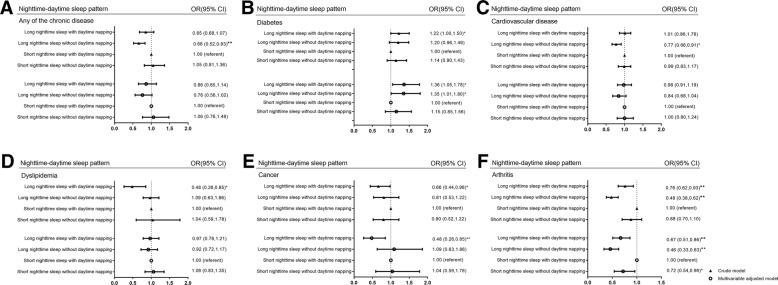
Overall prevalence of any of chronic diseases was 83.8%. Nighttime-daytime sleep patterns were defined according to nighttime sleep duration and habitual nappers/non-nappers. Taking the nighttime-daytime sleep pattern "short nighttime sleep with daytime napping" as reference, those with "long nighttime sleep without daytime napping" had higher prevalence of diabetes [OR and 95% CI, 1.35 (1.01-1.80)] and lower prevalence of arthritis [OR and 95% CI, 0.46 (0.33-0.63)]. And those with "long nighttime sleep with daytime napping" had higher prevalence of diabetes [OR and 95% CI, 1.36 (1.05-1.78)] while lower prevalence of cancer [OR and 95% CI, 0.48 (0.26-0.85)] and arthritis [OR and 95% CI, 0.67 (0.51-0.86)]. Further, in habitual nappers, subjects were classified according to duration of nighttime sleep and daytime naps. Compared to "short nighttime sleep with long daytime napping", individuals with "long nighttime sleep with short daytime napping" had significantly positive association with diabetes prevalence [OR and 95% CI, 1.73 (1.15-2.68)] while border-significantly and significantly negative association with cancer [OR and 95% CI, 0.49 (0.23-1.07)] and arthritis [OR and 95% CI, 0.64 (0.44-0.94)], respectively.
CONCLUSIONS
Elderly individuals with chronic diseases had different nighttime-daytime sleep patterns, and understanding these relationships may help to guide the management of chronic diseases.
背景
本研究旨在评估老年人中特定的夜间-日间睡眠模式与多种慢性疾病患病率之间的关系。
方法
我们在中国 4150 名老年人中进行了一项基于社区的横断面研究,平均年龄为 74 岁。收集了与睡眠相关的变量(夜间睡眠时间、日间小睡及时间)和慢性疾病状况,包括糖尿病、心血管疾病(CVD)、血脂异常、癌症和关节炎。多变量逻辑回归模型用于分析夜间-日间睡眠模式与慢性疾病患病率之间的关系。
结果
总体上,任何慢性疾病的患病率为 83.8%。根据夜间睡眠时间和习惯性小睡者/非小睡者来定义夜间-日间睡眠模式。以“夜间短睡伴日间小睡”的睡眠模式为参考,“夜间长睡且不日间小睡”者糖尿病患病率较高[比值比和 95%置信区间,1.35(1.01-1.80)],关节炎患病率较低[比值比和 95%置信区间,0.46(0.33-0.63)]。而“夜间长睡伴日间小睡”者糖尿病患病率较高[比值比和 95%置信区间,1.36(1.05-1.78)],癌症患病率较低[比值比和 95%置信区间,0.48(0.26-0.85)],关节炎患病率较低[比值比和 95%置信区间,0.67(0.51-0.86)]。此外,在习惯性小睡者中,根据夜间睡眠时间和日间小睡时间进一步分类。与“夜间短睡伴日间长小睡”相比,“夜间长睡伴日间短小睡”者糖尿病患病率显著升高[比值比和 95%置信区间,1.73(1.15-2.68)],而癌症患病率有边界显著性降低[比值比和 95%置信区间,0.49(0.23-1.07)],关节炎患病率显著降低[比值比和 95%置信区间,0.64(0.44-0.94)]。
结论
患有慢性疾病的老年人有不同的夜间-日间睡眠模式,了解这些关系可能有助于指导慢性疾病的管理。


 Zotero 插件