• 文献检索
  • 文档翻译
  • 深度研究
  • 学术资讯
  • Suppr Zotero 插件Zotero 插件
  • 邀请有礼
  • 套餐&价格
  • 历史记录
应用&插件
Suppr Zotero 插件Zotero 插件浏览器插件Mac 客户端Windows 客户端微信小程序
定价
高级版会员购买积分包购买API积分包
服务
文献检索文档翻译深度研究API 文档MCP 服务
关于我们
关于 Suppr公司介绍联系我们用户协议隐私条款
关注我们

Suppr 超能文献

核心技术专利:CN118964589B侵权必究
粤ICP备2023148730 号-1Suppr @ 2026

文献检索

告别复杂PubMed语法,用中文像聊天一样搜索,搜遍4000万医学文献。AI智能推荐,让科研检索更轻松。

立即免费搜索

文件翻译

保留排版,准确专业,支持PDF/Word/PPT等文件格式,支持 12+语言互译。

免费翻译文档

深度研究

AI帮你快速写综述,25分钟生成高质量综述,智能提取关键信息,辅助科研写作。

立即免费体验

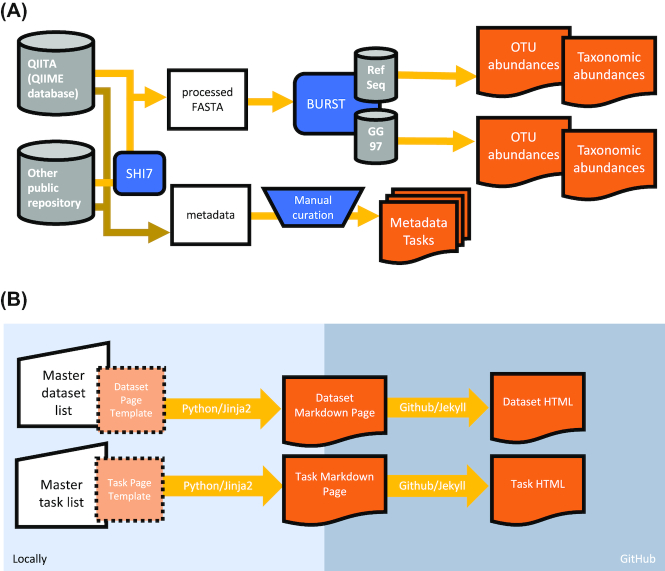
微生物组学习资源库(ML Repo):一个公开的微生物组回归和分类任务资源库。

Microbiome Learning Repo (ML Repo): A public repository of microbiome regression and classification tasks.

机构信息

Bioinformatics and Computational Biology, University of Minnesota, 200 Union Street SE, Minneapolis, MN 55455.

Department of Computer Science and Engineering, University of Minnesota, 200 Union Street SE, Minneapolis, MN 55455.

出版信息

Gigascience. 2019 May 1;8(5). doi: 10.1093/gigascience/giz042.

DOI:10.1093/gigascience/giz042
PMID:31042284
原文链接:https://pmc.ncbi.nlm.nih.gov/articles/PMC6493971/
Abstract

The use of machine learning in high-dimensional biological applications, such as the human microbiome, has grown exponentially in recent years, but algorithm developers often lack the domain expertise required for interpretation and curation of the heterogeneous microbiome datasets. We present Microbiome Learning Repo (ML Repo, available at https://knights-lab.github.io/MLRepo/), a public, web-based repository of 33 curated classification and regression tasks from 15 published human microbiome datasets. We highlight the use of ML Repo in several use cases to demonstrate its wide application, and we expect it to be an important resource for algorithm developers.

摘要

近年来,机器学习在人类微生物组等高维生物学应用中的使用呈指数级增长,但算法开发人员通常缺乏解释和管理异质微生物组数据集所需的领域专业知识。我们介绍了微生物组学习资源库 (ML Repo,可在 https://knights-lab.github.io/MLRepo/ 上获得),这是一个公共的基于网络的存储库,其中包含来自 15 个已发布的人类微生物组数据集的 33 个经过精心整理的分类和回归任务。我们强调了在几个用例中使用 ML Repo 的情况,以展示其广泛的应用,我们希望它成为算法开发人员的重要资源。
https://cdn.ncbi.nlm.nih.gov/pmc/blobs/e579/6493971/c39d242eb99f/giz042fig5.jpg
https://cdn.ncbi.nlm.nih.gov/pmc/blobs/e579/6493971/4988669a9fd2/giz042fig1.jpg
https://cdn.ncbi.nlm.nih.gov/pmc/blobs/e579/6493971/f660006f8ed3/giz042fig2.jpg
https://cdn.ncbi.nlm.nih.gov/pmc/blobs/e579/6493971/d89b4cc284db/giz042fig3.jpg
https://cdn.ncbi.nlm.nih.gov/pmc/blobs/e579/6493971/c603b1acff63/giz042fig4.jpg
https://cdn.ncbi.nlm.nih.gov/pmc/blobs/e579/6493971/c39d242eb99f/giz042fig5.jpg
https://cdn.ncbi.nlm.nih.gov/pmc/blobs/e579/6493971/4988669a9fd2/giz042fig1.jpg
https://cdn.ncbi.nlm.nih.gov/pmc/blobs/e579/6493971/f660006f8ed3/giz042fig2.jpg
https://cdn.ncbi.nlm.nih.gov/pmc/blobs/e579/6493971/d89b4cc284db/giz042fig3.jpg
https://cdn.ncbi.nlm.nih.gov/pmc/blobs/e579/6493971/c603b1acff63/giz042fig4.jpg
https://cdn.ncbi.nlm.nih.gov/pmc/blobs/e579/6493971/c39d242eb99f/giz042fig5.jpg

相似文献

1
Microbiome Learning Repo (ML Repo): A public repository of microbiome regression and classification tasks.微生物组学习资源库(ML Repo):一个公开的微生物组回归和分类任务资源库。
Gigascience. 2019 May 1;8(5). doi: 10.1093/gigascience/giz042.
2
mAML: an automated machine learning pipeline with a microbiome repository for human disease classification.mAML:一个带有微生物组库的自动化机器学习管道,用于人类疾病分类。
Database (Oxford). 2020 Jan 1;2020. doi: 10.1093/database/baaa050.
3
MITRE: inferring features from microbiota time-series data linked to host status.麻省理工学院:从与宿主状态相关的微生物组时间序列数据中推断特征。
Genome Biol. 2019 Sep 2;20(1):186. doi: 10.1186/s13059-019-1788-y.
4
Gene-based microbiome representation enhances host phenotype classification.基于基因的微生物组表示增强了宿主表型分类。
mSystems. 2023 Aug 31;8(4):e0053123. doi: 10.1128/msystems.00531-23. Epub 2023 Jul 5.
5
TADA: phylogenetic augmentation of microbiome samples enhances phenotype classification.TADA:微生物组样本的系统发育增强可提高表型分类。
Bioinformatics. 2019 Jul 15;35(14):i31-i40. doi: 10.1093/bioinformatics/btz394.
6
A repository of microbial marker genes related to human health and diseases for host phenotype prediction using microbiome data.一个与人类健康和疾病相关的微生物标记基因库,用于利用微生物组数据预测宿主表型。
Pac Symp Biocomput. 2019;24:236-247.
7
SKIOME Project: a curated collection of skin microbiome datasets enriched with study-related metadata.SKIOME 项目:一个经过策展的皮肤微生物组数据集集合,其中包含丰富的与研究相关的元数据。
Database (Oxford). 2022 May 16;2022. doi: 10.1093/database/baac033.
8
DeepMicro: deep representation learning for disease prediction based on microbiome data.深微:基于微生物组数据的疾病预测的深度学习表示。
Sci Rep. 2020 Apr 7;10(1):6026. doi: 10.1038/s41598-020-63159-5.
9
Taxonomy-aware feature engineering for microbiome classification.基于分类学的微生物组分类特征工程。
BMC Bioinformatics. 2018 Jun 15;19(1):227. doi: 10.1186/s12859-018-2205-3.
10
RMTL: an R library for multi-task learning.RMTL:一个用于多任务学习的 R 库。
Bioinformatics. 2019 May 15;35(10):1797-1798. doi: 10.1093/bioinformatics/bty831.

引用本文的文献

1
Exploring the role of normalization and feature selection in microbiome disease classification pipelines.探索标准化和特征选择在微生物组疾病分类流程中的作用。
Gigascience. 2025 Jan 6;14. doi: 10.1093/gigascience/giaf096.
2
Large-scale classification of metagenomic samples: a comparative analysis of classical machine learning techniques vs a novel brain-inspired hyperdimensional computing approach.宏基因组样本的大规模分类:经典机器学习技术与新型脑启发式高维计算方法的比较分析
bioRxiv. 2025 Jul 7:2025.07.06.663394. doi: 10.1101/2025.07.06.663394.
3
CODARFE: Unlocking the prediction of continuous environmental variables based on microbiome.

本文引用的文献

1
Qiita: rapid, web-enabled microbiome meta-analysis.Qiita:快速、支持网络的微生物组元分析。
Nat Methods. 2018 Oct;15(10):796-798. doi: 10.1038/s41592-018-0141-9. Epub 2018 Oct 1.
2
SHI7 Is a Self-Learning Pipeline for Multipurpose Short-Read DNA Quality Control.SHI7是一种用于多用途短读长DNA质量控制的自学习流程。
mSystems. 2018 Apr 24;3(3). doi: 10.1128/mSystems.00202-17. eCollection 2018 May-Jun.
3
Meta-analysis of gut microbiome studies identifies disease-specific and shared responses.基于宏基因组关联研究的肠道微生物组分析鉴定出疾病特异性和共享反应。
CODARFE:基于微生物组实现对连续环境变量的预测
Gigascience. 2025 Jan 6;14. doi: 10.1093/gigascience/giaf055.
4
The mycobiome in human cancer: analytical challenges, molecular mechanisms, and therapeutic implications.人类癌症中的真菌群落:分析挑战、分子机制及治疗意义。
Mol Cancer. 2025 Jan 15;24(1):18. doi: 10.1186/s12943-025-02227-8.
5
MicroHDF: predicting host phenotypes with metagenomic data using a deep forest-based framework.MicroHDF:基于深度森林框架利用宏基因组数据预测宿主表型。
Brief Bioinform. 2024 Sep 23;25(6). doi: 10.1093/bib/bbae530.
6
Maternal oral probiotic use is associated with decreased breastmilk inflammatory markers, infant fecal microbiome variation, and altered recognition memory responses in infants-a pilot observational study.孕妇口服益生菌与母乳炎症标志物减少、婴儿粪便微生物群变化以及婴儿识别记忆反应改变相关——一项初步观察性研究。
Front Nutr. 2024 Sep 25;11:1456111. doi: 10.3389/fnut.2024.1456111. eCollection 2024.
7
Microbiome signature suggestive of lactose-intolerance in rhesus macaques (Macaca mulatta) with intermittent chronic diarrhea.恒河猴(猕猴)间歇性慢性腹泻中提示乳糖不耐受的微生物群特征
Anim Microbiome. 2024 Sep 23;6(1):53. doi: 10.1186/s42523-024-00338-z.
8
Parallel-Meta Suite: Interactive and rapid microbiome data analysis on multiple platforms.并行元分析套件:多平台交互式快速微生物组数据分析
Imeta. 2022 Mar 6;1(1):e1. doi: 10.1002/imt2.1. eCollection 2022 Mar.
9
Interpretable metric learning in comparative metagenomics: The adaptive Haar-like distance.比较宏基因组学中的可解释度量学习:自适应 Haar 样距离。
PLoS Comput Biol. 2024 May 20;20(5):e1011543. doi: 10.1371/journal.pcbi.1011543. eCollection 2024 May.
10
A primer on the use of machine learning to distil knowledge from data in biological psychiatry.机器学习在生物精神病学中从数据中提取知识的基础教程。
Mol Psychiatry. 2024 Feb;29(2):387-401. doi: 10.1038/s41380-023-02334-2. Epub 2024 Jan 4.
Nat Commun. 2017 Dec 5;8(1):1784. doi: 10.1038/s41467-017-01973-8.
4
Accessible, curated metagenomic data through ExperimentHub.通过ExperimentHub获取经过整理的可访问宏基因组数据。
Nat Methods. 2017 Oct 31;14(11):1023-1024. doi: 10.1038/nmeth.4468.
5
mockrobiota: a Public Resource for Microbiome Bioinformatics Benchmarking.微生物群落模拟物:微生物组生物信息学基准测试的公共资源。
mSystems. 2016 Oct 18;1(5). doi: 10.1128/mSystems.00062-16. eCollection 2016 Sep-Oct.
6
Looking for a Signal in the Noise: Revisiting Obesity and the Microbiome.从噪音中寻找信号:重新审视肥胖与微生物群
mBio. 2016 Aug 23;7(4):e01018-16. doi: 10.1128/mBio.01018-16.
7
Machine Learning Meta-analysis of Large Metagenomic Datasets: Tools and Biological Insights.大型宏基因组数据集的机器学习荟萃分析:工具与生物学见解
PLoS Comput Biol. 2016 Jul 11;12(7):e1004977. doi: 10.1371/journal.pcbi.1004977. eCollection 2016 Jul.
8
HPMCD: the database of human microbial communities from metagenomic datasets and microbial reference genomes.HPMCD:来自宏基因组数据集和微生物参考基因组的人类微生物群落数据库。
Nucleic Acids Res. 2016 Jan 4;44(D1):D604-9. doi: 10.1093/nar/gkv1216. Epub 2015 Nov 17.
9
Reference sequence (RefSeq) database at NCBI: current status, taxonomic expansion, and functional annotation.美国国立生物技术信息中心的参考序列(RefSeq)数据库:当前状态、分类扩展及功能注释。
Nucleic Acids Res. 2016 Jan 4;44(D1):D733-45. doi: 10.1093/nar/gkv1189. Epub 2015 Nov 8.
10
Machine learning: Trends, perspectives, and prospects.机器学习:趋势、观点和展望。
Science. 2015 Jul 17;349(6245):255-60. doi: 10.1126/science.aaa8415.