Department of Health Sciences, Università degli Studi di Milano, Milan, Italy.
Institute of Biomedical Technologies, National Research Council, Segrate, Italy.
Front Cell Infect Microbiol. 2019 Apr 16;9:101. doi: 10.3389/fcimb.2019.00101. eCollection 2019.
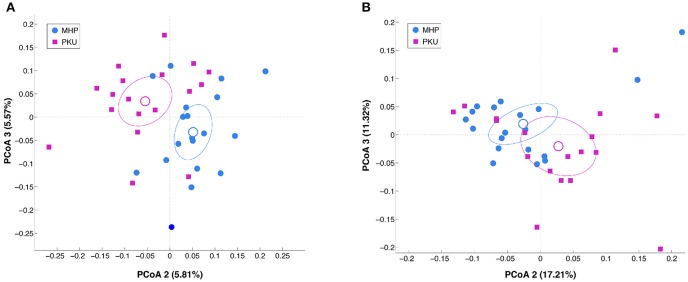
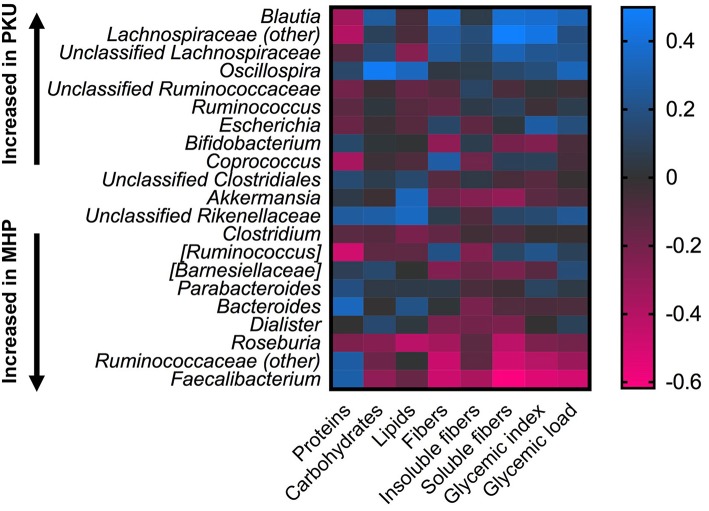
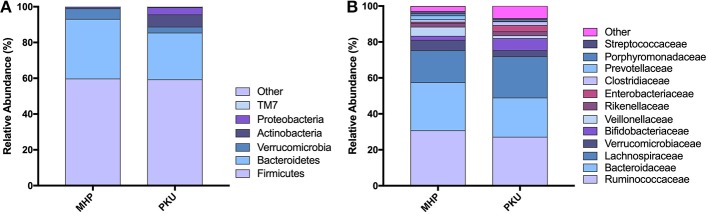
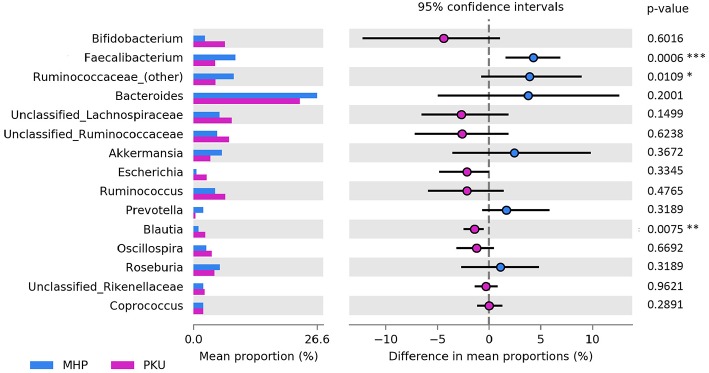
Low-phenylalanine diet, the mainstay of treatment for phenylketonuria (PKU), has been shown to increase glycemic index and glycemic load, affecting the availability of substrates for microbial fermentation. Indeed, changes in the PKU gut microbiota compared with healthy controls have been previously reported. In this study we compared the gut microbial communities of children with PKU and with mild hyperphenylalaninemia (MHP, unrestricted diet). For each group, we enrolled 21 children (4-18 years old), for a total dataset of 42 subjects. We assessed dietary intake and performed gut microbiota analysis by sequencing the V3-V4 hypervariable regions of the 16S rRNA gene. Short chain fatty acids (SCFAs) were quantified by gas chromatographic analysis. While alpha-diversity analysis showed no significant differences between PKU and MHP groups, microbial community analysis highlighted a significant separation of the gut microbiota according to both unweighted ( = 0.008) and weighted Unifrac distances ( = 0.033). Major differences were seen within the Firmicutes phylum. Indeed, PKU children were depleted in spp. and enriched in spp. and spp (family ). We found a divergent response of members of the Firmicutes phylum with respect to daily glycemic index, higher in PKU children. , unclassified and, to a lesser extent spp. negatively correlated with glycemic index, whereas unclassified were positively associated. Indicator species analysis suggested be related to MHP status and to be associated with PKU. Despite PKU children having a higher vegetable and fiber intake, resembling a vegan diet, their gut microbial profile is different from the microbiota reported in the literature for individuals consuming a high-fiber/low-protein diet. Indeed, beneficial microorganisms, such as , considered a biomarker for a healthy status and one of the main butyrate producers, are depleted in PKU gut microbiota. We suggest that both the quality and quantity of carbohydrates ingested participate in determining the observed Firmicutes shifts on the PKU population.
低苯丙氨酸饮食是苯丙酮尿症(PKU)的主要治疗方法,已被证明会增加血糖指数和血糖负荷,从而影响微生物发酵的基质可用性。事实上,与健康对照组相比,PKU 肠道微生物群已经发生了变化。在这项研究中,我们比较了 PKU 儿童和轻度高苯丙氨酸血症(MHP,不限食)儿童的肠道微生物群落。对于每组,我们招募了 21 名儿童(4-18 岁),总共 42 名受试者。我们评估了饮食摄入,并通过测序 16S rRNA 基因的 V3-V4 高变区进行了肠道微生物群落分析。通过气相色谱分析定量了短链脂肪酸(SCFAs)。虽然 alpha 多样性分析显示 PKU 和 MHP 组之间没有显著差异,但微生物群落分析根据未加权(= 0.008)和加权 Unifrac 距离(= 0.033)显著分离了肠道微生物群。在厚壁菌门中观察到主要差异。事实上,PKU 儿童中 spp.减少,而 spp.和 spp.(科)增加。我们发现厚壁菌门成员对每日血糖指数的反应不同,PKU 儿童的血糖指数更高。未分类的 、 和在较小程度上的 spp.与血糖指数呈负相关,而未分类的 与血糖指数呈正相关。指示物种分析表明 与 MHP 状态有关,而 与 PKU 有关。尽管 PKU 儿童的蔬菜和纤维摄入量较高,类似于素食饮食,但他们的肠道微生物谱与文献中报道的高纤维/低蛋白饮食个体的微生物群不同。事实上,有益的微生物,如被认为是健康状态的生物标志物之一,也是主要的丁酸盐生产者之一,在 PKU 肠道微生物群中减少。我们认为,摄入的碳水化合物的质量和数量都参与决定了 PKU 人群中观察到的厚壁菌门变化。