Division of Gastroenterology, Hepatology, and Nutrition, Department of Medicine, Vanderbilt University Medical Center, Nashville, Tennessee.
Division of Gastroenterology, Mayo Clinic Florida, Jacksonville, Florida.
Clin Gastroenterol Hepatol. 2020 Feb;18(2):347-359.e5. doi: 10.1016/j.cgh.2019.05.032. Epub 2019 May 30.
BACKGROUND & AIMS: Gastric cancer is the leading cause of infection-related cancer death and the third-leading cause of cancer death worldwide. The effect of immigration on gastric cancer risk is not well-defined but might be helpful for screening or surveillance endeavors. We performed a systematic review and meta-analysis to define the risk of gastric cancer in immigrants from high-incidence regions to low-incidence regions (including Western Europe, Australia, Brazil, Canada, Israel, and the United States).
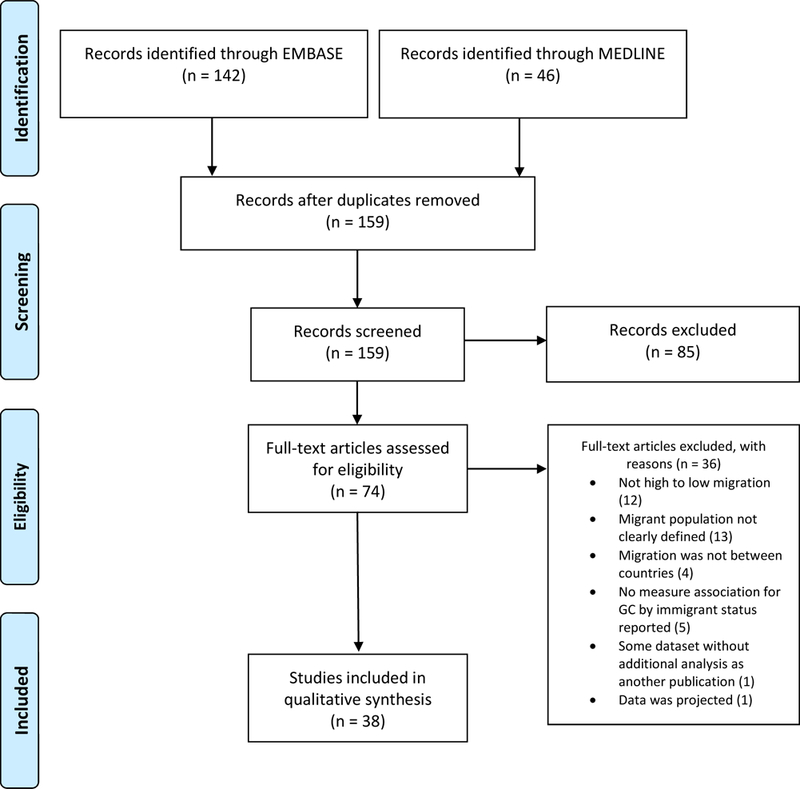
We searched MEDLINE and EMBASE databases, from January 1980 to January 2019, for studies that identified immigrants from high-incidence regions of gastric cancer, provided clear definitions of immigrant and reference populations, and provided sufficient data to calculate gastric cancer incidence and gastric cancer-related mortality. We performed meta-analyses of standardized incidence ratios (SIR) for first-generation immigrants from high- to low-incidence regions, stratified by immigrant generation, sex, and anatomic and histologic subtype, when data were available.
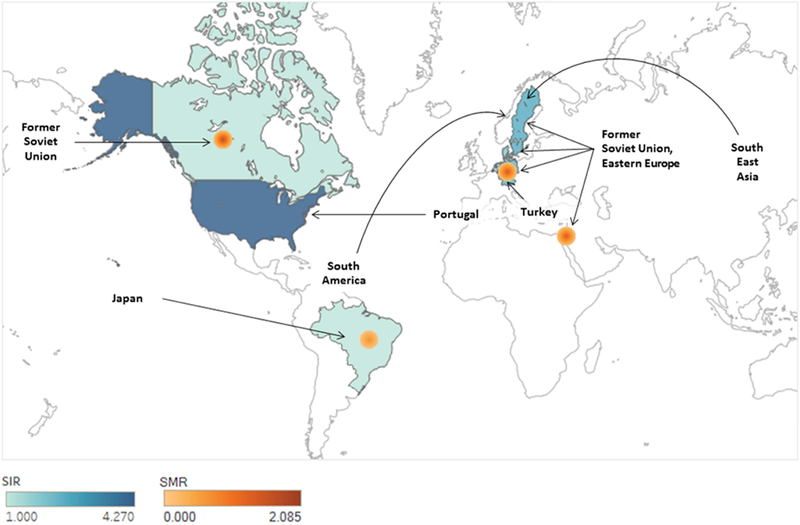
We identified 38 cohort studies that met our inclusion criteria. All 13 studies of 21 distinct populations reported significantly increased SIRs for gastric cancer in first-generation foreign-born immigrants (men SIR range, 1.24-4.50 and women SIR range, 1.27-5.05). The pooled SIR for immigrants with all types of gastric cancer was 1.66 (95% CI, 1.52-1.80) for men and 1.83 (95% CI, 1.69-1.98) for women. Nine studies from 2 high-incidence populations (the former Soviet Union and Japan) reported an increased gastric cancer standardized mortality ratio in first-generation immigrants who migrated to regions of low incidence (former Soviet Union immigrants, 1.44-1.91 for men and 1.40-2.56 for women).
Immigrants from regions with a high incidence of gastric cancer to regions of low incidence maintain a higher risk of gastric cancer and related mortality, based on a comprehensive systematic review and meta-analysis. Assessment of immigrant generation along with other risk factors might help identify high-risk populations for prevention and therapeutic interventions.
胃癌是感染相关癌症死亡的主要原因,也是全球癌症死亡的第三大原因。移民对胃癌风险的影响尚不清楚,但可能有助于筛查或监测工作。我们进行了系统评价和荟萃分析,以确定来自高发地区(包括西欧、澳大利亚、巴西、加拿大、以色列和美国)的移民患胃癌的风险。
我们检索了 MEDLINE 和 EMBASE 数据库,从 1980 年 1 月到 2019 年 1 月,以确定来自胃癌高发地区的移民,提供移民和参照人群的明确定义,并提供足够的数据来计算胃癌发病率和胃癌相关死亡率。当数据可用时,我们对第一代移民从高发地区到低发地区的标准化发病率比(SIR)进行了荟萃分析,按移民代际、性别以及解剖和组织学亚型进行分层。
我们确定了符合纳入标准的 38 项队列研究。所有 13 项针对 21 个不同人群的研究均报告了第一代外国出生移民胃癌 SIR 显著增加(男性 SIR 范围为 1.24-4.50,女性 SIR 范围为 1.27-5.05)。所有类型胃癌移民的汇总 SIR 为男性 1.66(95%CI,1.52-1.80),女性 1.83(95%CI,1.69-1.98)。来自两个高发地区(前苏联和日本)的 9 项研究报告称,第一代移民的胃癌标准化死亡率升高,这些移民从高发地区迁移到低发地区(前苏联移民的男性为 1.44-1.91,女性为 1.40-2.56)。
基于全面的系统评价和荟萃分析,来自胃癌高发地区的移民到低发地区的人群,胃癌和相关死亡率的风险仍然较高。评估移民代际以及其他风险因素可能有助于确定高危人群,以便进行预防和治疗干预。