ANSES Laboratoire de la Santé des Végétaux, Unité de Mycologie, Domaine de Pixérécourt Bât. E, 54220, Malzéville, France.
Department of Agriculture, Food and Environment, University of Catania, Via Santa Sofia, 100, Catania, 95123, Italy.
Sci Rep. 2019 Jun 3;9(1):8195. doi: 10.1038/s41598-019-44672-8.
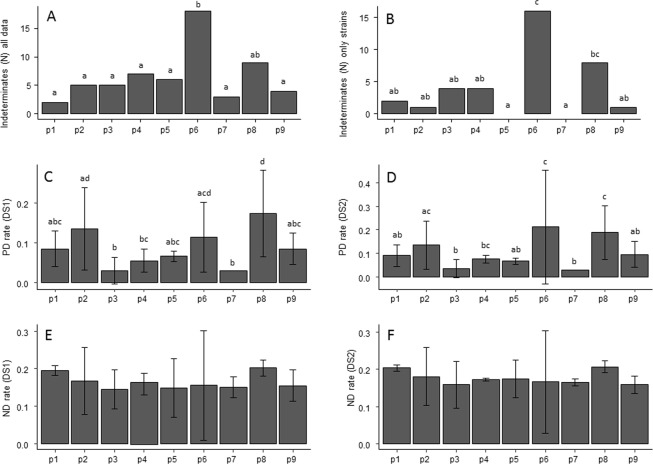
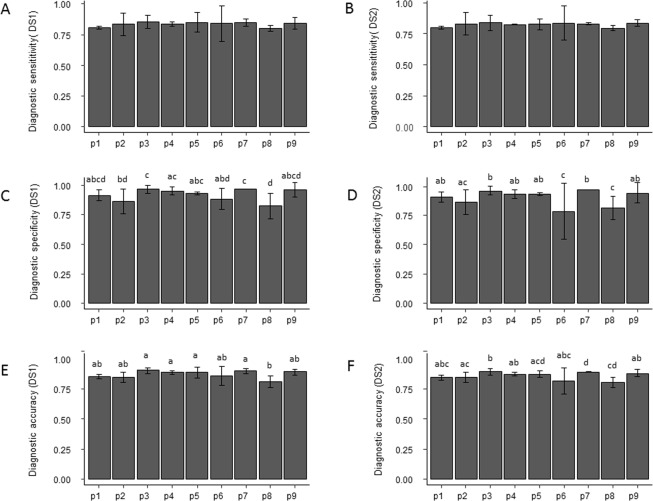
Fusarium circinatum is a harmful pathogenic fungus mostly attacking Pinus species and also Pseudotsuga menziesii, causing cankers in trees of all ages, damping-off in seedlings, and mortality in cuttings and mother plants for clonal production. This fungus is listed as a quarantine pest in several parts of the world and the trade of potentially contaminated pine material such as cuttings, seedlings or seeds is restricted in order to prevent its spread to disease-free areas. Inspection of plant material often relies on DNA testing and several conventional or real-time PCR based tests targeting F. circinatum are available in the literature. In this work, an international collaborative study joined 23 partners to assess the transferability and the performance of nine molecular protocols, using a wide panel of DNA from 71 representative strains of F. circinatum and related Fusarium species. Diagnostic sensitivity, specificity and accuracy of the nine protocols all reached values >80%, and the diagnostic specificity was the only parameter differing significantly between protocols. The rates of false positives and of false negatives were computed and only the false positive rates differed significantly, ranging from 3.0% to 17.3%. The difference between protocols for some of the performance values were mainly due to cross-reactions with DNA from non-target species, which were either not tested or documented in the original articles. Considering that participating laboratories were free to use their own reagents and equipment, this study demonstrated that the diagnostic protocols for F. circinatum were not easily transferable to end-users. More generally, our results suggest that the use of protocols using conventional or real-time PCR outside their initial development and validation conditions should require careful characterization of the performance data prior to use under modified conditions (i.e. reagents and equipment). Suggestions to improve the transfer are proposed.
尖孢镰刀菌是一种主要侵害松属和北美黄松的有害病原真菌,可导致各年龄段树木的溃疡、幼苗猝倒和插条及母株无性繁殖材料的死亡。该真菌在世界多个地区被列为检疫性有害生物,为防止其传播到无病地区,对潜在受污染的松木材料(如插条、幼苗或种子)的贸易进行了限制。植物材料的检查通常依赖于 DNA 测试,文献中已有几种针对尖孢镰刀菌的常规或实时 PCR 检测方法。在这项工作中,一个国际合作研究汇集了 23 个合作伙伴,使用来自 71 个具有代表性的尖孢镰刀菌及相关镰刀菌菌株的广泛 DNA 面板,评估了 9 种分子方案的可转移性和性能。9 种方案的诊断灵敏度、特异性和准确性均达到>80%,且诊断特异性是唯一在方案间有显著差异的参数。计算了 9 种方案的假阳性和假阴性率,只有假阳性率有显著差异,范围为 3.0%至 17.3%。一些性能值之间的方案差异主要归因于与非靶标种 DNA 的交叉反应,这些交叉反应在原始文章中要么未被测试,要么未被记录。考虑到参与实验室可以自由使用自己的试剂和设备,本研究表明,尖孢镰刀菌的诊断方案不易向终端用户转移。更普遍地,我们的研究结果表明,在最初开发和验证条件之外使用使用常规或实时 PCR 的方案时,应在修改条件(即试剂和设备)下使用之前,仔细表征性能数据。提出了改进转移的建议。