Department of Neurosurgery, Harvard Medical School, Massachusetts General Hospital, Boston, United States.
Department of Physiology, McGill University, Montreal, Canada.
Elife. 2019 Jun 14;8:e45573. doi: 10.7554/eLife.45573.
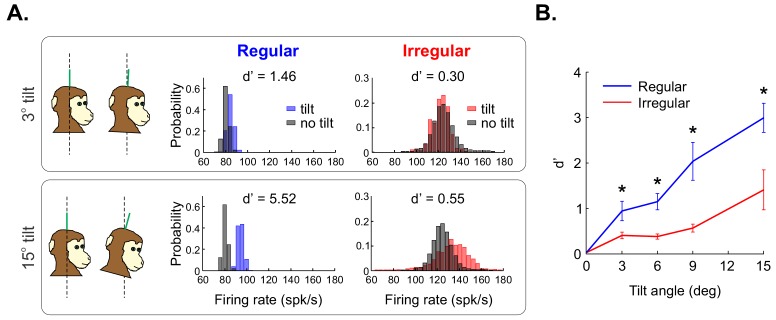
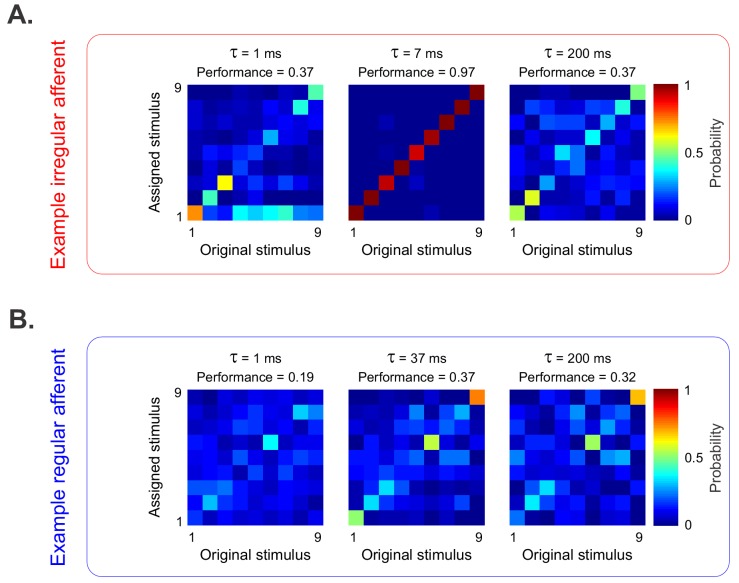
The detection of gravito-inertial forces by the otolith system is essential for our sense of balance and accurate perception. To date, however, how this system encodes the self-motion stimuli that are experienced during everyday activities remains unknown. Here, we addressed this fundamental question directly by recording from single otolith afferents in monkeys during naturalistic translational self-motion and changes in static head orientation. Otolith afferents with higher intrinsic variability transmitted more information overall about translational self-motion than their regular counterparts, owing to stronger nonlinearities that enabled precise spike timing including phase locking. By contrast, more regular afferents better discriminated between different static head orientations relative to gravity. Using computational methods, we further demonstrated that coupled increases in intrinsic variability and sensitivity accounted for the observed functional differences between afferent classes. Together, our results indicate that irregular and regular otolith afferents use different strategies to encode naturalistic self-motion and static head orientation relative to gravity.
耳石系统对重重力的检测对于我们的平衡感和精确感知至关重要。然而,迄今为止,我们尚不清楚该系统如何对日常活动中经历的自身运动刺激进行编码。在这里,我们通过在猴子自然的平移自身运动和静态头方向变化期间记录单个耳石传入神经来直接解决这个基本问题。具有较高固有变异性的耳石传入神经比常规传入神经总体上传输更多关于平移自身运动的信息,这是由于更强的非线性使其能够进行精确的尖峰定时,包括相位锁定。相比之下,更规则的传入神经能够更好地区分相对于重力的不同静态头方向。使用计算方法,我们进一步证明了固有变异性和敏感性的耦合增加解释了传入神经类之间观察到的功能差异。总的来说,我们的研究结果表明,不规则和规则的耳石传入神经使用不同的策略来编码相对于重力的自然平移自身运动和静态头方向。