Human Development Department, Japan International Cooperation Agency (JICA), 3rd floor, Nibancho Center Building, 5-25 Niban-cho, Chiyoda-ku, Tokyo, 102-8012, Japan.
Department of Global Health, Milken Institute School of Public Health, The George Washington University, 950 New Hampshire Ave, NW, 7th floor, Washington, DC, 20052, USA.
BMC Public Health. 2019 Jun 17;19(1):773. doi: 10.1186/s12889-019-7013-9.
For over 20 years, Madagascar has been challenged by continued high prevalence of stunting, underweight and wasting among children under 5 years of age. Yet, nutritional status of post-under-five age group has never been assessed in the country, despite its importance in relation not only to physical health but also to cognitive capacity and educational achievements of children. This study aims to estimate prevalence of malnutrition among schoolchildren aged 5-14 years in Madagascar. It further attempts to identify the possible risk factors for their malnutrition. This is the first study that estimates prevalence of malnutrition among school-aged children in Madagascar.
A cross-sectional household survey was conducted in Antananarivo-Avaradrano district, Analamanga region, Madagascar. The study targeted 393 first and second graders 5-14 years of age enrolled at 10 primary schools, where school-feeding was implemented. Data were collected from anthropometric measurements, their subsequent household structured interviews and observations. Bivariate (Chi-square test or Mann-Whitney's U test) and multivariable (logistic regression) analyses were performed, to identify the possible risk factors associated with malnutrition.
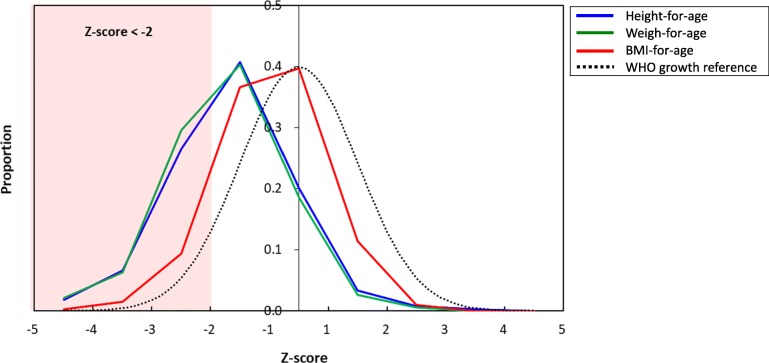
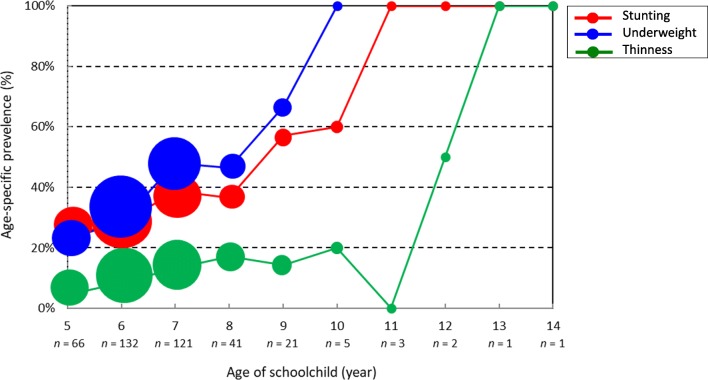
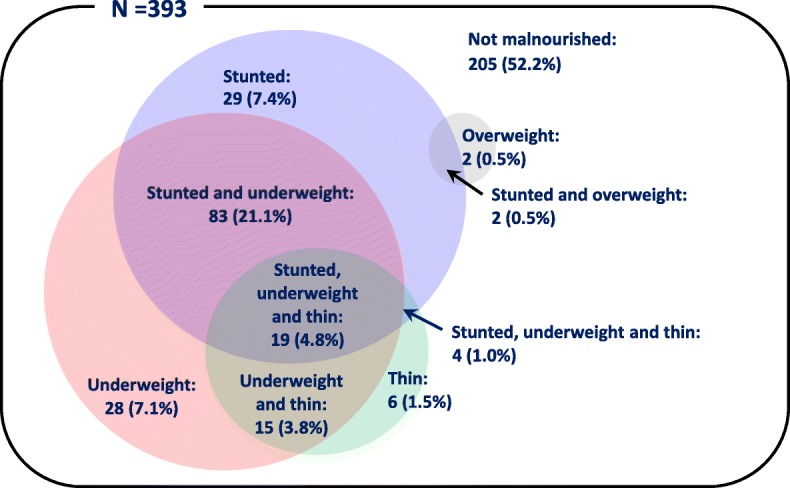
The overall prevalence rates of stunting, underweight and thinness were 34.9%, 36.9% and 11.2%, respectively. Nineteen children (4.8%) suffered from all the three forms of undernutrition. Older schoolchildren had a significantly greater likelihood of being stunted, underweight and thin. The greater number of members a household had, the higher likelihood of being stunted and thin its schoolchild had. Children having lower Household Dietary Diversity Score were more likely to be underweight. Yet, 'Had lunch at school yesterday' was associated neither with being stunted nor with being underweight and thin. This implies room for improvement of the current school feeding program.
Prevalence rates of stunting and underweight among 393 children examined were as high as the national averages among children under 5 years of age. Adequate food availability and dietary diversity over a sufficient period (incl. 5-14 years of age) are necessary for increasing likelihood of catch-up in height-for-age and weight-for-age, which are expectable during adolescence. To supplement inadequate household dietary diversity practices, school-feeding program may need to use more animal-protein ingredients.
20 多年来,马达加斯加一直面临着 5 岁以下儿童持续存在发育迟缓、体重不足和消瘦的问题。然而,该国从未评估过 5 岁以下儿童群体的营养状况,尽管这不仅与身体健康有关,还与儿童的认知能力和教育成就有关。本研究旨在估计马达加斯加 5-14 岁学童的营养不良患病率。它还试图确定导致他们营养不良的可能危险因素。这是首次估计马达加斯加学龄儿童营养不良患病率的研究。
在马达加斯加安塔那那利佛-阿瓦拉德拉诺区(Analamanga 地区)进行了一项横断面家庭调查。该研究以在 10 所实施学校供餐的小学就读的 393 名一至二年级 5-14 岁学生为目标。数据来自人体测量、随后的家庭结构访谈和观察。进行了单变量(卡方检验或曼-惠特尼 U 检验)和多变量(逻辑回归)分析,以确定与营养不良相关的可能危险因素。
总体发育迟缓、体重不足和消瘦的患病率分别为 34.9%、36.9%和 11.2%。19 名儿童(4.8%)患有所有三种形式的营养不良。年龄较大的学生发育迟缓、体重不足和消瘦的可能性明显更大。一个家庭的成员越多,其子女发育迟缓或消瘦的可能性就越高。家庭膳食多样性得分较低的儿童更容易体重不足。然而,“昨天在学校吃午饭”与发育迟缓或体重不足和消瘦无关。这意味着当前学校供餐计划还有改进的空间。
在所检查的 393 名儿童中,发育迟缓率和消瘦率与全国 5 岁以下儿童的平均水平一样高。在足够长的时间内(包括 5-14 岁)提供充足的食物供应和膳食多样性,对于增加身高年龄和体重年龄的追赶机会是必要的,这在青春期是可以预期的。为了补充家庭膳食多样性实践的不足,学校供餐计划可能需要使用更多的动物蛋白成分。