Da Silva Jessica, Jesus Sandra, Bernardi Natália, Colaço Mariana, Borges Olga
Center for Neuroscience and Cell Biology, University of Coimbra, Coimbra, Portugal.
Faculty of Pharmacy, University of Coimbra, Azinhaga de Santa Comba, Coimbra, Portugal.
Front Bioeng Biotechnol. 2019 Jun 6;7:137. doi: 10.3389/fbioe.2019.00137. eCollection 2019.
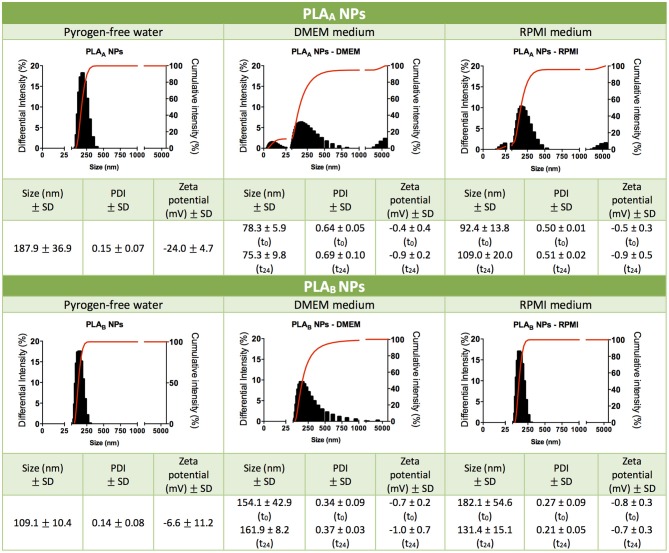
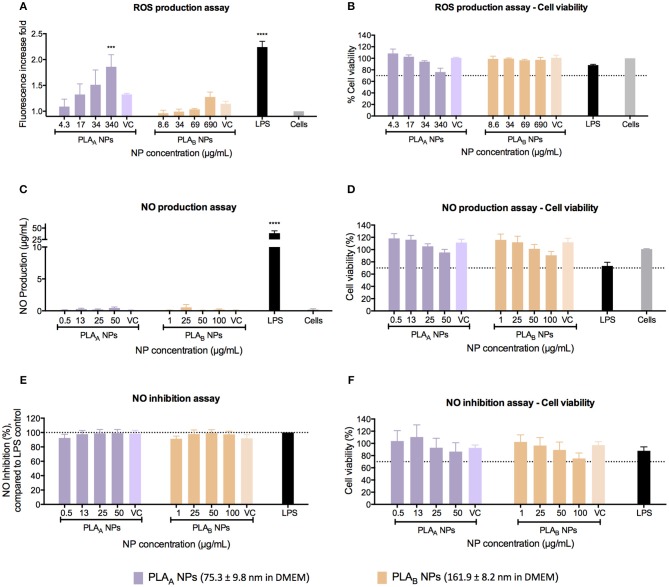
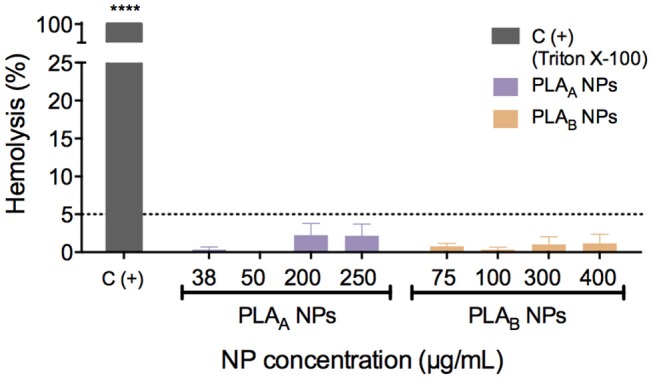
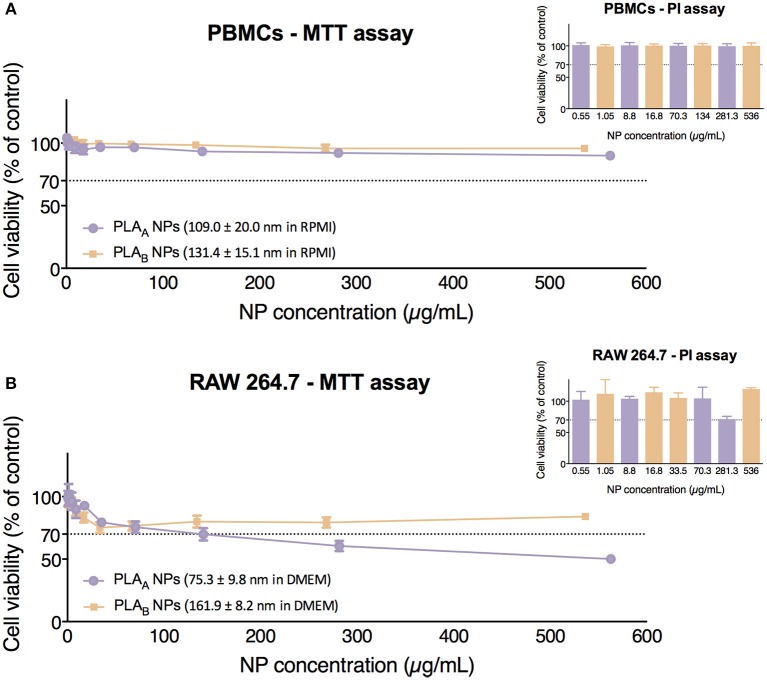
Polylactic acid (PLA), a biodegradable and biocompatible polymer produced from renewable resources, has been widely used as a nanoparticulate platform for antigen and drug delivery. Despite generally regarded as safe, its immunotoxicological profile, when used as a polymeric nanoparticle (NP), is not well-documented. Thus, this study intends to address this gap, by evaluating the toxicity of two different sized PLA NPs (PLA NPs and PLA NPs), produced by two nanoprecipitation methods and extensively characterized regarding their physicochemical properties in experimental conditions. After production, PLA NPs mean diameter (187.9 ± 36.9 nm) was superior to PLA NPs (109.1 ± 10.4 nm). Interestingly, when in RPMI medium, both presented similar mean size (around 100 nm) and neutral zeta potential, possibly explaining the similarity between their cytotoxicity profile in PBMCs. On the other hand, in DMEM medium, PLA NPs presented smaller mean diameter (75.3 ± 9.8 nm) when compared to PLA NPs (161.9 ± 8.2 nm), which may explain its higher toxicity in RAW 264.7. Likewise, PLA NPs induced a higher dose-dependent ROS production. Irrespective of size differences, none of the PLA NPs presented an inflammatory potential (NO production) or a hemolytic activity in human blood. The results herein presented suggest the hypothesis, to be tested in the future, that PLA NPs presenting a smaller sized population possess increased cytotoxicity. Furthermore, this study emphasizes the importance of interpreting results based on adequate physicochemical characterization of nanoformulations in biological medium. As observed, small differences in size triggered by the dispersion in cell culture medium can have repercussions on toxicity, and if not correctly evaluated can lead to misinterpretations, and subsequent ambiguous conclusions.
聚乳酸(PLA)是一种由可再生资源生产的可生物降解且生物相容的聚合物,已被广泛用作抗原和药物递送的纳米颗粒平台。尽管通常被认为是安全的,但其作为聚合物纳米颗粒(NP)时的免疫毒理学特征却鲜有文献记载。因此,本研究旨在通过评估两种不同尺寸的PLA NPs(PLA NPs和PLA NPs)的毒性来填补这一空白,这两种PLA NPs通过两种纳米沉淀方法制备,并在实验条件下对其理化性质进行了广泛表征。制备后,PLA NPs的平均直径(187.9±36.9 nm)大于PLA NPs(109.1±10.4 nm)。有趣的是,当置于RPMI培养基中时,两者呈现出相似的平均尺寸(约100 nm)和中性zeta电位,这可能解释了它们在PBMCs中的细胞毒性特征相似的原因。另一方面,在DMEM培养基中,与PLA NPs(161.9±8.2 nm)相比,PLA NPs的平均直径更小(75.3±9.8 nm),这可能解释了其在RAW 264.7中更高的毒性。同样,PLA NPs诱导更高的剂量依赖性活性氧产生。无论尺寸差异如何,PLA NPs在人血中均未表现出炎症潜力(一氧化氮产生)或溶血活性。本文给出的结果提出了一个有待未来检验的假设,即尺寸较小的PLA NPs群体具有更高的细胞毒性。此外,本研究强调了基于纳米制剂在生物介质中的充分理化表征来解释结果的重要性。如所观察到的,细胞培养基中的分散作用引发的微小尺寸差异可能会对毒性产生影响,如果没有正确评估,可能会导致误解以及随后的模糊结论。