The School of Nursing and Midwifery, The University of Sheffield, Sheffield, UK.
Palliat Med. 2019 Sep;33(8):969-984. doi: 10.1177/0269216319858247. Epub 2019 Jun 28.
Patient/carer involvement in palliative care research has been reported as complex, difficult and less advanced compared to other areas of health and social care research. There is seemingly limited evidence on impact and effectiveness.
To examine the evidence regarding patient/carer involvement in palliative care research and identify the facilitators, barriers, impacts and gaps in the evidence base.
Qualitative evidence synthesis using an integrative review approach and thematic analysis.
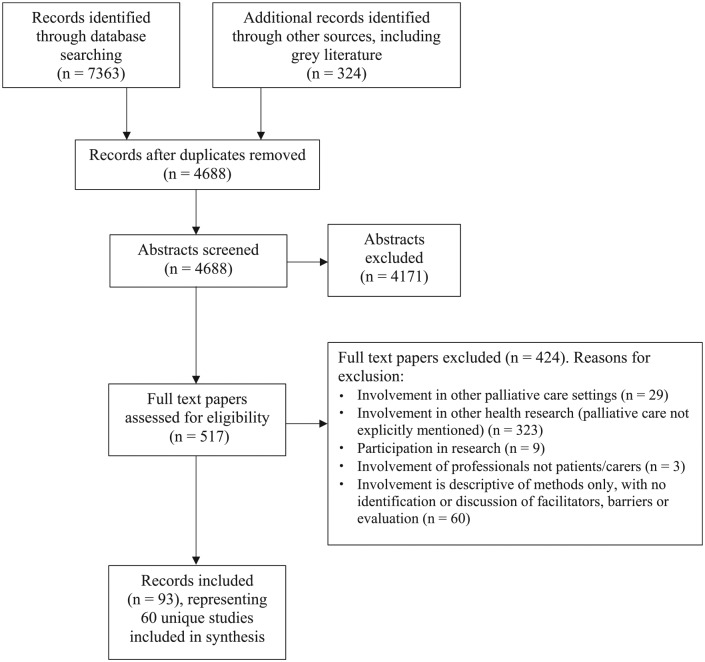
Electronic databases were searched up to March 2018. Additional methods included searching websites and ongoing/unpublished studies, author searching and contacting experts. Eligibility criteria were based on the SPICE (Setting, Perspective, Intervention, Comparison, Evaluation) framework. Two quality assessments on methodology and involvement were undertaken.
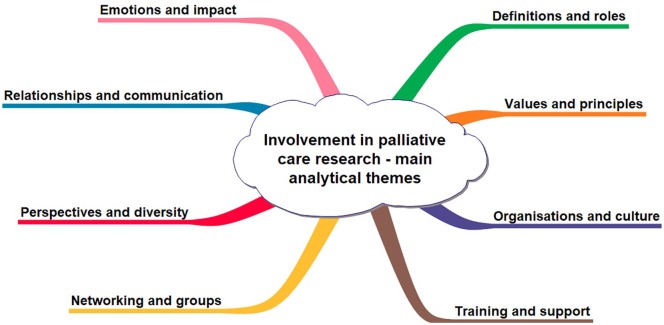
A total of 93 records were included. Eight main themes were identified, mainly concerning facilitators and barriers to effective patient and carer involvement in palliative care research: definitions/roles, values/principles, organisations/culture, training/support, networking/groups, perspectives/diversity, relationships/communication and emotions/impact. Evidence on the impact of involvement was limited, but when carried out effectively, involvement brought positive benefits for all concerned, improving the relevance and quality of research. Evidence gaps were found in non-cancer populations and collaborative/user-led involvement.
Evidence identified suggests that involvement in palliative care research is challenging, but not dissimilar to that elsewhere. The facilitators and barriers identified relate mainly to the conduct of researchers at an individual level; in particular, there exists a reluctance among professionals to undertake involvement, and myths still perpetuate that patients/carers do not want to be involved. A developed infrastructure, more involvement-friendly organisational cultures and a strengthening of the evidence base would also be beneficial.
与其他健康和社会保健研究领域相比,患者/护理人员参与姑息治疗研究被报告为复杂、困难和落后。关于影响和效果的证据似乎有限。
检查姑息治疗研究中患者/护理人员参与的证据,并确定证据基础中的促进因素、障碍、影响和差距。
使用综合审查方法和主题分析进行定性证据综合。
截至 2018 年 3 月,对电子数据库进行了搜索。其他方法包括搜索网站和正在进行/未发表的研究、作者搜索和联系专家。入选标准基于 SPICE(环境、视角、干预、比较、评估)框架。对方法和参与度进行了两次质量评估。
共纳入 93 项记录。确定了 8 个主要主题,主要涉及有效参与姑息治疗研究的患者和护理人员的促进因素和障碍:定义/角色、价值观/原则、组织/文化、培训/支持、网络/团体、观点/多样性、关系/沟通和情感/影响。参与影响的证据有限,但当有效实施时,参与为所有相关人员带来了积极的好处,提高了研究的相关性和质量。在非癌症人群和合作/用户主导的参与方面发现了证据差距。
确定的证据表明,姑息治疗研究中的参与具有挑战性,但与其他地方的参与并无不同。确定的促进因素和障碍主要与研究人员的个人行为有关;特别是,专业人员不愿意参与,并且仍然存在患者/护理人员不想参与的神话。发展基础设施、更有利于参与的组织文化以及加强证据基础也将是有益的。