Gilbert Paul, Basran Jaskaran
Centre for Compassion Research and Training, College of Health and Social Care Research Centre, University of Derby, Derby, United Kingdom.
Front Psychol. 2019 Jun 25;10:610. doi: 10.3389/fpsyg.2019.00610. eCollection 2019.
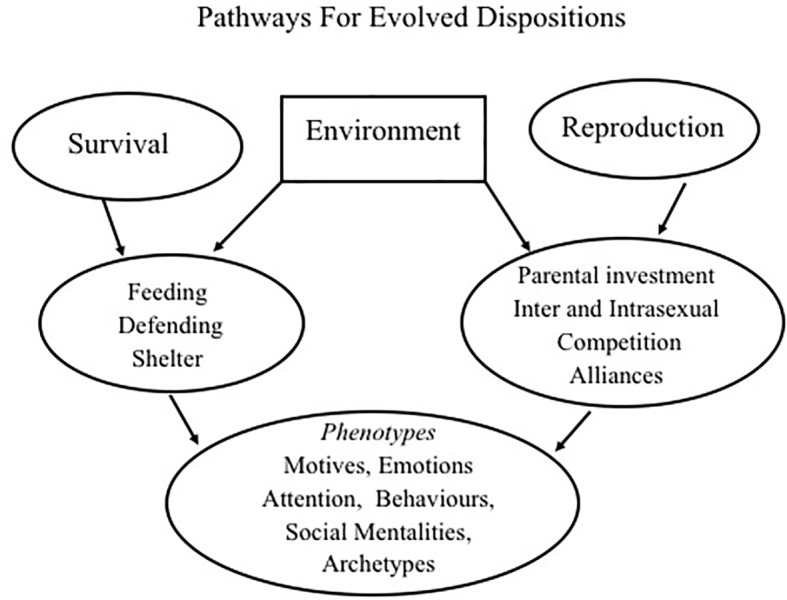
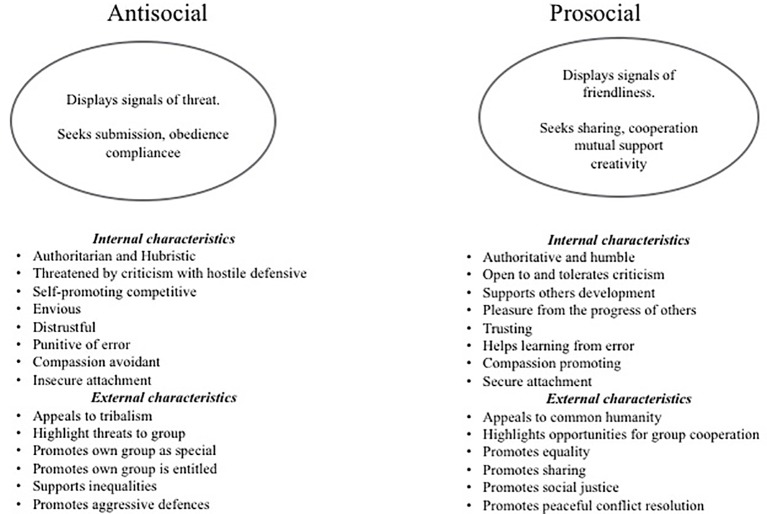
Evolutionary analysis focuses on how genes build organisms with different strategies for engaging and solving life's challenges of survival and reproduction. One of those challenges is competing with conspecifics for limited resources including reproductive opportunities. This article suggests that there is now good evidence for considering two dimensions of social competition. The first, has been labeled as strategies, to the extent that they tend to be self-focused, threat sensitive and aggressive, and use tactics of bulling, threatening, and intimidating subordinates, or even injuring/killing competitors. Such strategies can inhibit care and affiliative social interactions and motivation. The social signals emitted stimulate threat processing in recipients and can create stressed and highly stratified groups with a range of detrimental psychological and physiological effects. Second, in contrast, strategies seek to create relaxed and secure social interactions that enable sharing, cooperative, mutually supportive and beneficial relationships. The friendly and low/no threat social signals emitted in friendly cooperative and affiliative relationships stimulate physiological systems (e.g., oxytocin, the vagus nerve of the parasympathetic system) that downregulates threat processing, enhances the immune system, and facilitates frontal cortical processes and general wellbeing. This article reviews the literature pertaining to the evidence for these two dimensions of social engagement.
进化分析关注基因如何构建具有不同策略的生物体,这些策略用于应对和解决生存与繁殖过程中面临的生活挑战。其中一项挑战是与同种个体竞争有限的资源,包括繁殖机会。本文表明,现在有充分的证据支持考虑社会竞争的两个维度。第一个维度被标记为“争斗策略”,在某种程度上,它们往往以自我为中心、对威胁敏感且具有攻击性,会使用欺凌、威胁和恐吓下属的策略,甚至伤害/杀死竞争对手。这类策略会抑制关爱和亲和性的社会互动及动机。所发出的社会信号会刺激接受者的威胁处理过程,并可能造成压力大且高度分层的群体,产生一系列有害的心理和生理影响。相比之下,第二个维度的“亲和策略”旨在创造轻松且安全的社会互动,从而促成共享、合作、相互支持且有益的关系。在友好合作和亲和关系中发出的友好且低威胁/无威胁的社会信号会刺激生理系统(例如,催产素、副交感神经系统的迷走神经),这些生理系统会下调威胁处理过程、增强免疫系统,并促进额叶皮质活动和总体幸福感。本文回顾了与这两个社会参与维度的证据相关的文献。