Gao Yu, Li Renfu, Zheng Wei, Shang Xiaoying, Wei Jiaojiao, Zhang Meiran, Xu Jin, You Wenwu, Chen Zhuo, Chen Xueyuan
CAS Key Laboratory of Design and Assembly of Functional Nanostructures , Fujian Key Laboratory of Nanomaterials , Fujian Institute of Research on the Structure of Matter , Chinese Academy of Sciences , Fuzhou , Fujian 350002 , China . Email:
School of Physical Science and Technology , ShanghaiTech University , Shanghai 201210 , China.
Chem Sci. 2019 May 10;10(21):5452-5460. doi: 10.1039/c9sc01321k. eCollection 2019 Jun 7.
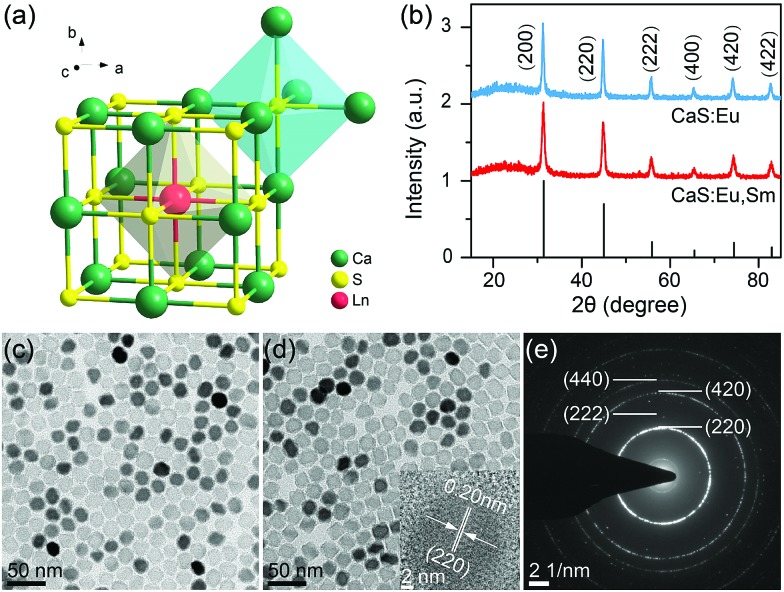
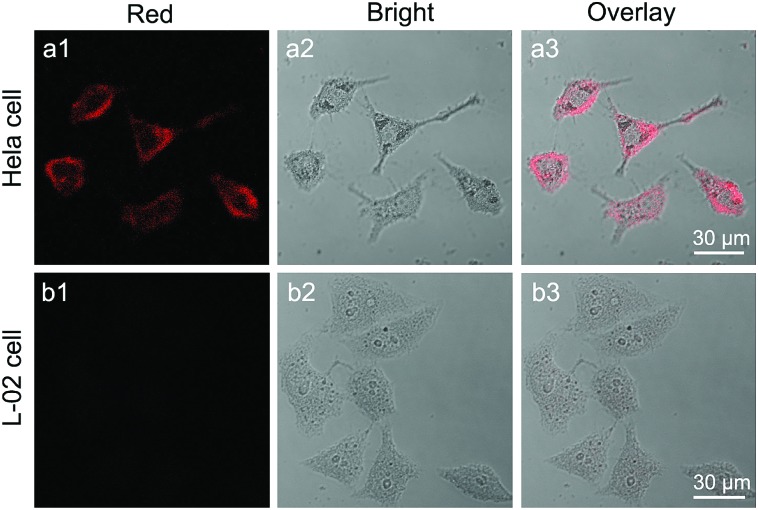
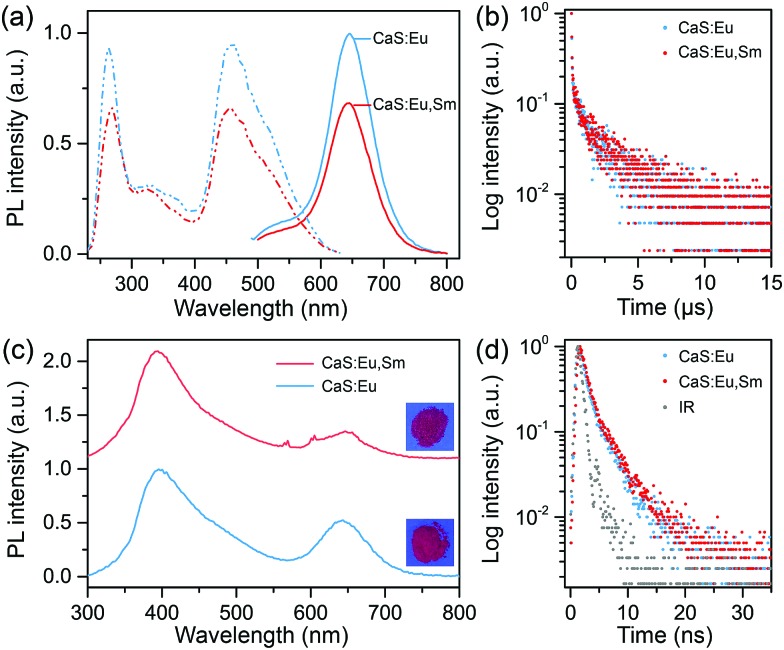
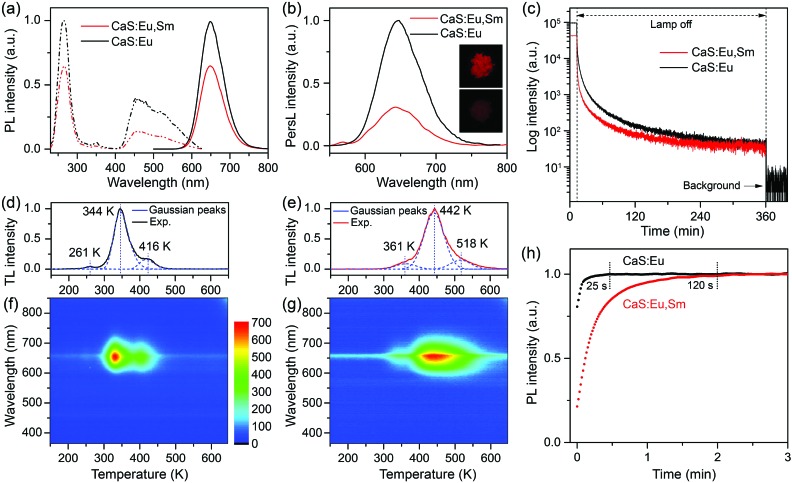
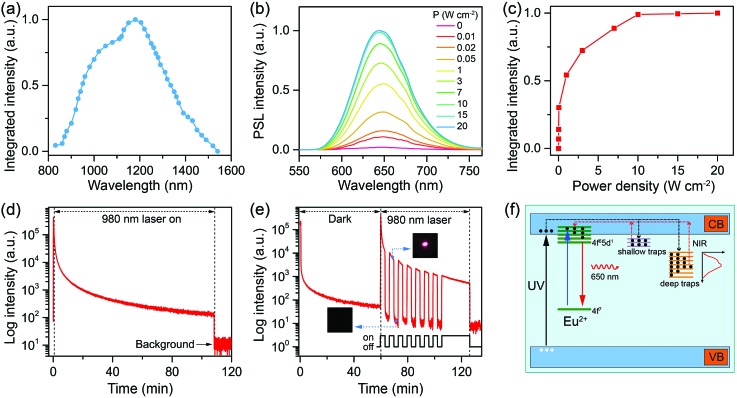
Near-infrared (NIR) photostimulated luminescence (PSL) nanocrystals (NCs) have recently evoked considerable interest in the field of biomedicine, but are currently limited by the controlled synthesis of efficient PSL NCs. Herein, we report for the first time the controlled synthesis of CaS:Eu,Sm NIR PSL NCs through a high-temperature co-precipitation method. The role of Sm co-doping and the effect of thermal annealing on the optical properties of the NCs as well as the charging and discharging processes, the trap depth distribution, and the underlying PSL mechanism are comprehensively surveyed by means of photoluminescence, persistent luminescence, thermoluminescence, and PSL spectroscopies. The as-prepared NCs exhibit intense PSL of Eu at 650 nm with a fast response to stimulation in a broad NIR region from 800 nm to 1600 nm, a duration time longer than 2 h, and an extremely low power density threshold down to 10 mW cm at 980 nm. Furthermore, by taking advantage of the intense NIR PSL, we demonstrate the application of CaS:Eu,Sm NCs as sensitive luminescent nanoprobes for biotin receptor-targeted cancer cell imaging. These results reveal the great promise of CaS:Eu,Sm nanoprobes for autofluorescence-free bioimaging, and also lay the foundation for future design of efficient NIR PSL nanoprobes towards versatile bioapplications.
近红外(NIR)光刺激发光(PSL)纳米晶体(NCs)最近在生物医学领域引起了相当大的关注,但目前受到高效PSL NCs可控合成的限制。在此,我们首次报道了通过高温共沉淀法可控合成CaS:Eu,Sm近红外PSL纳米晶体。通过光致发光、持续发光、热释光和PSL光谱学,全面研究了Sm共掺杂的作用、热退火对纳米晶体光学性质的影响以及充放电过程、陷阱深度分布和潜在的PSL机制。所制备的纳米晶体在650 nm处表现出强烈的Eu PSL,在800 nm至1600 nm的宽近红外区域对刺激有快速响应,持续时间超过2小时,在980 nm处的极低功率密度阈值低至10 mW cm。此外,利用强烈的近红外PSL,我们展示了CaS:Eu,Sm纳米晶体作为生物素受体靶向癌细胞成像的灵敏发光纳米探针的应用。这些结果揭示了CaS:Eu,Sm纳米探针在无自发荧光生物成像方面的巨大潜力,也为未来设计用于多功能生物应用的高效近红外PSL纳米探针奠定了基础。