Center for Wireless & Population Health Systems, Department of Family Medicine and Public Health, Design Lab and Qualcomm Institute Faculty Member, UC San Diego, 9500 Gilman Ave, San Diego, CA, 92093, USA.
School of Information, University of Michigan, Ann Arbor, MI, USA.
BMC Med. 2019 Jul 17;17(1):133. doi: 10.1186/s12916-019-1366-x.
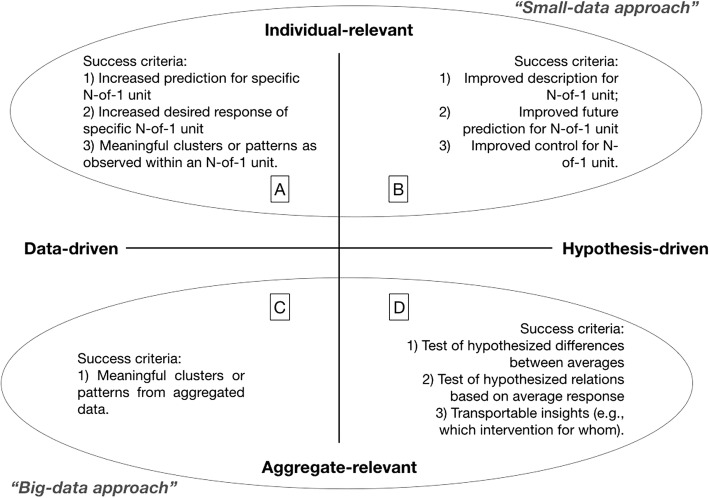
There is great interest in and excitement about the concept of personalized or precision medicine and, in particular, advancing this vision via various 'big data' efforts. While these methods are necessary, they are insufficient to achieve the full personalized medicine promise. A rigorous, complementary 'small data' paradigm that can function both autonomously from and in collaboration with big data is also needed. By 'small data' we build on Estrin's formulation and refer to the rigorous use of data by and for a specific N-of-1 unit (i.e., a single person, clinic, hospital, healthcare system, community, city, etc.) to facilitate improved individual-level description, prediction and, ultimately, control for that specific unit.
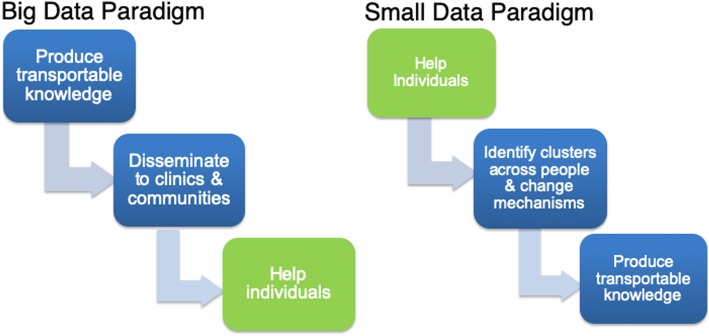
The purpose of this piece is to articulate why a small data paradigm is needed and is valuable in itself, and to provide initial directions for future work that can advance study designs and data analytic techniques for a small data approach to precision health. Scientifically, the central value of a small data approach is that it can uniquely manage complex, dynamic, multi-causal, idiosyncratically manifesting phenomena, such as chronic diseases, in comparison to big data. Beyond this, a small data approach better aligns the goals of science and practice, which can result in more rapid agile learning with less data. There is also, feasibly, a unique pathway towards transportable knowledge from a small data approach, which is complementary to a big data approach. Future work should (1) further refine appropriate methods for a small data approach; (2) advance strategies for better integrating a small data approach into real-world practices; and (3) advance ways of actively integrating the strengths and limitations from both small and big data approaches into a unified scientific knowledge base that is linked via a robust science of causality.
Small data is valuable in its own right. That said, small and big data paradigms can and should be combined via a foundational science of causality. With these approaches combined, the vision of precision health can be achieved.
个性化或精准医学的概念引起了极大的关注和兴奋,特别是通过各种“大数据”努力来推进这一愿景。虽然这些方法是必要的,但它们不足以实现完整的个性化医学承诺。还需要一种严格的、互补的“小数据”范式,可以独立于大数据,也可以与大数据合作。通过“小数据”,我们借鉴了 Estrin 的表述,是指严格使用数据,针对的是特定的 N-of-1 单位(即一个人、诊所、医院、医疗保健系统、社区、城市等),以促进对该特定单位的个体水平描述、预测,最终实现控制。
本文旨在阐述为什么需要小数据范式,以及它本身的价值,并为未来的工作提供初步方向,以推进小数据方法在精准健康中的研究设计和数据分析技术。从科学角度来看,小数据方法的核心价值在于,它可以独特地管理复杂、动态、多因果、表现独特的现象,如慢性病,与大数据相比。除此之外,小数据方法更能使科学和实践的目标保持一致,从而可以用更少的数据更快地进行灵活学习。从某种意义上说,从小数据方法中也有可能获得可移植的知识,这与大数据方法是互补的。未来的工作应该(1)进一步完善小数据方法的适当方法;(2)推进将小数据方法更好地融入实际实践的策略;(3)推进将小数据和大数据方法的优势和局限性主动整合到一个统一的科学知识库中的方法,该知识库通过强大的因果关系科学链接。
小数据本身就有价值。也就是说,小数据和大数据范式可以而且应该通过因果关系的基础科学结合在一起。通过结合这些方法,可以实现精准健康的愿景。