Uphill Mark A, Rossato Claire J L, Swain Jon, O'Driscoll Jamie
Section of Sport and Exercise Sciences, Canterbury Christ Church University, Canterbury, United Kingdom.
Department of Psychology, Social Work and Counselling, Old Royal Naval College, University of Greenwich, London, United Kingdom.
Front Psychol. 2019 Jul 2;10:1255. doi: 10.3389/fpsyg.2019.01255. eCollection 2019.
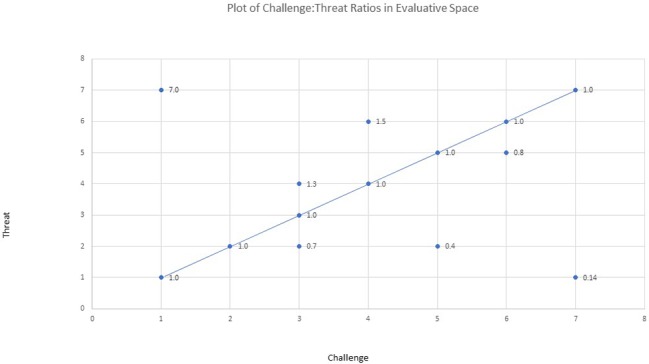
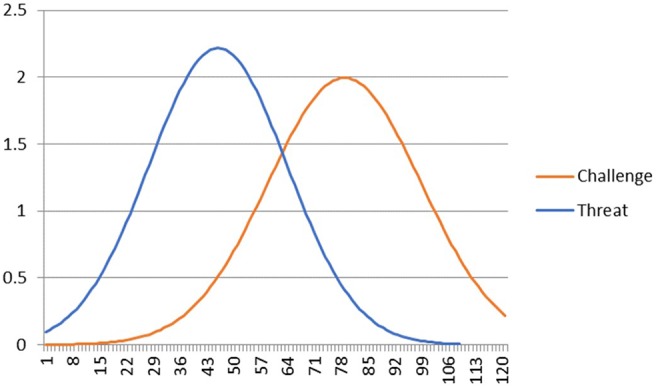
In this article, the authors describe a new theory, the Evaluative Space Approach to Challenge and Threat (ESACT). Prompted by the Biopsychosocial model of challenge and threat (BPS: Blascovich and Tomaka, 1996) and the development of the Theory of Challenge and Threat States in Athletes (Jones et al., 2009), recent years have witnessed a considerable increase in research examining challenge and threat in sport. This manuscript provides a critical review of the literature examining challenge and threat in sport, tracing its historical development and some of the current empirical ambiguities. To reconcile some of these ambiguities, and utilizing neurobiological evidence associated with approach and avoidance motivation (c.f. Elliot and Covington, 2001), this paper draws upon the Evaluative Space Model (ESM; Cacioppo et al., 1997) and considers the implications for understanding challenge and threat in sport. For example, rather than see challenge and threat as opposite ends of a single bipolar continuum, the ESM implies that individuals could be (1) challenged, (2) threatened, (3) challenged and threatened, or (4) neither challenged or threatened by a particular stimulus. From this perspective, it could be argued that the appraisal of some sport situations as both challenging threatening could be advantageous, whereas the current literature seems to imply that the appraisal of stress as a threat is maladaptive for performance. The ESACT provides several testable hypotheses for advancing understanding of challenge and threat (in sport) and we describe a number of measures that can be used to examine these hypotheses. In sum, this paper provides a significant theoretical, empirical, and practical contribution to our understanding of challenge and threat (in sport).
在本文中,作者描述了一种新理论,即挑战与威胁的评估空间方法(ESACT)。受挑战与威胁的生物心理社会模型(BPS:Blascovich和Tomaka,1996)以及运动员挑战与威胁状态理论的发展(Jones等人,2009)的启发,近年来,研究体育领域中挑战与威胁的研究显著增加。本手稿对体育领域中挑战与威胁的文献进行了批判性综述,追溯了其历史发展以及当前一些实证上的模糊之处。为了调和其中的一些模糊之处,并利用与趋近和回避动机相关的神经生物学证据(参见Elliot和Covington,2001),本文借鉴了评估空间模型(ESM;Cacioppo等人,1997),并考虑了其对理解体育领域中挑战与威胁的意义。例如,与将挑战和威胁视为单一双极连续体的两端不同,ESM意味着个体可能会(1)受到挑战,(2)受到威胁,(3)既受到挑战又受到威胁,或者(4)既不受到挑战也不受到特定刺激的威胁。从这个角度来看,可以认为将某些体育情境评估为既具有挑战性又具有威胁性可能是有利的,而当前的文献似乎暗示将压力评估为威胁对表现是适应不良的。ESACT为推进对(体育领域中的)挑战与威胁的理解提供了几个可检验的假设,并且我们描述了一些可用于检验这些假设的措施。总之,本文为我们对(体育领域中的)挑战与威胁的理解做出了重大的理论、实证和实践贡献。