Luna Diego, López-Alonso Marta, Cedeño Yolanda, Rigueira Lucas, Pereira Víctor, Miranda Marta
Department of Animal Pathology, Veterinary Faculty, Universidade de Santiago de Compostela, 27002 Lugo, Spain.
Faculty of Veterinary Medicine, Universidad Central del Ecuador, EC170521 Quito, Ecuador.
Animals (Basel). 2019 Jul 21;9(7):465. doi: 10.3390/ani9070465.
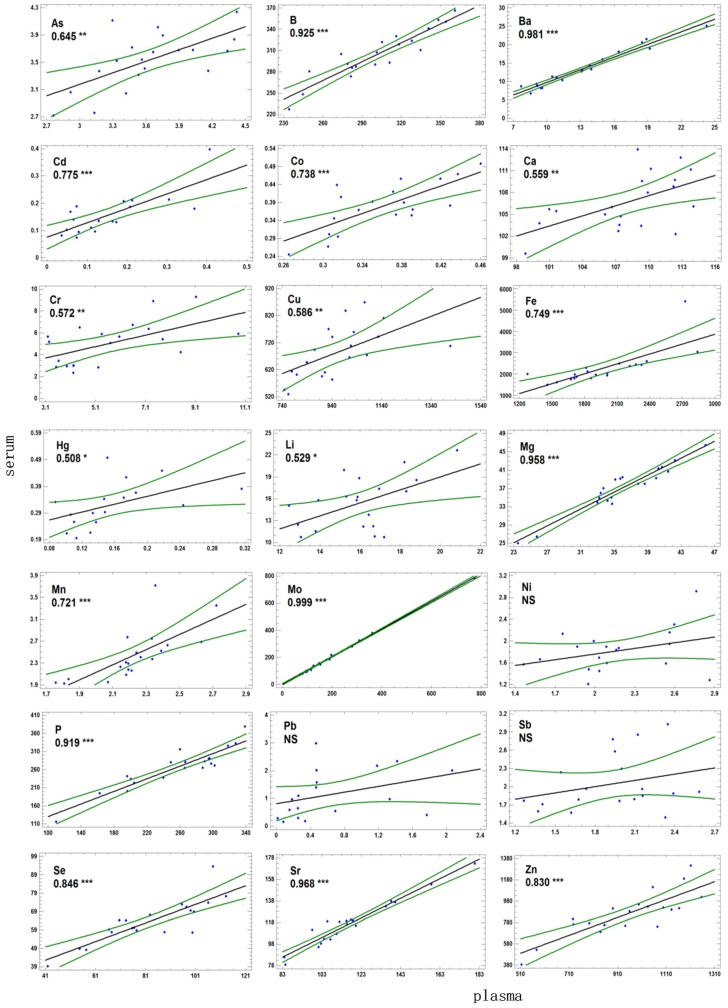
This study was designed to evaluate the influence of type of blood sample (serum or plasma) on essential and toxic element analysis in cattle. Paired plasma and serum samples ( = 20) were acid digested, and the concentrations of As, B, Ba, Ca, Cd, Co, Cr, Cu, Fe, Hg, Li, Mg, Mn. Mo, Ni, P, Pb, Sb, Se, Sr and Zn were determined by inductively coupled plasma mass spectrometry (ICP-MS). The study findings indicate that plasma and serum samples appear suitable and interchangeable for the determination of most of the essential and toxic elements in blood in cattle. The only exceptions are Cu and Se, the concentrations of which were significantly lower (40.9 and 29.9% respectively) in serum than in plasma. Some of the Cu in blood samples from bovine ruminants is known to be sequestered during clotting. However, further research on Se in ruminants and other animal species is warranted. Finally, the significantly higher Mn (9.9%) concentrations in serum than in plasma may have been caused by haemolysis of some samples. Special attention should be paid to preventing haemolysis of samples during collection and processing, in order to prevent overestimation of elements present at high concentrations inside erythrocytes (i.e., Fe, Mn and Zn).
本研究旨在评估血样类型(血清或血浆)对牛体内必需元素和有毒元素分析的影响。采集了20对血浆和血清样本进行酸消解,并通过电感耦合等离子体质谱法(ICP-MS)测定了其中砷、硼、钡、钙、镉、钴、铬、铜、铁、汞、锂、镁、锰、钼、镍、磷、铅、锑、硒、锶和锌的浓度。研究结果表明,血浆和血清样本似乎适用于测定牛血液中的大多数必需元素和有毒元素,并且二者可以互换使用。唯一的例外是铜和硒,血清中这两种元素的浓度分别比血浆中低40.9%和29.9%,显著降低。已知反刍动物血样中的一些铜在凝血过程中会被螯合。然而,有必要对反刍动物和其他动物物种中的硒进行进一步研究。最后,血清中锰的浓度比血浆中高9.9%,这可能是由于一些样本发生了溶血。在采集和处理样本过程中应特别注意防止样本溶血,以避免高估红细胞内高浓度存在的元素(即铁、锰和锌)。