Artificial Intelligence for Medical Systems (AIMS) Lab, Department of Biomedical Engineering, OregonHealth and Science University, Portland, OR 97239, USA.
Proto-tech Research, Portland, OR 97267, USA.
Biosensors (Basel). 2019 Jul 22;9(3):90. doi: 10.3390/bios9030090.
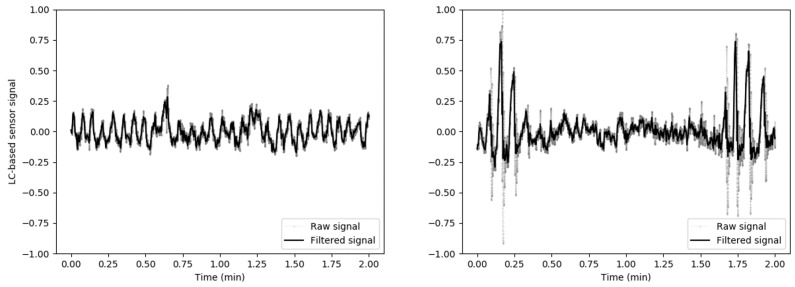
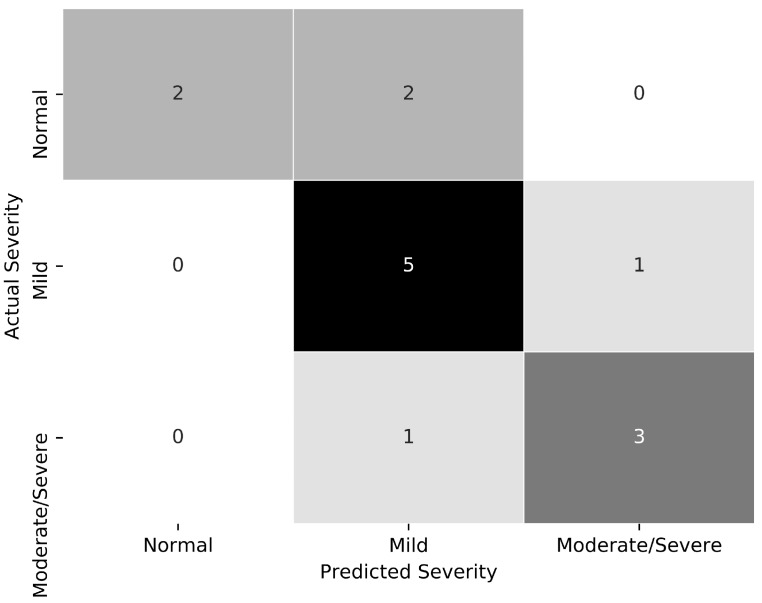
We conducted a pilot study to evaluate the accuracy of a custom built non-contactpressure-sensitive device in diagnosing obstructive sleep apnea (OSA) severity as an alternative toin-laboratory polysomnography (PSG) and a Type 3 in-home sleep apnea test (HSAT). Fourteenpatients completed PSG sleep studies for one night with simultaneous recording from ourload-cell-based sensing device in the bed. Subjects subsequently installed pressure sensors in theirbed at home and recorded signals for up to four nights. Machine learning models were optimized toclassify sleep apnea severity using a standardized American Academy of Sleep Medicine (AASM)scoring of the gold standard studies as reference. On a per-night basis, our model reached a correctOSA detection rate of 82.9% (sensitivity = 88.9%, specificity = 76.5%), and OSA severity classificationaccuracy of 74.3% (61.5% and 81.8% correctly classified in-clinic and in-home tests, respectively).There was no difference in Apnea Hypopnea Index (AHI) estimation when subjects wore HSATsensors versus load cells (LCs) only (p-value = 0.62). Our in-home diagnostic system providesan unobtrusive method for detecting OSA with high sensitivity and may potentially be used forlong-term monitoring of breathing during sleep. Further research is needed to address the lowerspecificity resulting from using the highest AHI from repeated samples.
我们进行了一项初步研究,以评估一种定制的非接触压力敏感设备在诊断阻塞性睡眠呼吸暂停 (OSA) 严重程度方面的准确性,作为替代实验室多导睡眠图 (PSG) 和家庭睡眠呼吸暂停测试 (HSAT) 第 3 型的方法。14 名患者在一夜之间完成了 PSG 睡眠研究,同时记录了我们基于称重传感器的感应设备在床铺上的信号。随后,受试者在家中安装了压力传感器,并记录了长达四晚的信号。机器学习模型经过优化,使用标准化的美国睡眠医学学会 (AASM) 评分作为参考,对睡眠呼吸暂停严重程度进行分类。基于每夜的结果,我们的模型达到了 82.9%的正确 OSA 检测率(敏感性=88.9%,特异性=76.5%),以及 74.3%的 OSA 严重程度分类准确性(在诊所和家庭测试中分别有 61.5%和 81.8%的分类正确)。当受试者佩戴 HSAT 传感器而不是 LCs 时,呼吸暂停低通气指数 (AHI) 的估计没有差异(p 值=0.62)。我们的家庭诊断系统提供了一种非侵入性的方法,可以高灵敏度地检测 OSA,并且可能潜在地用于睡眠期间呼吸的长期监测。需要进一步的研究来解决由于使用重复样本中的最高 AHI 而导致的特异性较低的问题。