Department of Nutrition, Gillings School of Global Public Health, University of North Carolina at Chapel Hill, Chapel Hill, NC 27599-7400, USA.
Institute of Nutrition and Food Technology (INTA), University of Chile, Santiago 7830490, Chile.
Nutrients. 2019 Jul 23;11(7):1695. doi: 10.3390/nu11071695.
Food source and eating location are important factors associated with the quality of dietary intake. In Chile the main food sources and eating locations of preschool children and adolescents and how these relate to dietary quality are unknown.
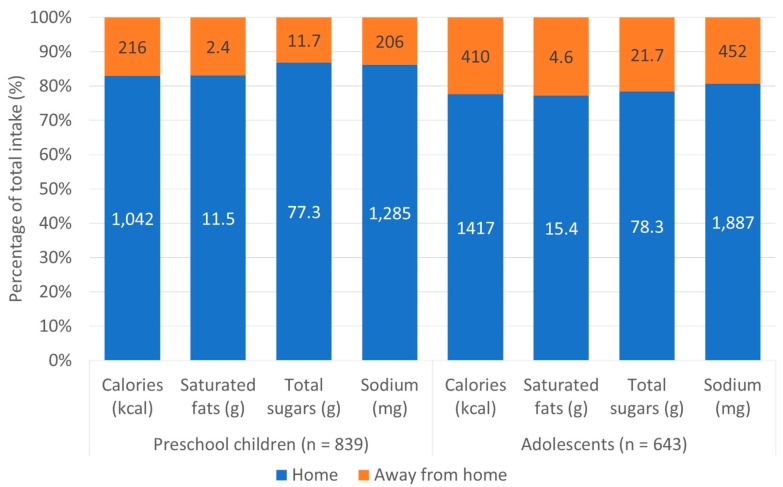
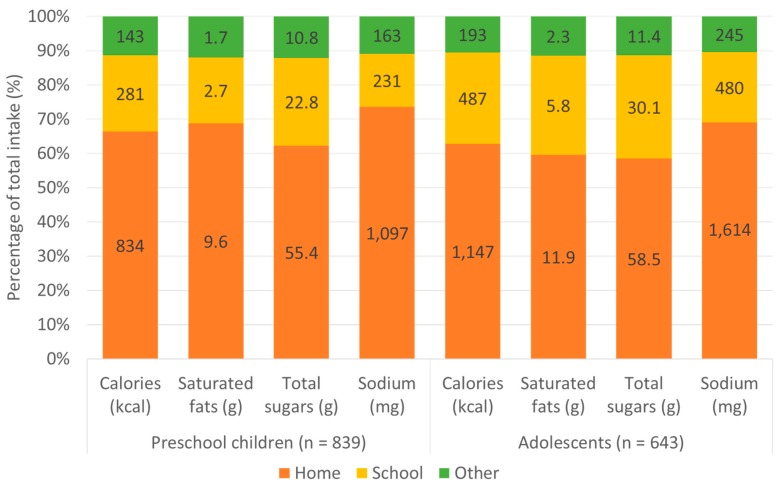
We analyzed 24 h dietary recalls collected in 2016 from low- and middle-income Chilean preschool children (3-6 years, n = 839) and adolescents (12-14 years, n = 643) from southeastern Santiago. Surveys collected the food source and eating location for each food reported during the recall. We estimated the mean intake of calories and key nutrients of concern, such as saturated fats, total sugars, and sodium, by food source and eating location.
Foods obtained and eaten at home contributed the greatest proportion of total calories and the key nutrients of concern. Foods obtained at home tended to have lower caloric densities but higher sugar and sodium densities than foods obtained away from home in both age groups. With regard to location, for preschool children foods consumed at home had lower caloric and sugar densities than foods eaten at school, while for adolescents foods consumed at home had lower caloric, saturated fat, and sugar densities than foods eaten at school. For both children and adolescents, home was the primary source of sugar-sweetened beverages (SSBs) calories. SSBs were important calorie contributors among foods across all settings, but the highest absolute amount of calories from these beverages was consumed at home.
While most of Chilean youths' calories and key nutrients of concern are obtained and consumed at home, these foods tended to have lower caloric densities than foods obtained and consumed away from home. Home was the main food source for SSBs, but the relative consumption of these beverages was high in all eating locations. More research will be needed to inform and evaluate policies and interventions to improve children's dietary quality across settings.
食物来源和进食地点是与饮食摄入质量相关的重要因素。在智利,学龄前儿童和青少年的主要食物来源和进食地点以及这些因素与饮食质量的关系尚不清楚。
我们分析了 2016 年在智利东南部圣地亚哥采集的来自低收入和中等收入家庭的 839 名学龄前儿童(3-6 岁)和 643 名青少年(12-14 岁)的 24 小时膳食回忆。调查收集了回忆中报告的每种食物的食物来源和进食地点。我们根据食物来源和进食地点估计了卡路里和关键营养素(如饱和脂肪、总糖和钠)的平均摄入量。
在家中获得和食用的食物提供了总卡路里和关键营养素的最大比例。在两个年龄段,与离家获取的食物相比,在家获取的食物热量密度较低,但糖和钠密度较高。就地点而言,对于学龄前儿童,在家中食用的食物的热量和糖密度低于在学校食用的食物,而对于青少年,在家中食用的食物的热量、饱和脂肪和糖密度低于在学校食用的食物。对于儿童和青少年来说,家是含糖饮料(SSB)卡路里的主要来源。SSB 是所有环境中重要的卡路里来源,但这些饮料的绝对卡路里摄入量最高。
虽然智利大部分青少年的卡路里和关键营养素都来自家庭,但这些食物的热量密度往往低于离家获取和食用的食物。家是 SSB 的主要食物来源,但这些饮料的相对摄入量在所有进食地点都很高。需要进一步研究,以提供信息并评估政策和干预措施,以改善儿童在所有环境中的饮食质量。