Tsai Wei-An, Weng Sung-Hsia, Chen Ming-Cheng, Lin Jeng-Shane, Tsai Wen-Shih
Hualien District Agricultural Research and Extension Station, Council of Agriculture, Executive Yuan, Hualien City, Taiwan.
Queensland Alliance for Agriculture and Food Innovation, The University of Queensland, St Lucia, QLD, Australia.
Front Plant Sci. 2019 Jul 12;10:906. doi: 10.3389/fpls.2019.00906. eCollection 2019.
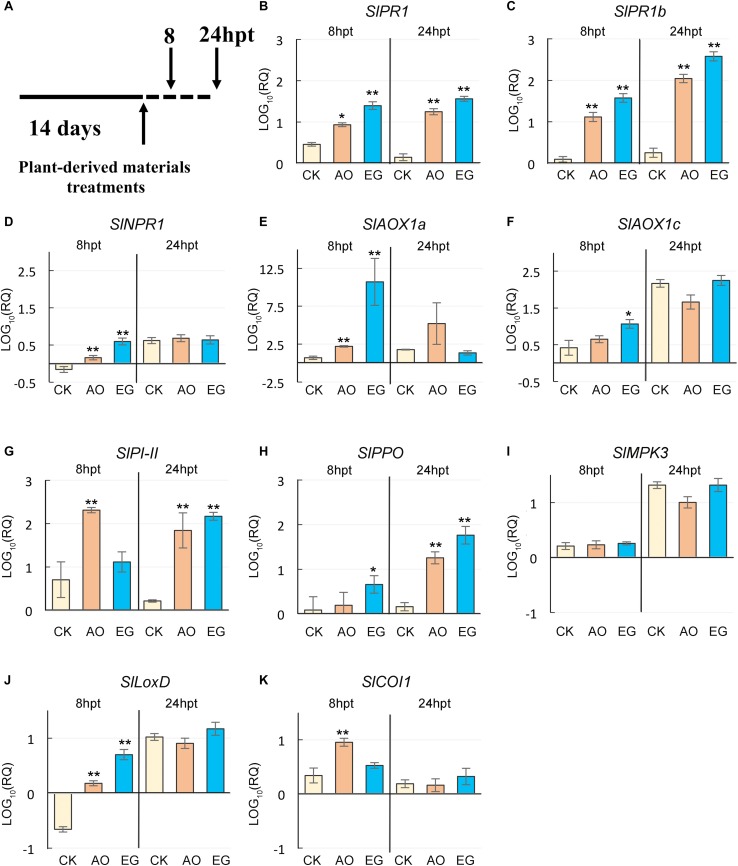
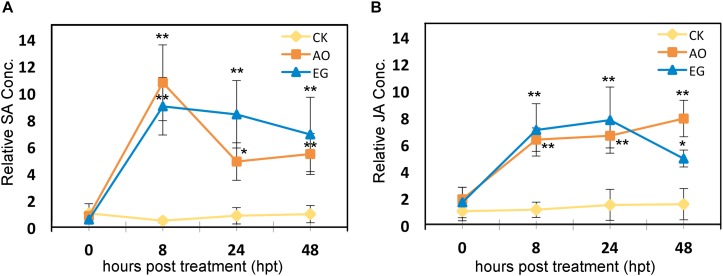
Plants are often simultaneously exposed to diverse environmental stresses, and can tune suitable responses to them through hormones. Salicylic acid (SA) and jasmonic acid (JA) signaling pathways are known to enhance resistance against heat stress and tomato yellow leaf curl Thailand virus (TYLCTHV) infection. However, there is limited information regarding alternative natural priming agents against heat stress and viruses. In this study, two plant-derived priming agents, eugenol and anise oil, were tested for their roles in conferring thermotolerance and virus resistance in tomato plants. Under heat stress, the survival rates and average fresh weight were higher in plants treated with eugenol or anise oil than in control plants. These two priming agents were further tested for antiviral activities. After TYLCTHV infection, the disease incidence and relative abundance of TYLCTHV were lower in anise oil- and eugenol-treated plants than in control plants. Further analyses revealed that a few SA, JA, and RNA silencing genes were enhanced in the former. Moreover, SA, JA, and HO contents increased considerably after eugenol and anise oil treatments. Our findings imply that anise oil and eugenol initiated SA- and JA-mediated defenses to promote thermotolerance and antiviral responses of tomato plants.
植物常常同时面临多种环境胁迫,并能通过激素调节对这些胁迫作出合适的反应。已知水杨酸(SA)和茉莉酸(JA)信号通路可增强植物对热胁迫和番茄黄化曲叶泰国病毒(TYLCTHV)感染的抗性。然而,关于对抗热胁迫和病毒的其他天然引发剂的信息有限。在本研究中,测试了两种植物源引发剂丁香酚和茴芹油在赋予番茄植株耐热性和抗病毒性方面的作用。在热胁迫下,用丁香酚或茴芹油处理的植株的存活率和平均鲜重高于对照植株。进一步测试了这两种引发剂的抗病毒活性。在感染TYLCTHV后,用茴芹油和丁香酚处理的植株的发病率和TYLCTHV的相对丰度低于对照植株。进一步分析表明,前者中一些SA、JA和RNA沉默基因得到增强。此外,丁香酚和茴芹油处理后,SA、JA和H2O2含量显著增加。我们的研究结果表明,茴芹油和丁香酚启动了SA和JA介导的防御反应,以促进番茄植株的耐热性和抗病毒反应。