Doheny Eye Institute, Los Angeles, CA, 90033, USA.
Australian e-Health Research Centre, CSIRO, Perth, Australia.
Sci Rep. 2019 Jul 29;9(1):10990. doi: 10.1038/s41598-019-47390-3.
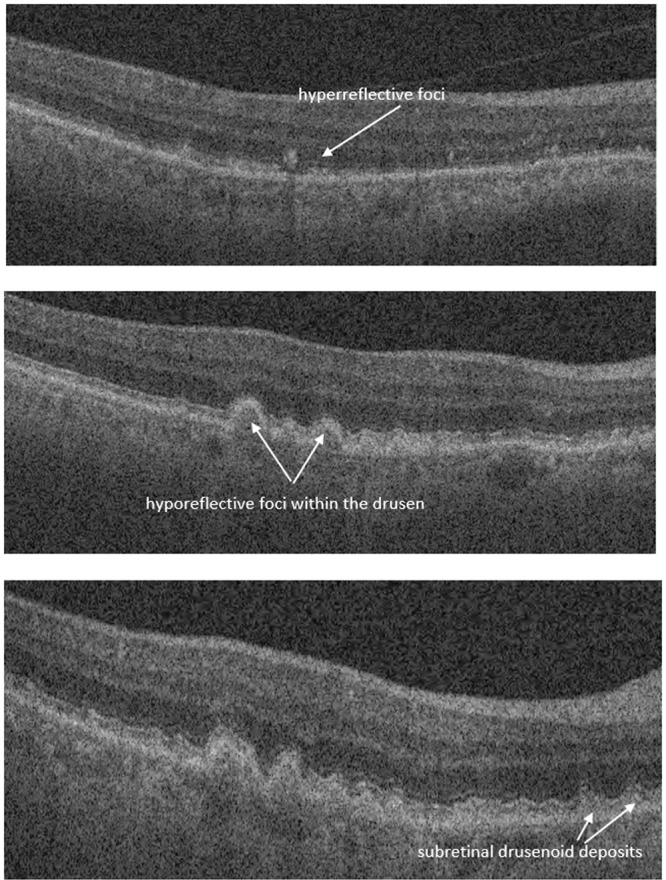
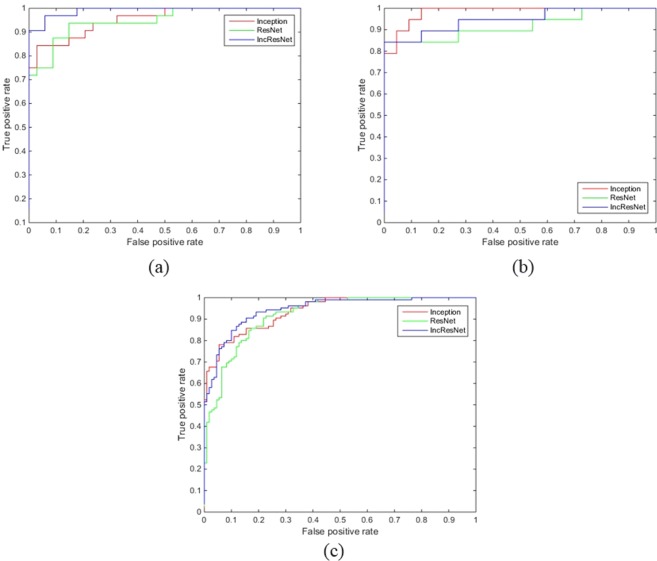
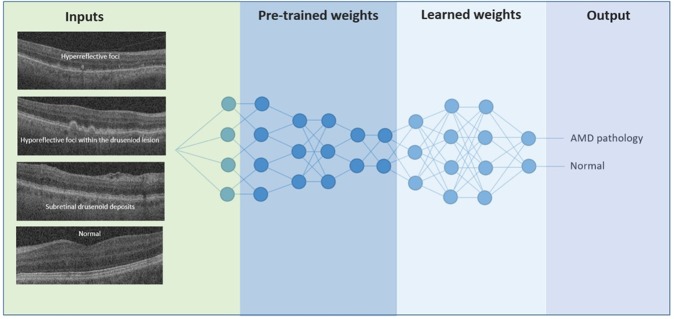
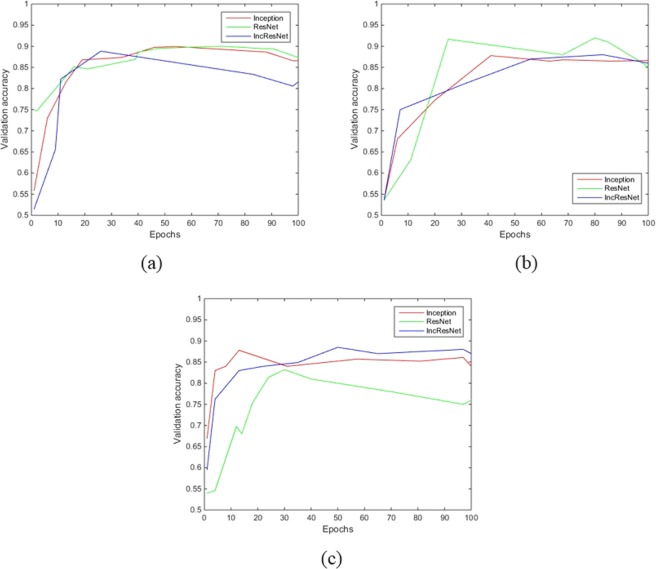
Age-related macular degeneration (AMD) affects millions of people and is a leading cause of blindness throughout the world. Ideally, affected individuals would be identified at an early stage before late sequelae such as outer retinal atrophy or exudative neovascular membranes develop, which could produce irreversible visual loss. Early identification could allow patients to be staged and appropriate monitoring intervals to be established. Accurate staging of earlier AMD stages could also facilitate the development of new preventative therapeutics. However, accurate and precise staging of AMD, particularly using newer optical coherence tomography (OCT)-based biomarkers may be time-intensive and requires expert training which may not feasible in many circumstances, particularly in screening settings. In this work we develop deep learning method for automated detection and classification of early AMD OCT biomarker. Deep convolution neural networks (CNN) were explicitly trained for performing automated detection and classification of hyperreflective foci, hyporeflective foci within the drusen, and subretinal drusenoid deposits from OCT B-scans. Numerous experiments were conducted to evaluate the performance of several state-of-the-art CNNs and different transfer learning protocols on an image dataset containing approximately 20000 OCT B-scans from 153 patients. An overall accuracy of 87% for identifying the presence of early AMD biomarkers was achieved.
年龄相关性黄斑变性(AMD)影响着数百万人,是全球致盲的主要原因。理想情况下,在晚期后遗症(如外视网膜萎缩或渗出性新生血管膜)出现之前,就应及早发现受影响的个体,这可能导致不可逆转的视力丧失。早期发现可以使患者分期,并确定适当的监测间隔。早期 AMD 阶段的准确分期也可以促进新的预防性治疗方法的发展。然而,AMD 的准确和精确分期,特别是使用新的基于光学相干断层扫描(OCT)的生物标志物,可能需要耗费大量时间,并且需要专家培训,而在许多情况下,特别是在筛查环境中,这可能是不切实际的。在这项工作中,我们开发了一种用于自动检测和分类早期 AMD OCT 生物标志物的深度学习方法。深度卷积神经网络(CNN)被专门用于从 OCT B 扫描中自动检测和分类高反射焦点、玻璃膜疣内低反射焦点和视网膜下玻璃膜疣状沉积物。进行了大量实验,以评估几种最先进的 CNN 和不同迁移学习协议在包含约 20000 个来自 153 名患者的 OCT B 扫描的图像数据集上的性能。通过识别早期 AMD 生物标志物的存在,实现了 87%的总体准确性。