Research Centre for Analytical Instrumentation, Institute of Cyber-Systems and Control, State Key Laboratory of Industrial Control Technology, Zhejiang University, Hangzhou, 310058, China.
Cancer Institute (Key Laboratory of Cancer Prevention and Intervention, National Ministry of Education), The Second Affiliated Hospital, School of Medicine, Zhejiang University, Hangzhou, 310009 China and Institute of Translational Medicine, Zhejiang University, Hangzhou, 310029 China.
Lab Chip. 2019 Sep 7;19(17):2769-2785. doi: 10.1039/c9lc00389d. Epub 2019 Jul 31.
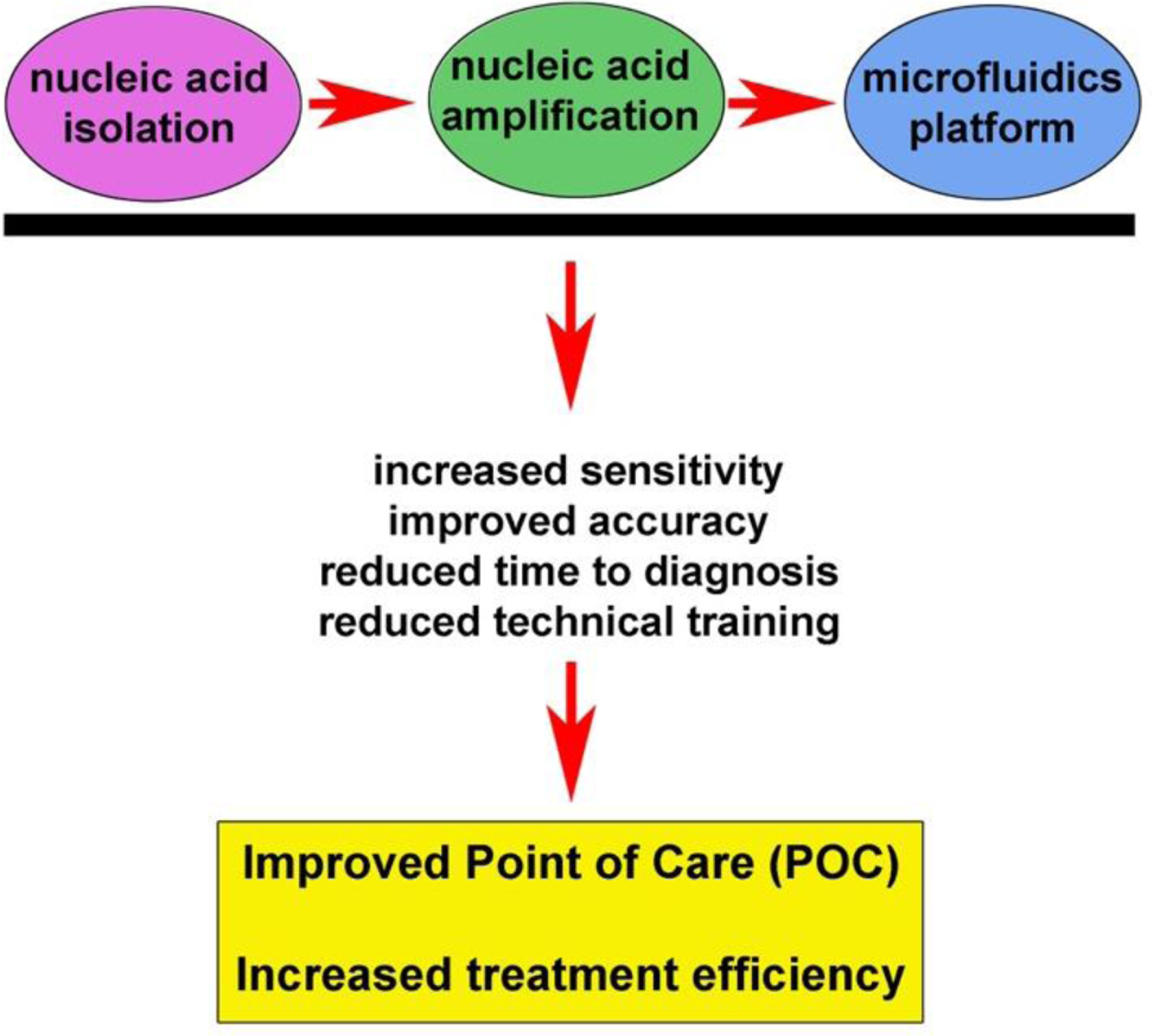
Rapid, efficient and accurate nucleic acid molecule detection is important in the screening of diseases and pathogens, yet remains a limiting factor at point of care (POC) treatment. Microfluidic systems are characterized by fast, integrated, miniaturized features which provide an effective platform for qualitative and quantitative detection of nucleic acid molecules. The nucleic acid detection process mainly includes sample preparation and target molecule amplification. Given the advancements in theoretical research and technological innovations to date, nucleic acid extraction and amplification integrated with microfluidic systems has advanced rapidly. The primary goal of this review is to outline current approaches used for nucleic acid detection in the context of microfluidic systems. The secondary goal is to identify new approaches that will help shape future trends at the intersection of nucleic acid detection and microfluidics, particularly with regard to increasing disease and pathogen detection for improved diagnosis and treatment.
快速、高效、准确的核酸分子检测在疾病和病原体的筛查中至关重要,但在即时护理(POC)治疗中仍是一个限制因素。微流控系统具有快速、集成、小型化的特点,为定性和定量检测核酸分子提供了有效的平台。核酸检测过程主要包括样品制备和目标分子扩增。鉴于目前理论研究和技术创新的进展,核酸提取和扩增与微流控系统的集成已迅速发展。本文的主要目标是概述当前在微流控系统中用于核酸检测的方法。次要目标是确定新的方法,以帮助塑造核酸检测与微流控交叉领域的未来趋势,特别是在提高疾病和病原体检测方面,以改善诊断和治疗。