Department of Microbiology, College of Medicine and Medical Research Institute, Chungbuk National University, Chungdae-ro 1, Seowon-Ku, Cheongju, 28644, Republic of Korea.
Department of Clinical Laboratory Science, Chungbuk Health and Science University, Cheongju, Republic of Korea.
BMC Infect Dis. 2019 Aug 1;19(1):676. doi: 10.1186/s12879-019-4277-8.
In addition to seasonal influenza viruses recently circulating in humans, avian influenza viruses (AIVs) of H5N1, H5N6 and H7N9 subtypes have also emerged and demonstrated human infection abilities with high mortality rates. Although influenza viral infections are usually diagnosed using viral isolation and serological/molecular analyses, the cost, accessibility, and availability of these methods may limit their utility in various settings. The objective of this study was to develop and optimized a multiplex detection system for most influenza viruses currently infecting humans.
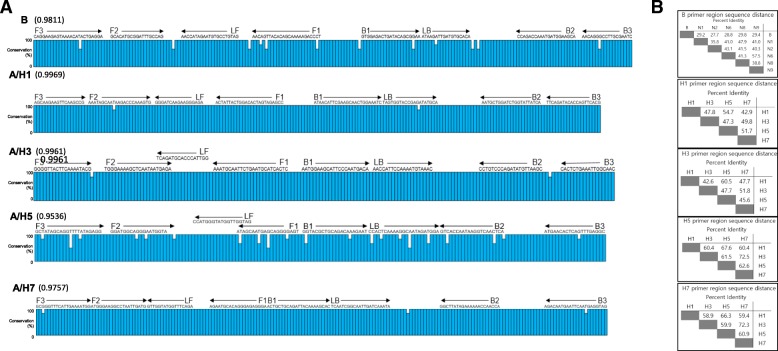
We developed and optimized a multiplex detection system for most influenza viruses currently infecting humans including two type B (both Victoria lineages and Yamagata lineages), H1N1, H3N2, H5N1, H5N6, and H7N9 using Reverse Transcriptional Loop-mediated Isothermal Amplification (RT-LAMP) technology coupled with a one-pot colorimetric visualization system to facilitate direct determination of results without additional steps. We also evaluated this multiplex RT-LAMP for clinical use using a total of 135 clinical and spiked samples (91 influenza viruses and 44 other human infectious viruses).
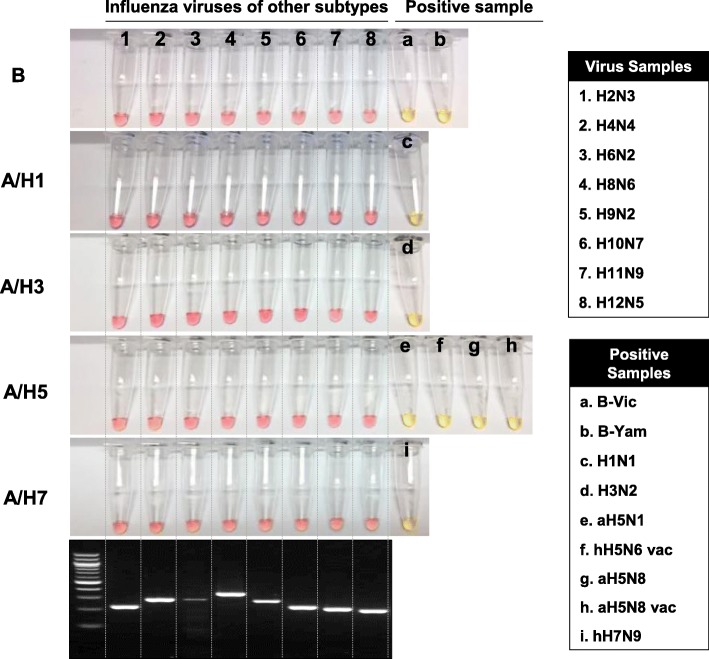
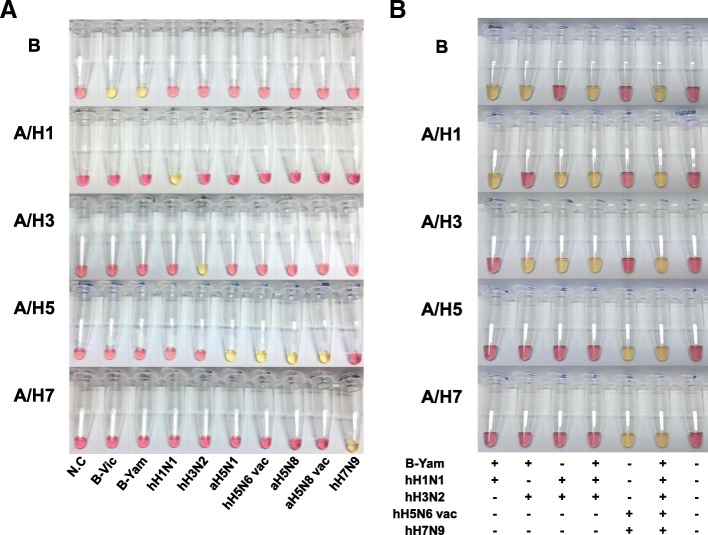
We achieved rapid detection of seasonal influenza viruses (H1N1, H3N2, and Type B) and avian influenza viruses (H5N1, H5N6, H5N8 and H7N9) within an hour. The assay could detect influenza viruses with high sensitivity (i.e., from 100 to 0.1 viral genome copies), comparable to conventional RT-PCR-based approaches which would typically take several hours and require expensive equipment. This assay was capable of specifically detecting each influenza virus (Type B, H1N1, H3N2, H5N1, H5N6, H5N8 and H7N9) without cross-reactivity with other subtypes of AIVs or other human infectious viruses. Furthermore, 91 clinical and spiked samples confirmed by qRT-PCR were also detected by this multiplex RT-LAMP with 98.9% agreement. It was more sensitive than one-step RT-PCR approach (92.3%).
Results of this study suggest that our multiplex RT-LAMP assay may provide a rapid, sensitive, cost-effective, and reliable diagnostic method for identifying recent influenza viruses infecting humans, especially in locations without access to large platforms or sophisticated equipment.
除了最近在人类中流行的季节性流感病毒外,H5N1、H5N6 和 H7N9 亚型的禽流感病毒也已出现,并显示出具有高死亡率的人类感染能力。尽管流感病毒感染通常使用病毒分离和血清学/分子分析进行诊断,但这些方法的成本、可及性和可用性可能会限制其在各种情况下的应用。本研究的目的是开发和优化一种用于目前感染人类的大多数流感病毒的多重检测系统。
我们使用逆转录环介导等温扩增(RT-LAMP)技术开发和优化了一种用于目前感染人类的大多数流感病毒的多重检测系统,包括两种乙型(维多利亚谱系和 Yamagata 谱系)、H1N1、H3N2、H5N1、H5N6 和 H7N9,该系统结合了一种一锅式比色可视化系统,便于直接确定结果,无需额外步骤。我们还使用总共 135 个临床和加标样本(91 个流感病毒和 44 个其他人类传染性病毒)评估了这种多重 RT-LAMP 的临床应用。
我们在一小时内实现了季节性流感病毒(H1N1、H3N2 和 B 型)和禽流感病毒(H5N1、H5N6、H5N8 和 H7N9)的快速检测。该检测方法具有较高的灵敏度(即,从 100 到 0.1 个病毒基因组拷贝),与传统的基于 RT-PCR 的方法相当,后者通常需要数小时,并且需要昂贵的设备。该检测方法能够特异性检测每种流感病毒(B 型、H1N1、H3N2、H5N1、H5N6、H5N8 和 H7N9),与其他禽流感病毒亚型或其他人类传染性病毒无交叉反应。此外,通过 qRT-PCR 确认的 91 个临床和加标样本也通过该多重 RT-LAMP 检测到,一致性为 98.9%。它比一步法 RT-PCR 方法(92.3%)更敏感。
本研究结果表明,我们的多重 RT-LAMP 检测方法可能为鉴定近期感染人类的流感病毒提供一种快速、灵敏、经济有效的可靠诊断方法,尤其是在无法获得大型平台或复杂设备的地方。