Tian Hui, Kah Melanie, Kariman Khalil
Key Laboratory of Plant Nutrition and Agri-environment in Northwest China, Ministry of Agriculture, College of Natural Resources and Environment, Northwest A&F University, Yangling, China.
School of Environment, The University of Auckland, Auckland, New Zealand.
Front Microbiol. 2019 Jul 24;10:1660. doi: 10.3389/fmicb.2019.01660. eCollection 2019.
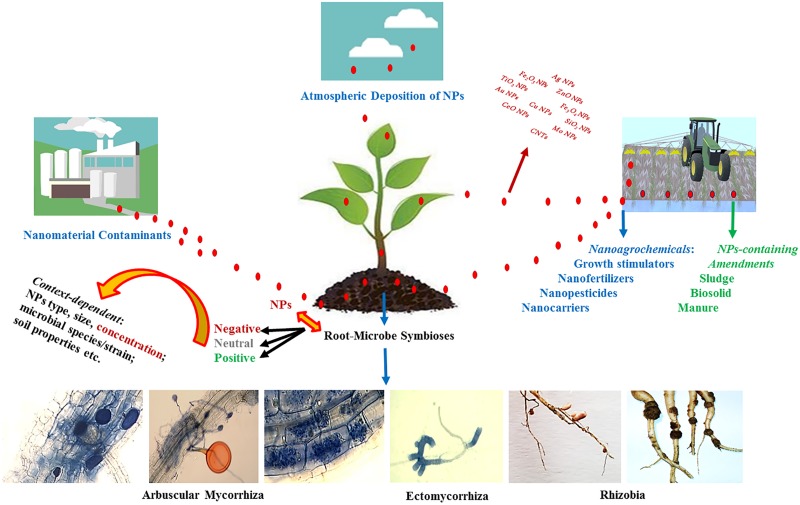
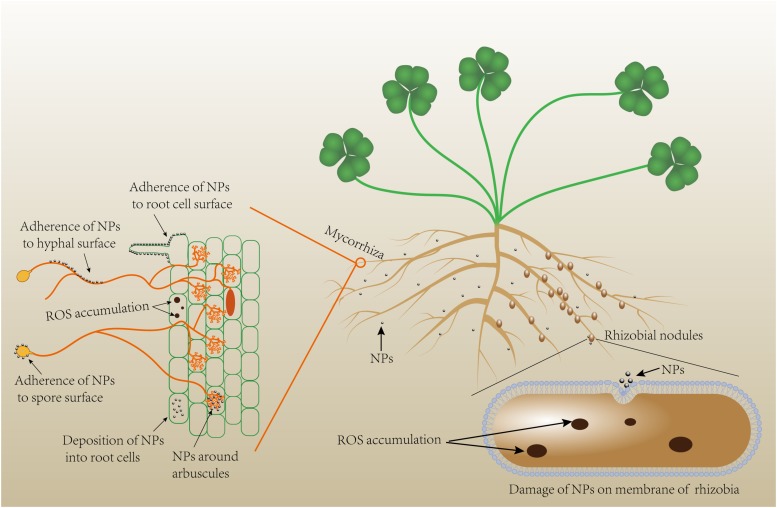
Soil microorganisms can be exposed to, and affected by, nanoparticles (NPs) that are either purposely released into the environment (e.g., nanoagrochemicals and NP-containing amendments) or reach soil as nanomaterial contaminants. It is crucial to evaluate the potential impact of NPs on key plant-microbe symbioses such as mycorrhizas and rhizobia, which are vital for health, functioning and sustainability of both natural and agricultural ecosystems. Our critical review of the literature indicates that NPs may have neutral, negative, or positive effects on development of mycorrhizal and rhizobial symbioses. The net effect of NPs on mycorrhizal development is driven by various factors including NPs type, speciation, size, concentration, fungal species, and soil physicochemical properties. As expected for potentially toxic substances, NPs concentration was found to be the most critical factor determining the toxicity of NPs against mycorrhizas, as even less toxic NPs such as ZnO NPs can be inhibitory at high concentrations, and highly toxic NPs such as Ag NPs can be stimulatory at low concentrations. Likewise, rhizobia show differential responses to NPs depending on the NPs concentration and the properties of NPs, rhizobia, and growth substrate, however, most rhizobial studies have been conducted in soil-less media, and the documented effects cannot be simply interpreted within soil systems in which complex interactions occur. Overall, most studies indicating adverse effects of NPs on mycorrhizas and rhizobia have been performed using either unrealistically high NP concentrations that are unlikely to occur in soil, or simple soil-less media (e.g., hydroponic cultures) that provide limited information about the processes occurring in the real environment/agrosystems. To safeguard these ecologically paramount associations, along with other ecotoxicological considerations, large-scale application of NPs in farming systems should be preceded by long-term field trials and requires an appropriate application rate and comprehensive (preferably case-specific) assessment of the context parameters i.e., the properties of NPs, microbial symbionts, and soil. Directions and priorities for future research are proposed based on the gaps and experimental restrictions identified.
土壤微生物可能会接触到纳米颗粒(NPs)并受到其影响,这些纳米颗粒要么是有意释放到环境中的(例如纳米农用化学品和含NP的改良剂),要么作为纳米材料污染物进入土壤。评估纳米颗粒对关键植物-微生物共生关系(如菌根和根瘤菌)的潜在影响至关重要,这些共生关系对于自然和农业生态系统的健康、功能和可持续性至关重要。我们对文献的批判性综述表明,纳米颗粒可能对菌根和根瘤菌共生关系的发展产生中性、负面或正面影响。纳米颗粒对菌根发育的净效应受多种因素驱动,包括纳米颗粒类型、形态、大小、浓度、真菌种类和土壤理化性质。正如对潜在有毒物质的预期那样,纳米颗粒浓度被发现是决定纳米颗粒对菌根毒性的最关键因素,因为即使毒性较小的纳米颗粒(如ZnO纳米颗粒)在高浓度下也可能具有抑制作用,而毒性高的纳米颗粒(如Ag纳米颗粒)在低浓度下可能具有刺激作用。同样,根瘤菌对纳米颗粒的反应也因纳米颗粒浓度以及纳米颗粒、根瘤菌和生长基质的性质而异,然而,大多数根瘤菌研究是在无土培养基中进行的,所记录的效应无法简单地在发生复杂相互作用的土壤系统中进行解释。总体而言,大多数表明纳米颗粒对菌根和根瘤菌有不利影响的研究,要么使用了土壤中不太可能出现的过高纳米颗粒浓度,要么使用了提供关于实际环境/农业系统中发生过程有限信息的简单无土培养基(如水培培养)。为了保护这些对生态至关重要的关联,以及出于其他生态毒理学考虑,在农业系统中大规模应用纳米颗粒之前,应进行长期田间试验,并需要适当的施用量以及对背景参数(即纳米颗粒、微生物共生体和土壤的性质)进行全面(最好是针对具体情况)的评估。基于已确定的差距和实验限制,提出了未来研究的方向和重点。