School of Allied Health Science, Department of Nursing, Osaka University, Osaka, Japan.
School of Nursing, Juntendo University, Chiba, Japan.
PLoS One. 2019 Aug 19;14(8):e0219589. doi: 10.1371/journal.pone.0219589. eCollection 2019.
The aging of populations is rapidly accelerating worldwide. Especially, Japan has maintained the highest rate of population aging worldwide. As countermeasures, the Japanese government prioritized the promotion of local comprehensive care systems and collaboration in medical care and social (long-term) care. Development of a system to connect medical and social services in the community is necessary for the increasing older people, especially for the people in the stage of end of life.
This study aimed to assess the effect of a multidisciplinary end-of-life educational intervention program on confidence in inter-professional collaboration and job satisfaction among health and social care professionals.
a cluster-randomized controlled trial.
SETTING/PARTICIPANTS: Three professional groups (home care nurses, care managers, and heads of care workers) in an urban area participated in this trial.
We implemented a multidisciplinary end-of-life educational intervention program comprising two educational workshops and an educational booklet to support multidisciplinary care for end-of-life patients during the 7-month study period.
Confidence in improved interactions among professionals and job satisfaction were assessed with the Face-to-Face Cooperative Confidence Questionnaire and the Minnesota Satisfaction Questionnaire at T1 (before intervention) and T2 (7 months after the intervention).
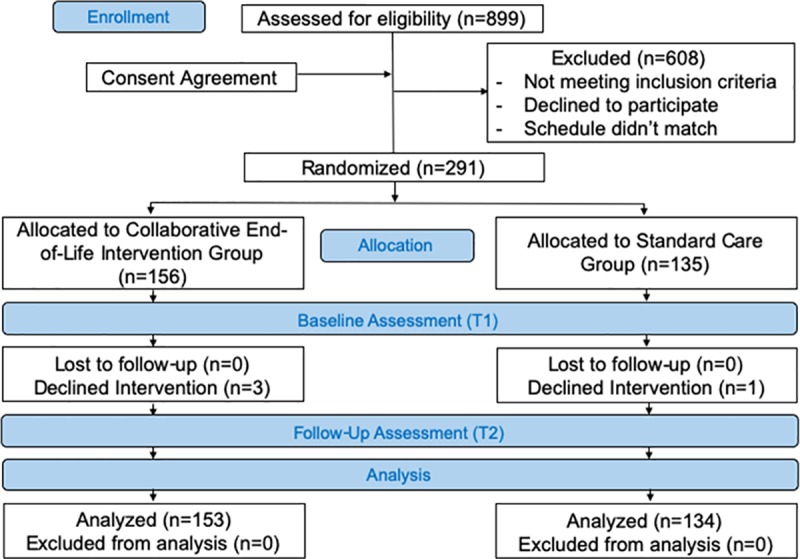
In total, 291 professionals participated in this study (experimental group n = 156; control group n = 135). Multivariate regression analyses showed significant between-group increases on all of seven subscales in participants' face-to-face cooperative confidence over the study period; no effect was evident regarding job satisfaction.
A multidisciplinary end-of-life educational intervention program increased confidence in multidisciplinary collaboration among health and social care professionals.
UMIN Clinical Trial Registry, Japan UMIN000022772.
全球人口老龄化正在迅速加速。特别是,日本保持着全球人口老龄化率最高的纪录。作为应对措施,日本政府优先推动地方综合护理系统以及医疗和社会(长期)护理的协作。为了满足不断增加的老年人的需求,特别是临终阶段的老年人,开发一种将医疗和社区社会服务联系起来的系统是必要的。
本研究旨在评估多学科临终教育干预方案对卫生和社会保健专业人员在跨专业协作和工作满意度方面的信心的影响。
整群随机对照试验。
地点/参与者:该试验涉及城市地区的三个专业群体(家庭护理护士、护理经理和护理工作者负责人)。
我们实施了多学科临终教育干预方案,包括两个教育研讨会和一本教育手册,以在 7 个月的研究期间为临终患者提供多学科护理支持。
在 T1(干预前)和 T2(干预后 7 个月),使用面对面合作信心问卷和明尼苏达满意度问卷评估专业人员之间互动信心的改善和工作满意度。
共有 291 名专业人员参与了这项研究(实验组 n = 156;对照组 n = 135)。多变量回归分析显示,在研究期间,参与者在面对面合作信心的所有七个子量表上均表现出显著的组间增长;而工作满意度则没有明显效果。
多学科临终教育干预方案提高了卫生和社会保健专业人员对多学科协作的信心。
日本 UMIN 临床试验注册中心,UMIN000022772。