Duffy Ian R, Boyle Amanda J, Vasdev Neil
1 Azrieli Centre for Neuro-Radiochemistry, Research Imaging Centre, Centre for Addiction and Mental Health, Toronto, Ontario, Canada.
2 Department of Psychiatry, University of Toronto, Toronto, Ontario, Canada.
Mol Imaging. 2019 Jan-Dec;18:1536012119869070. doi: 10.1177/1536012119869070.
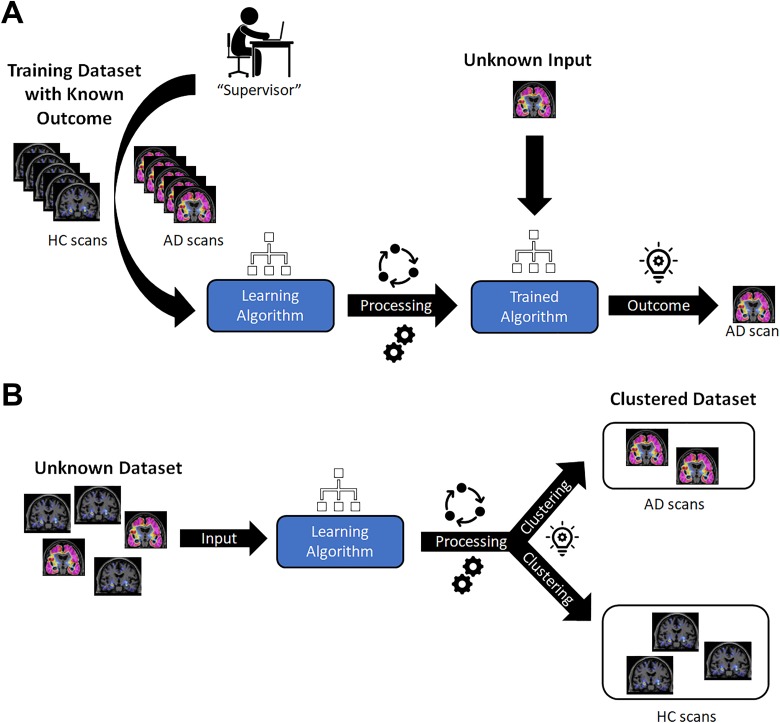
Machine learning (ML) algorithms have found increasing utility in the medical imaging field and numerous applications in the analysis of digital biomarkers within positron emission tomography (PET) imaging have emerged. Interest in the use of artificial intelligence in PET imaging for the study of neurodegenerative diseases and oncology stems from the potential for such techniques to streamline decision support for physicians providing early and accurate diagnosis and allowing personalized treatment regimens. In this review, the use of ML to improve PET image acquisition and reconstruction is presented, along with an overview of its applications in the analysis of PET images for the study of Alzheimer's disease and oncology.
机器学习(ML)算法在医学成像领域的应用越来越广泛,并且在正电子发射断层扫描(PET)成像中的数字生物标志物分析方面出现了众多应用。对在PET成像中使用人工智能来研究神经退行性疾病和肿瘤学的兴趣源于此类技术有可能简化医生的决策支持,从而实现早期准确诊断并制定个性化治疗方案。在本综述中,介绍了使用ML来改善PET图像采集和重建的方法,以及其在分析PET图像以研究阿尔茨海默病和肿瘤学方面的应用概述。