Section of Biology and Environmental Science, Department of Chemistry and Bioscience, Aalborg University, Frederik Bajers Vej 7H, Aalborg, DK 9220, Denmark.
Department of Bioscience, Aarhus University, Ny Munkegade 116, DK-8000, Aarhus C, Denmark.
Sci Rep. 2019 Aug 23;9(1):12305. doi: 10.1038/s41598-019-48752-7.
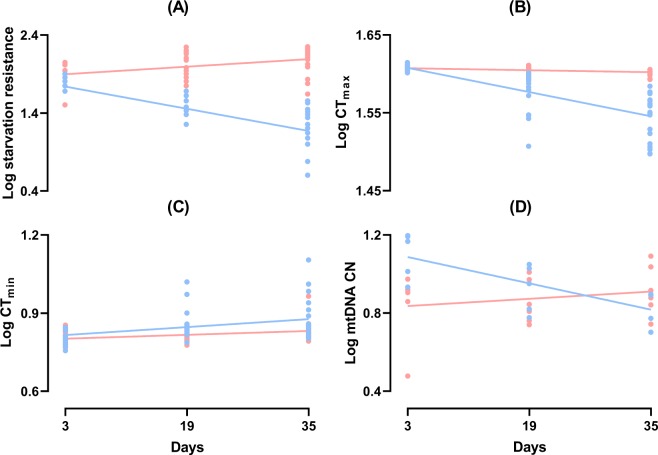
Environmental stresses such as extreme temperatures, dehydration and food deprivation may have distinct consequences for different age-classes and for males and females across species. Here we investigate a natural population of the model organism Drosophila melanogaster. Males and females at ages 3, 19 and 35 days were tested for stress resistance; i.e. the ability of flies to cope with starvation and both cold and hot temperatures. Further, we tested a measure of metabolic efficiency, namely mitochondrial DNA copy number (mtDNA CN) in both sexes at all three age-classes. We hypothesize that stress resistance is reduced at old age and more so in males, and that mtDNA CN is a biomarker for sex- and age-dependent reductions in the ability to cope with harsh environments. We show that: (1) males exhibit reduced starvation tolerance at old age, whereas older females are better in coping with periods without food compared to younger females, (2) heat tolerance decreases with increasing age in males but not in females, (3) cold tolerance is reduced at old age in both sexes, and (4) old males have reduced mtDNA CN whereas mtDNA CN slightly increases with age in females. In conclusion, our data provide strong evidence for trait and sex specific consequences of aging with females generally being better at coping with environmental stress at old age. The reduced mtDNA CN in old males suggests reduced metabolic efficiency and this may partly explain why males are less stress tolerant at old age than females. We suggest that mtDNA CN might be a suitable biomarker for physiological robustness. Our findings likely extend to other taxa than Drosophila and therefore we discuss the observations in relation to aging and sex specific lifespan across species.
环境压力,如极端温度、脱水和食物匮乏,可能对不同年龄段和不同物种的雄性和雌性产生不同的影响。在这里,我们研究了一个模型生物黑腹果蝇的自然种群。对 3、19 和 35 天大的雄性和雌性进行了抗应激能力测试;即苍蝇应对饥饿以及冷、热温度的能力。此外,我们测试了一种代谢效率的衡量标准,即在所有三个年龄段的两性中都检测线粒体 DNA 拷贝数 (mtDNA CN)。我们假设抗应激能力随着年龄的增长而降低,雄性更为明显,并且 mtDNA CN 是衡量两性随年龄增长而降低应对恶劣环境能力的生物标志物。我们的研究结果表明:(1)雄性在老年时表现出较低的耐饥饿能力,而老年雌性比年轻雌性在没有食物的情况下更能应对,(2)雄性的耐热能力随年龄的增长而降低,但雌性则不然,(3)两性的耐寒能力都随着年龄的增长而降低,(4)老年雄性的 mtDNA CN 减少,而雌性的 mtDNA CN 随着年龄的增长略有增加。综上所述,我们的数据为衰老对特征和性别产生的特定影响提供了强有力的证据,表明雌性在老年时通常更能应对环境压力。老年雄性的 mtDNA CN 减少表明代谢效率降低,这可能部分解释了为什么雄性在老年时比雌性更不耐受应激。我们认为 mtDNA CN 可能是生理稳健性的合适生物标志物。我们的发现可能不仅限于果蝇等其他分类群,因此我们将这些观察结果与不同物种的衰老和性别特异性寿命联系起来进行讨论。