Department of Child and Adolescent Psychiatry, Center of Expertise on Gender Dysphoria, Amsterdam UMC, Vrije Universiteit Amsterdam, De Boelelaan 1117, Amsterdam, The Netherlands.
Department of Epidemiology and Biostatics, Amsterdam UMC, Vrije Universiteit Amsterdam, De Boelelaan 1117, Amsterdam, The Netherlands.
Eur Child Adolesc Psychiatry. 2020 Jun;29(6):803-811. doi: 10.1007/s00787-019-01394-6. Epub 2019 Aug 31.
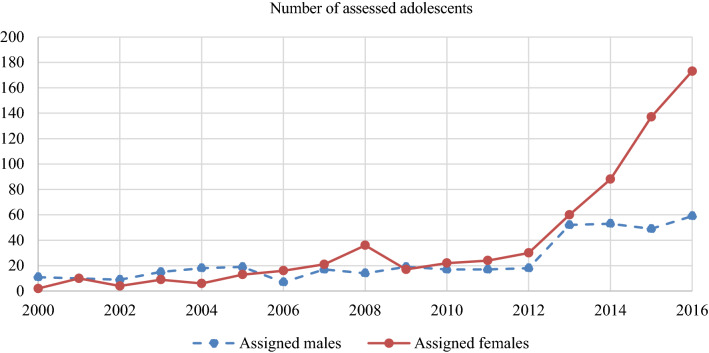
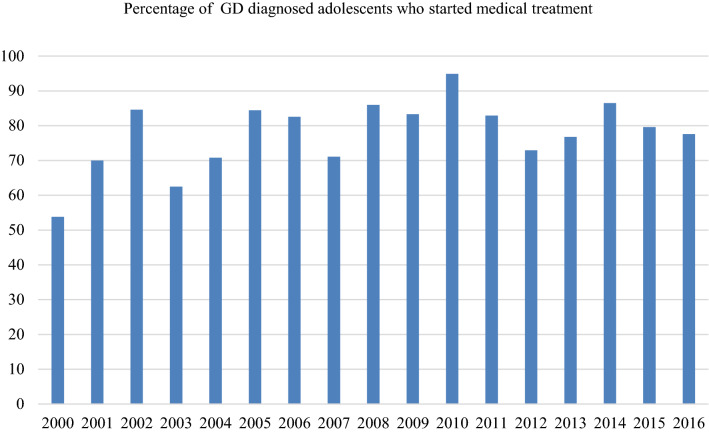
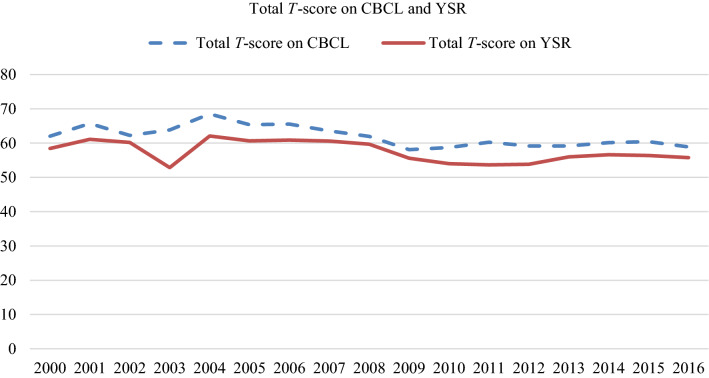
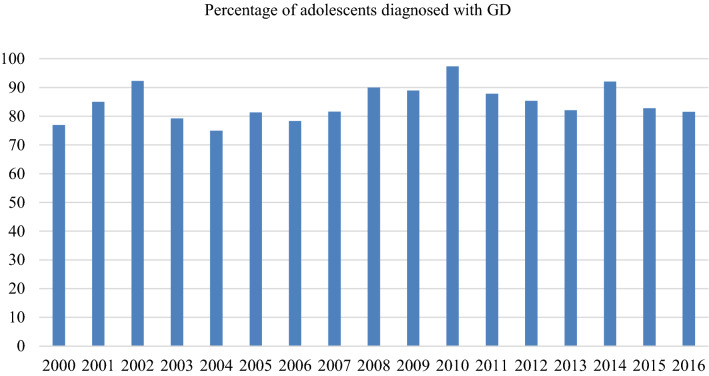
The background of this article is to examine whether consecutively transgender clinic-referred adolescents between 2000 and 2016 differ over time in demographic, psychological, diagnostic, and treatment characteristics. The sample under study consisted of 1072 adolescents (404 assigned males, 668 assigned females, mean age 14.6 years, and range 10.1-18.1 years). The data regarding the demographic, diagnostic, and treatment characteristics were collected from the adolescents' files. Psychological functioning was measured by the Child Behaviour Check List and the Youth Self-Report, intensity of gender dysphoria by the Utrecht Gender Dysphoria Scale. Time trend analyses were performed with 2016 as reference year. Apart from a shift in sex ratio in favour of assigned females, no time trends were observed in demographics and intensity of dysphoria. It was found, however, that the psychological functioning improved somewhat over time (CBCL β - 0.396, p < 0.001, 95% CI - 0.553 to - 0.240, YSR β - 0.278, p < 0.001, 95% CI - 0.434 to - 0.122). The percentage of referrals diagnosed with gender dysphoria (mean 84.6%, range 75-97.4%) remained the same. The percentage of diagnosed adolescents that started with affirmative medical treatment (puberty suppression and/or gender-affirming hormones) did not change over time (mean 77.7%; range 53.8-94.9%). These findings suggest that the recently observed exponential increase in referrals might reflect that seeking help for gender dysphoria has become more common rather than that adolescents are referred to gender identity services with lower intensities of gender dysphoria or more psychological difficulties.
本文的背景是研究 2000 年至 2016 年间连续转诊的跨性别青少年诊所的人口统计学、心理学、诊断和治疗特征是否随时间发生变化。研究样本包括 1072 名青少年(404 名被分配为男性,668 名被分配为女性,平均年龄为 14.6 岁,范围为 10.1-18.1 岁)。有关人口统计学、诊断和治疗特征的数据是从青少年的档案中收集的。心理功能通过儿童行为检查表和青少年自我报告进行测量,性别焦虑的强度通过乌得勒支性别焦虑量表进行测量。时间趋势分析以 2016 年为参考年。除了性别比例向分配女性倾斜的变化外,人口统计学和焦虑强度没有观察到时间趋势。然而,发现随着时间的推移,心理功能有所改善(CBCLβ-0.396,p<0.001,95%置信区间-0.553 至-0.240,YSRβ-0.278,p<0.001,95%置信区间-0.434 至-0.122)。被诊断为性别焦虑症的转诊患者比例(平均 84.6%,范围为 75-97.4%)保持不变。开始接受肯定性医疗治疗(青春期抑制和/或性别肯定激素)的被诊断为青少年的比例在时间上没有变化(平均 77.7%;范围为 53.8-94.9%)。这些发现表明,最近观察到的转诊人数呈指数级增长可能反映出寻求性别焦虑症帮助的现象变得更为普遍,而不是青少年的性别焦虑症强度或更多心理困难程度较低,更倾向于寻求性别认同服务。