Chen Bing Bing, Han Ying, Pan Xinting, Yan Jianhui, Liu Wenjuan, Li Yangfan, Lin Xu, Xu Shanghua, Peng Xian-E
Department of Epidemiology and Health Statistics, Fujian Provincial Key Laboratory of Environment Factors and Cancer, School of Public Health, Fujian Medical University, Fuzhou, China.
Fujian Hypertension Research Institute, VIP ward, The First Affiliated Hospital of Fujian Medical University, Fuzhou, Fujian, China.
BMJ Open. 2019 Sep 4;9(9):e028961. doi: 10.1136/bmjopen-2019-028961.
Nut consumption has been associated with a lower risk of type 2 diabetes, metabolic syndrome and insulin resistance. However, its effect on the risk of non-alcoholic fatty liver disease (NAFLD) is unknown. Therefore, we investigated the relationship between nut consumption and NAFLD risk.
We conducted a retrospective case-control study including 534 patients diagnosed with NAFLD and 534 controls matched by sex and age (±5 years) from the Affiliated Nanping First Hospital of Fujian Medical University in China.
Information on dietary intake was collected using a semiquantitative food frequency questionnaire and nut consumption was calculated. Nut consumption was categorised using quartiles based on the distribution of daily nut intake of the controls. Binary logistic regression models were used to estimate ORs and the 95% CIs for the association between nut consumption and NAFLD risk.
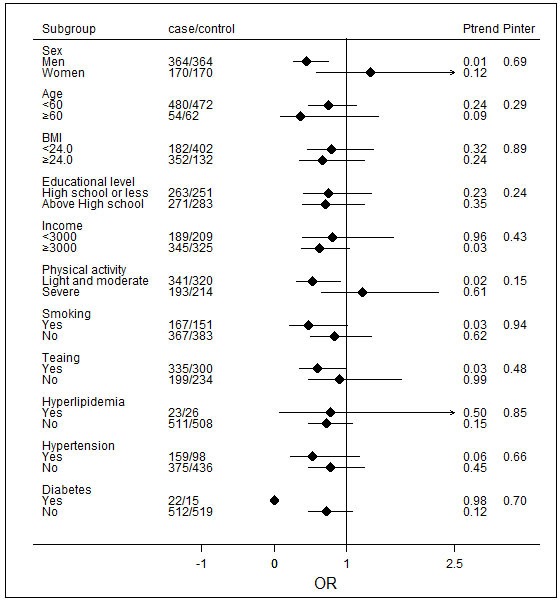
After adjusting for potential confounding variables, nut consumption was not associated with NAFLD risk in the overall sample. When the fully adjusted model was stratified by sex, a significant inverse association was found between high nut consumption and NAFLD only among the men in the highest quartile (OR=0.43; 95% CI 0.26 to 0.71; 0.01). The inverse association of nut consumption with NAFLD risk in men remained significant after controlling for other known or suspected risk factors for NAFLD.
Diets with a higher intake of nuts may be associated with a decreased risk of NAFLD, particularly in men.
食用坚果与2型糖尿病、代谢综合征和胰岛素抵抗风险降低有关。然而,其对非酒精性脂肪性肝病(NAFLD)风险的影响尚不清楚。因此,我们研究了食用坚果与NAFLD风险之间的关系。
我们进行了一项回顾性病例对照研究,纳入了534例被诊断为NAFLD的患者以及来自中国福建医科大学附属南平第一医院的534名按性别和年龄(±5岁)匹配的对照者。
使用半定量食物频率问卷收集饮食摄入信息并计算坚果摄入量。根据对照者每日坚果摄入量的分布,将坚果摄入量分为四分位数。采用二元逻辑回归模型估计坚果摄入量与NAFLD风险之间关联的比值比(OR)和95%置信区间(CI)。
在调整潜在混杂变量后,总体样本中坚果摄入量与NAFLD风险无关。当按性别对完全调整模型进行分层时,仅在最高四分位数的男性中发现高坚果摄入量与NAFLD之间存在显著的负相关(OR=0.43;95%CI 0.26至0.71;P=0.01)。在控制了其他已知或疑似的NAFLD风险因素后,男性中坚果摄入量与NAFLD风险的负相关仍然显著。
坚果摄入量较高的饮食可能与NAFLD风险降低有关,尤其是在男性中。