Hemida Maged Gomaa
Department of Microbiology and Parasitology, College of Veterinary Medicine, King Faisal University, Al-Hufuf, Al-Hasa, Saudi Arabia.
Department of Virology, faculty of veterinary medicine, Kafrelsheikh University, Egypt, Kafrelsheikh University, Kafrelsheikh, Kafrelsheikh, Egypt.
PeerJ. 2019 Aug 22;7:e7556. doi: 10.7717/peerj.7556. eCollection 2019.
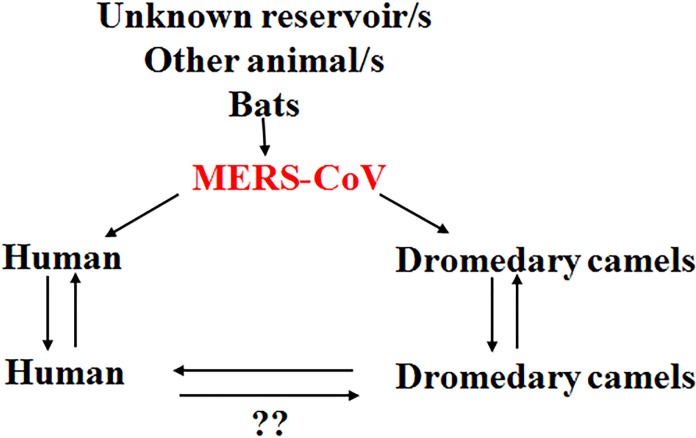
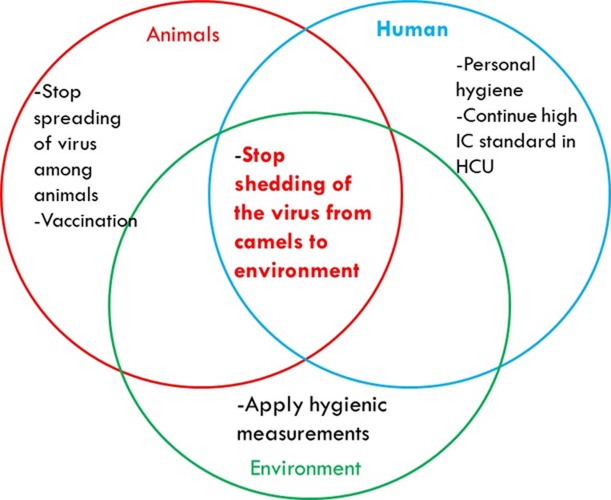
Middle East Respiratory Syndrome Coronavirus (MERS-CoV) is one of the major threats to the healthcare systems in some countries, especially in the Arabian Peninsula. MERS-CoV is considered an ideal example of the One Health concept. This is due to the animals, especially dromedary camels, play important roles in the transmission and sustainability of the virus, and the virus can be transmitted through aerosols of infected patients into the environment. However, there is some debate regarding the origin of MERS-CoV either from bats or other unknown reservoirs. The dromedary camel is the only identified animal reservoir to date. These animals play important roles in sustaining the virus in certain communities and may act as an amplifier of the virus by secreting it in their body fluids, especially in nasal and rectal discharges. MERS-CoV has been detected in the nasal and rectal secretions of infected camels, and MERS-CoV of this origin has full capacity to infect human airway epithelium in both in vitro and in vivo models. Other evidence confirms the direct transmission of MERS-CoV from camels to humans, though the role of camel meat and milk products has yet to be well studied. Human-to-human transmission is well documented through contact with an active infected patient or some silently infected persons. Furthermore, there are some significant risk factors of individuals in close contact with a positive MERS-CoV patient, including sleeping in the same patient room, removing patient waste (urine, stool, and sputum), and touching respiratory secretions from the index case. Outbreaks within family clusters have been reported, whereby some blood relative patients were infected through their wives in the same house were not infected. Some predisposing genetic factors favor MERS-CoV infection in some patients, which is worth investigating in the near future. The presence of other comorbidities may be another factor. Overall, there are many unknown/confirmed aspects of the virus/human/animal network. Here, the most recent advances in this context are discussed, and the possible reasons behind the emergence and sustainability of MERS-CoV in certain regions are presented. Identification of the exact mechanism of transmission of MERS-CoV from camels to humans and searching for new reservoir/s are of high priority. This will reduce the shedding of the virus into the environment, and thus the risk of human infection can be mitigated.
中东呼吸综合征冠状病毒(MERS-CoV)是一些国家医疗系统面临的主要威胁之一,尤其是在阿拉伯半岛。MERS-CoV被认为是“同一健康”概念的一个理想例子。这是因为动物,特别是单峰骆驼,在病毒的传播和持续存在中发挥着重要作用,并且病毒可以通过感染患者的气溶胶传播到环境中。然而,关于MERS-CoV的起源是来自蝙蝠还是其他未知宿主存在一些争议。单峰骆驼是迄今为止唯一已确定的动物宿主。这些动物在某些社区维持病毒方面发挥着重要作用,并且可能通过在其体液中分泌病毒,特别是在鼻腔和直肠分泌物中,而成为病毒的放大器。已在感染骆驼的鼻腔和直肠分泌物中检测到MERS-CoV,并且这种来源的MERS-CoV在体外和体内模型中都具有完全感染人气道上皮细胞的能力。其他证据证实了MERS-CoV从骆驼直接传播给人类,尽管骆驼肉和奶制品的作用还有待深入研究。通过与活跃感染患者或一些隐性感染者接触,人际传播已有充分记录。此外,与MERS-CoV阳性患者密切接触的个体存在一些重大风险因素,包括在同一病房睡觉、清理患者排泄物(尿液、粪便和痰液)以及接触首例患者的呼吸道分泌物。已有家庭聚集性疫情的报告,其中一些有血缘关系的患者通过其妻子在同一房屋内被感染,而妻子却未被感染。一些易感遗传因素使某些患者易感染MERS-CoV,这在不久的将来值得研究。存在其他合并症可能是另一个因素。总体而言,病毒/人类/动物网络存在许多未知/已确认的方面。在此,讨论了这方面的最新进展,并阐述了MERS-CoV在某些地区出现和持续存在的可能原因。确定MERS-CoV从骆驼传播给人类的确切机制并寻找新的宿主至关重要。这将减少病毒向环境中的排放,从而降低人类感染的风险。