Cierech Mariusz, Wojnarowicz Jacek, Kolenda Adam, Krawczyk-Balska Agata, Prochwicz Emilia, Woźniak Bartosz, Łojkowski Witold, Mierzwińska-Nastalska Elżbieta
Department of Prosthodontics, Medical University of Warsaw, 02-006 Warsaw, Poland.
Institute of High Pressure Physics, Polish Academy of Sciences, 01-142 Warsaw, Poland.
Nanomaterials (Basel). 2019 Sep 15;9(9):1318. doi: 10.3390/nano9091318.
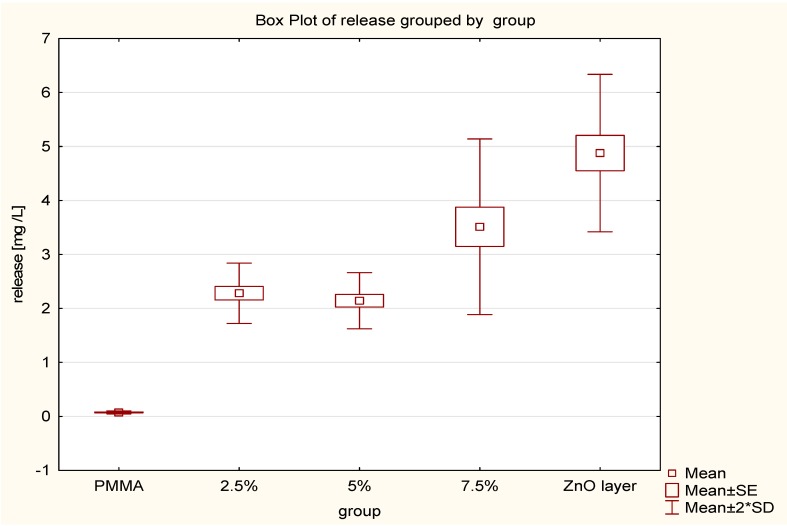
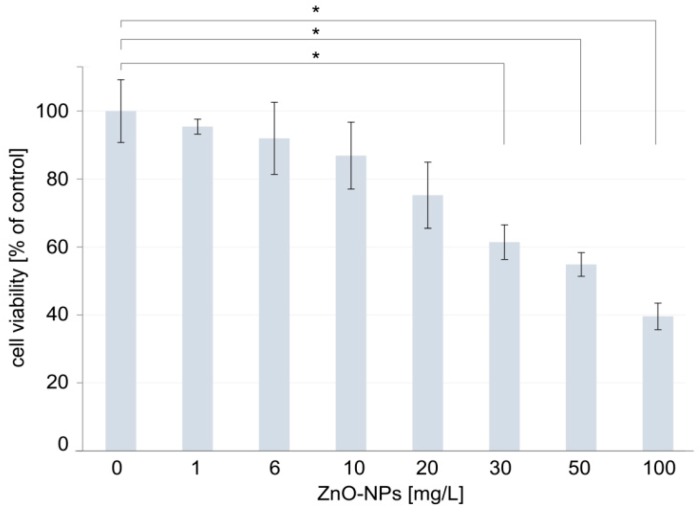
The goal of the study was to investigate the level of zinc oxide nanoparticles (ZnO NPs) release from polymethyl methacrylate (PMMA)-ZnO nanocomposites (2.5%, 5%, and 7.5% /), as well as from the ZnO NPs layer produced on pure PMMA, and the impact of the achieved final ZnO NPs concentration on cytotoxicity, before the potential use as an alternative material for denture bases. The concentration of ZnO nanoparticles released to the aqueous solution of Zn ions was assessed using optical emission spectrometry with inductively coupled plasma (ICP-OES). In the control group (pure PMMA), the released mean for ZnO was 0.074 mg/L and for individual nanocomposites at concentrations of 2.5%, 5%, and 7.5% was 2.281 mg/L, 2.143 mg/L, and 3.512 mg/L, respectively. The median for the ZnO NPs layer produced on PMMA was 4.878 mg/L. In addition, in vitro cytotoxicity of ZnO NPs against the human HeLa cell line was determined through the reduction of 3-(4,5-dimethylthiazol-2-yl)-2,5-diphenyltetrazolium bromide (MTT) dye. The cytotoxicity studies demonstrate that ZnO nanoparticles in the concentrations up to 20 mg/L have no adverse effect on HeLa cells. When compared with the released and cytotoxic concentrations of ZnO NPs, it can be expected that ZnO released from dental prostheses to the oral cavity environment will have no cytotoxic effect on host cells.
本研究的目的是调查聚甲基丙烯酸甲酯(PMMA)-氧化锌纳米复合材料(2.5%、5%和7.5%/)以及纯PMMA上生成的氧化锌纳米颗粒(ZnO NPs)层中氧化锌纳米颗粒的释放水平,以及在用作义齿基托替代材料的潜在用途之前,所达到的最终ZnO NPs浓度对细胞毒性的影响。使用电感耦合等离子体发射光谱法(ICP-OES)评估释放到锌离子水溶液中的ZnO纳米颗粒浓度。在对照组(纯PMMA)中,ZnO的平均释放量为0.074 mg/L,浓度为2.5%、5%和7.5%的单个纳米复合材料的平均释放量分别为2.281 mg/L、2.143 mg/L和3.512 mg/L。在PMMA上生成的ZnO NPs层的中位数为4.878 mg/L。此外,通过3-(4,5-二甲基噻唑-2-基)-2,5-二苯基四氮唑溴盐(MTT)染料的还原测定了ZnO NPs对人HeLa细胞系的体外细胞毒性。细胞毒性研究表明,浓度高达20 mg/L的ZnO纳米颗粒对HeLa细胞没有不利影响。与ZnO NPs的释放浓度和细胞毒性浓度相比,可以预期从假牙释放到口腔环境中的ZnO对宿主细胞没有细胞毒性作用。